Chou Collection, Upper Volume
Radical: Mouth (kǒu)
Kangxi Strokes: 3
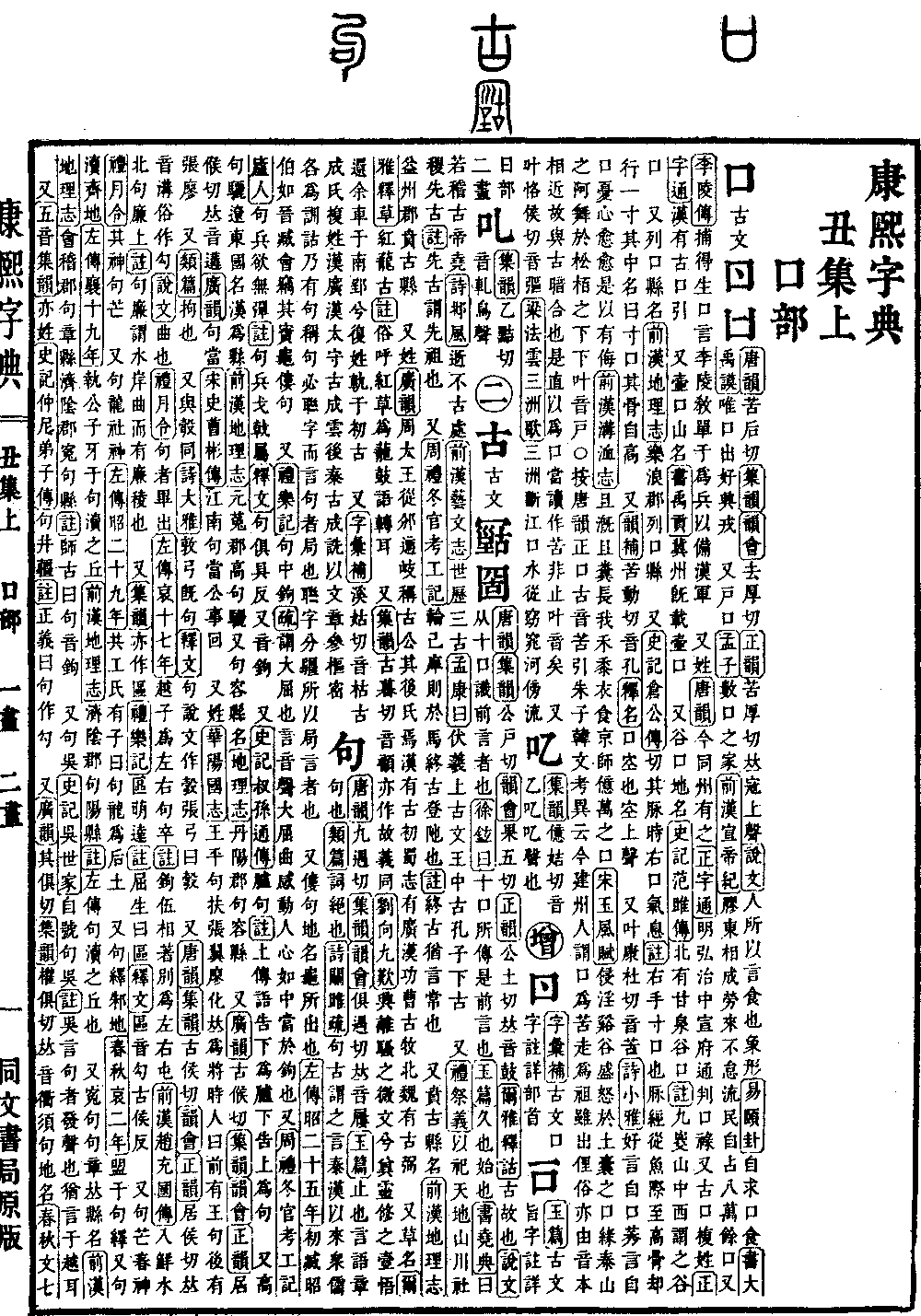
Page 171, Entry 01
Archaic character. Pronounced kou (rising tone). According to Explaining Graphs and Analyzing Characters (Shuowen Jiezi), it is the organ used by humans to speak and eat. A pictographic character. Book of Changes (Yijing), Hexagram Yi: One seeks food for one's own mouth. Book of Documents (Shujing), Counsels of the Great Yu: Only the mouth can speak good words or incite war.
Also refers to population. Mencius: A family of how many mouths. History of the Former Han (Qian Han Shu), Annals of Emperor Xuan: Wang Cheng, Chancellor of Jiaodong, consoled and recruited the common people without laxity; those among the displaced population who registered themselves numbered over eighty thousand. Also, Biography of Li Ling: Captured a live mouth (prisoner), who said Li Ling taught the Xiongnu Shanyu to train soldiers to defend against the Han army.
Also a surname. Tang Rhymes (Tang Yun): Nowadays in Tongzhou there is this surname. Zhengzitong: During the Hongzhi reign of the Ming dynasty, there was a Tongpan of Xuanfu named Kou Lu.
Also Gukou, a compound surname. Zhengzitong: In the Han dynasty, there was Gukou Yin.
Also Hukou, a mountain name. Book of Documents (Shujing), Tribute of Yu: After the governance of Jizhou, there is Hukou.
Also Gukou, a place name. Records of the Grand Historian (Shiji), Biography of Fan Sui: To the north lie Ganquan and Gukou. Commentary: The middle part of Mount Jiuzong is called Gukou.
Also Liekou, a county name. History of the Former Han (Qian Han Shu), Treatise on Geography: Lelang Commandery, Liekou County.
Also Records of the Grand Historian (Shiji), Biography of Cang Gong: When taking his pulse, the qi of the cun-kou pulse on the right hand. Commentary: Refers to the cun-kou on the right hand. The Pulse Classic (Maijing) records: Moving one inch backward from the yuji (thenar eminence) to the high bone, the position therein is named cun-kou, where the bone naturally rises.
Also Rhyme Supplement (Yunbu), pronounced kong. Explanation of Names (Shiming): Kou means empty. Kong is read with a rising tone.
Also rhyming as ku, pronounced like ku. Book of Odes (Shijing), Minor Odes: Good words come from the mouth, bad words also come from the mouth. The worried heart grows heavier, and thus invites insults. History of the Former Han (Qian Han Shu), Treatise on Rivers and Canals: Irrigating on one side and fertilizing on the other, making my millet grow. Providing clothing and food for the capital, which is the rations for hundreds of millions of people. Song Yu, Rhapsody on the Wind: Gradually invading the streams and valleys, erupting violently at the entrance of the soil bag, following the depressions of Mount Tai, dancing under the pines and cypresses. The character xia rhymes with hu.
According to Tang Rhymes Corrected (Tang Yun Zheng), the ancient pronunciation of kou is read as ku. Citing Zhu Xi’s Textual Research on Han Yu’s Works (Hanwen Kaoyi): Nowadays people in Jianzhou call kou "ku" and call zou "zu." Although this originates from folk vernacular, it is because the sounds are naturally similar, thus coinciding with the ancient pronunciation. This directly posits that kou should be read as ku, not merely as a rhyming variant.
Also rhyming as kou, pronounced like kou. Liang Fayun, Three Continents Song: The three continents block the river mouth, and the water flows away beside the deep and winding river channel.