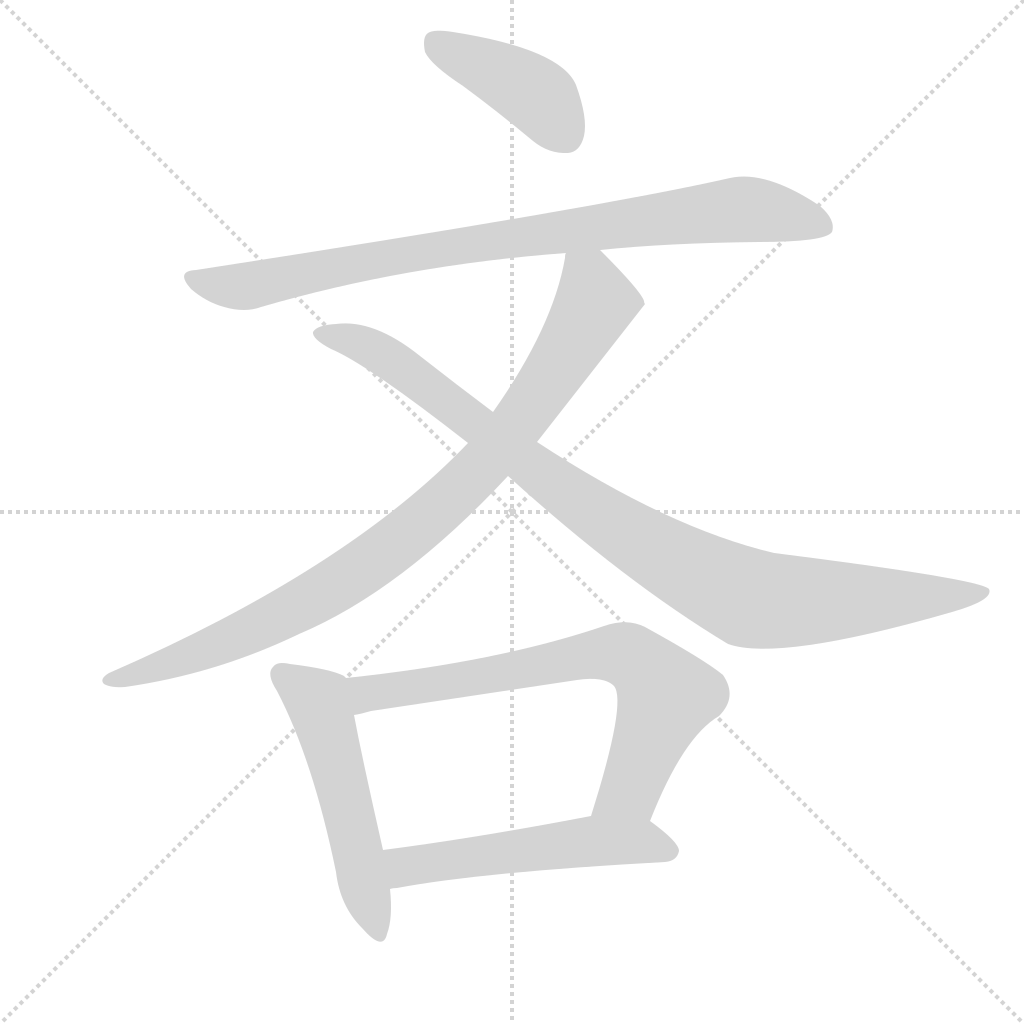
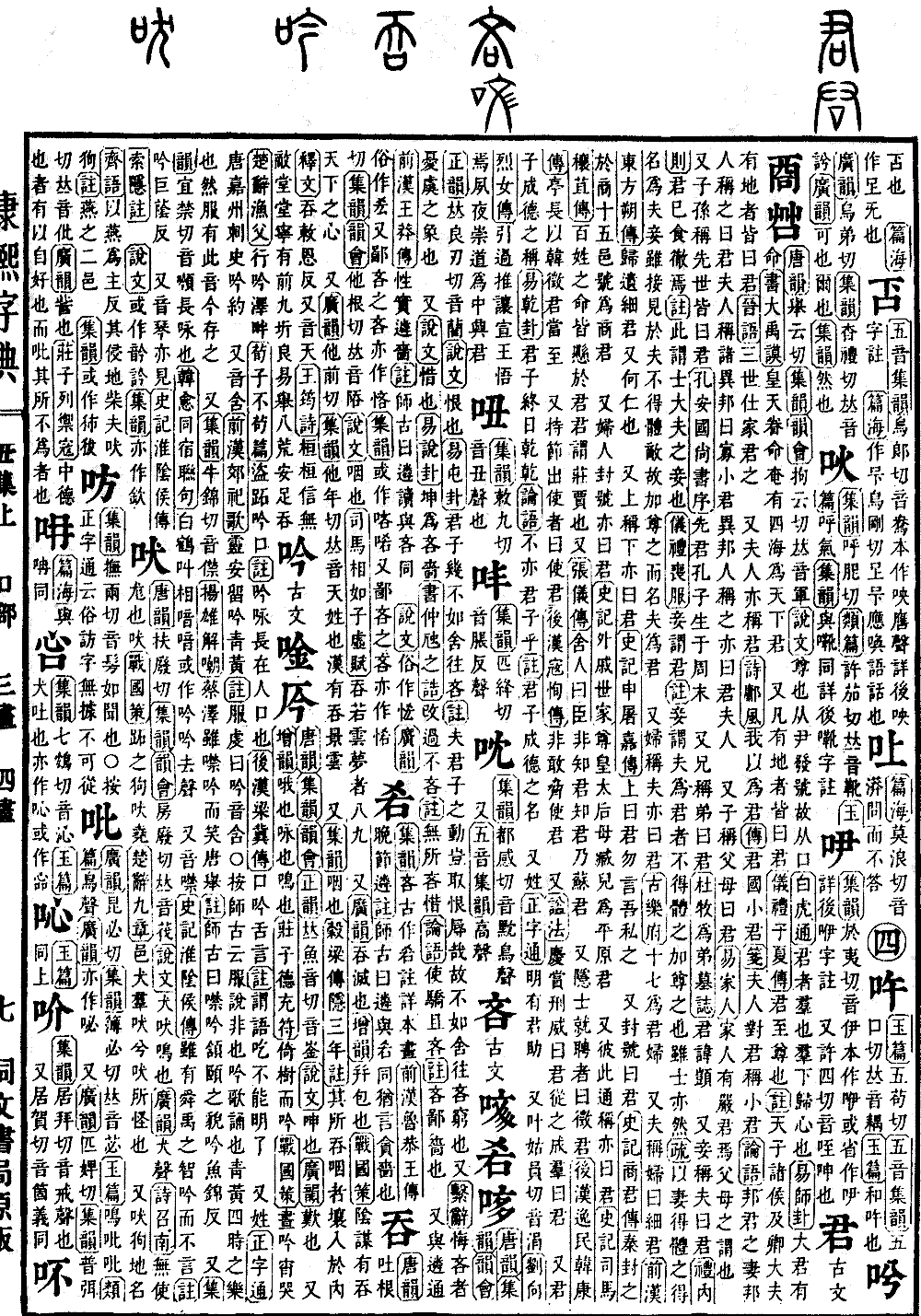
Chou Collection, Upper Volume
Radical: Mouth (kǒu)
Lin
Kangxi stroke count: 7
Page 177, Entry 13
Historical records state: Tang Rhymes (Tangyun), Collected Rhymes (Jiyun), Rhyme Compilation (Yunhui), and Correct Rhymes (Zhengyun) all state the pronunciation is lin (falling tone), sounding the same as lin. The Explaining Graphs and Analyzing Characters (Shuowen Jiezi) defines it as resentment. The Book of Changes (Yijing), Hexagram Tun, states: A noble person observes the opportunity to act; it is better to abandon the pursuit, otherwise it will lead to regret. Note: How could the actions of a noble person bring about resentment and shame? Therefore, it is better to abandon the pursuit to avoid falling into distress and regret. Also, the Appended Remarks (Xici) states: Regret and remorse are signs of anxiety. Furthermore, the Explaining Graphs and Analyzing Characters (Shuowen Jiezi) defines it as stinginess. The Book of Changes (Yijing), Discussion of Hexagrams (Shuogua), states: The Kun hexagram represents stinginess. The Book of Documents (Shangshu), Proclamation of Zhonghui (Zhonghui zhi Gao), states: Correcting mistakes without any stinginess. Note: There is nothing that one is unwilling to part with. The Analects (Lunyu) states: If a person is arrogant and stingy. Note: Lin refers to being vulgar and petty. It is also interchangeable with the character lin. The History of the Former Han (Qian Hanshu), Biography of Wang Mang, states: By nature, he was truly stingy and petty. Note: Shigu states that the pronunciation of lin is the same as lin. The Explaining Graphs and Analyzing Characters (Shuowen Jiezi) notes that a vulgar form is written as lin. The Extensive Rhymes (Guangyun) notes that a vulgar form is written as a variant. Additionally, the term for being vulgar and petty, lin, is also written as lin. Collected Rhymes (Jiyun) states it is sometimes written as a variant, and is also written as another variant.