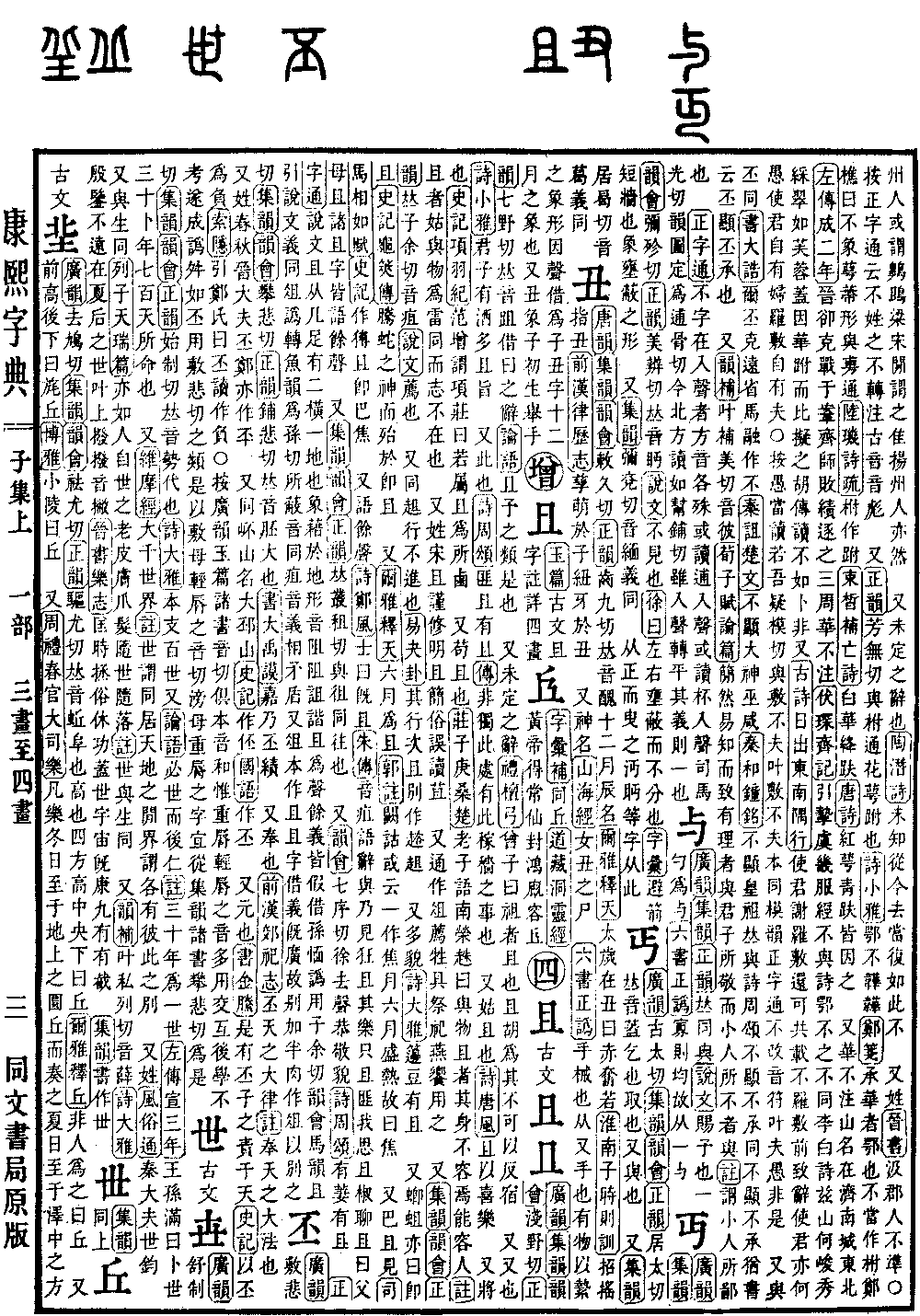
Zi Collection, Page Position: Upper
Radical: One (yī)
Character: 且
Kangxi Stroke Count: 5
Page 77, Number 07
In ancient texts, the Broad Rhymes (Guangyun), Collected Rhymes (Jiyun), and Rhyme Assembly (Yunhui) provide the fanqie pronunciation qiǎn yě, while the Correct Rhymes (Zhengyun) provides qī yě, pronounced the same as jǔ. It is a word used to indicate a supposition or metaphor. The phrase "it is like my case" in the Analects (Lunyu) follows this usage.
It also indicates an uncertain tone. The Book of Rites (Liji) records Master Zeng saying: The ancestral sacrifice is a tentative matter. For how could the spirit not return to its resting place?
It also means moreover or and. The Classic of Poetry (Shijing) in the Minor Odes (Xiaoya) section contains the line: The gentleman has wine, abundant and delicious.
It also means this. In the Hymns of Zhou (Zhousong) within the Classic of Poetry, the phrase not only here but also there is explained by the Commentary (Zhuan) as: it is not only in this place that such agricultural work exists.
It also means for the time being. The Odes of Tang (Tangfeng) in the Classic of Poetry says: Let us be happy for the time being.
It also means about to or will. In the Records of the Grand Historian (Shiji) in the Annals of Xiang Yu, Fan Zeng says to Xiang Zhuang: You and your lot will soon be captured.
It also means careless or superficial. The Zhuangzi records Laozi saying to Nanrong Chu: One who is merely superficial with things cannot even find a place for himself, so how can he accommodate others? The commentary explains that superficial here means tentatively conforming to the surface of things while the mind is not truly present.
It is also a surname. During the Song Dynasty there was Qie Jinxiu, and in the Ming Dynasty there was Qie Jian. It is commonly mispronounced with the sound jū.
It is also used interchangeably with the character for a sacrificial stand pronounced zǔ. It refers to a vessel used for displaying offerings during sacrifices and banquets.
Furthermore, the Collected Rhymes, Rhyme Assembly, and Correct Rhymes provide the fanqie pronunciation zǐ yú, pronounced the same as jū. The Explaining Graphs and Analyzing Characters (Shuowen Jiezi) explains it as to present or a mat.
It is also synonymous with the character for to hesitate pronounced qiè. It refers to walking without making progress. The Book of Changes (Yijing) says: His walking is hesitant. It is also written as zīqiè.
It also describes the appearance of being numerous. The Major Odes (Daya) in the Classic of Poetry says: The sacrificial vessels are numerous.
The centipede, known as jíjū, is also written as jíqiě. The Records of the Grand Historian in the Biographies of Diviners says: The divine flying serpent is yet vulnerable to the centipede.
According to the Approaching the Correct (Erya) in the section Explaining the Heavens, the sixth month is called qiě. Guo Pu's commentary states that the explanation is missing. Some say it is also written as the scorched month, or jiāoyuè. Because the sixth month is extremely hot, it is called scorched.
There is also the term bāqiě, found in the rhapsodies of Sima Xiangru. In the Records of the Grand Historian it is written as bóqiě, which refers to the banana plant.
It also serves as a final grammatical particle. The Odes of Zheng (Zhengfeng) in the Classic of Poetry says: The gentleman says it is already done. Zhu Xi's Collected Commentaries on the Poetry provides the pronunciation jū. It is a modal particle, functioning the same way as in phrases like then I see that wild fellow, his joy is such, it is not what I think of, the pepper plant is so, and calling to father and mother, all of which use it as a sentence-ending particle.
Additionally, the Collected Rhymes, Rhyme Assembly, and Correct Rhymes provide the fanqie pronunciation cóng zū. It is synonymous with the character for to go, pronounced cú.
The Rhyme Assembly also provides the fanqie pronunciation qī xù, read like the departing tone of xú. It describes a respectful appearance. The Hymns of Zhou in the Classic of Poetry says: Being dignified and respectful.
The Correct Character Mastery (Zhengzitong) states: In Explaining Graphs and Analyzing Characters, the character is derived from the radical for a small table, or jī, with two horizontal lines at the base. One horizontal line represents the ground. It is a pictograph of something placed on the ground as a cushion. The pronunciation is zǔ. Characters such as obstruction, or zǔ, and curse, or zù, use this character as a phonetic component, while all other meanings are borrowed. Sun Mian incorrectly adopted the pronunciation zǐ yú. The Rhyme Assembly, under the Ma rhyme category, quotes Explaining Graphs and Analyzing Characters to explain that this character has the same meaning as the sacrificial stand, or zǔ, yet it mistakenly moved it to the Yu rhyme category, where it was obscured by Sun Mian's fanqie pronunciation and read like jū, causing a contradiction between sound and meaning. Furthermore, the character for sacrificial stand was originally written as this character. Because the borrowed meanings of this character became so widespread, a meat component was added to create the distinct character for sacrificial stand to differentiate them.