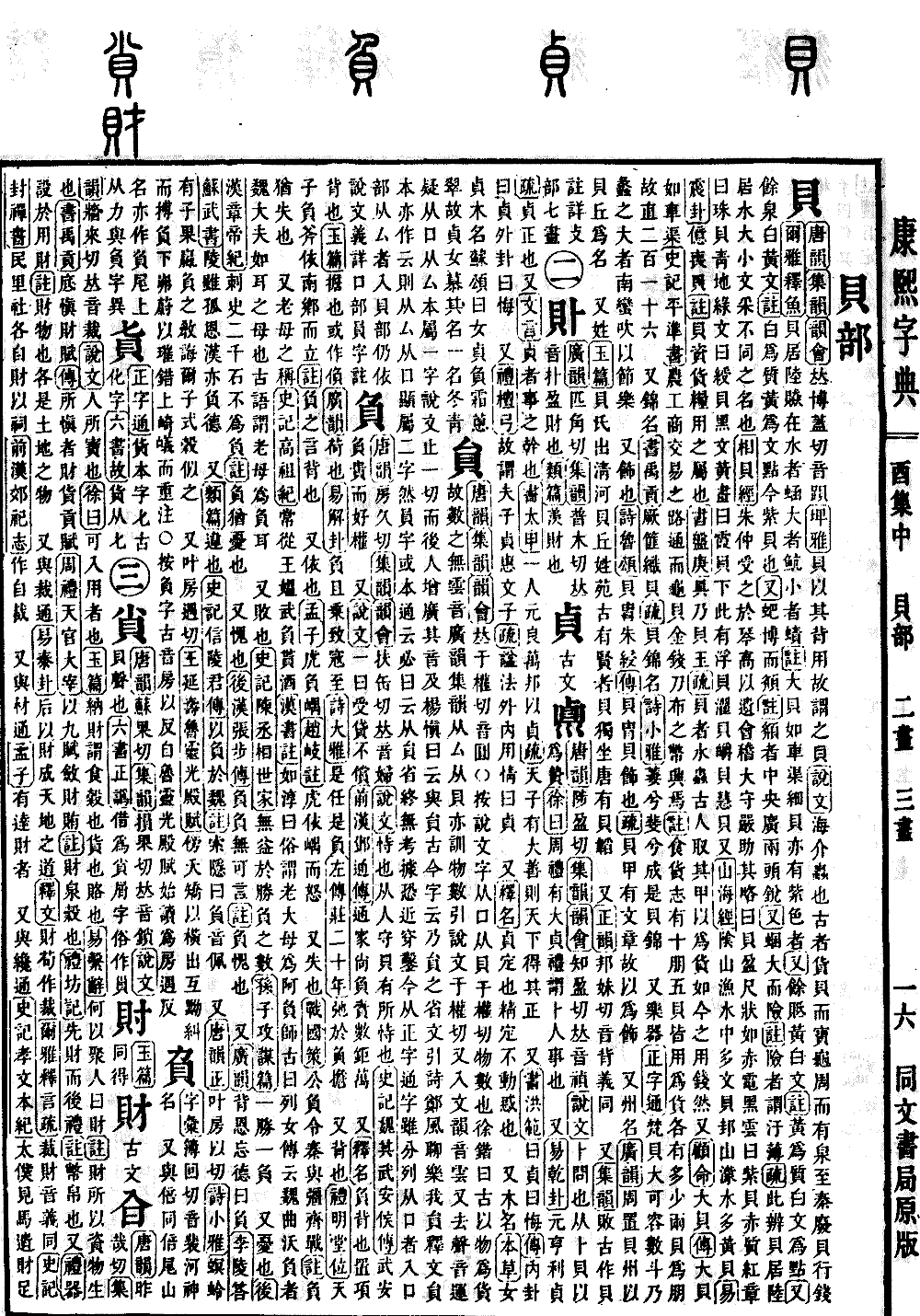
You Collection, Middle Volume
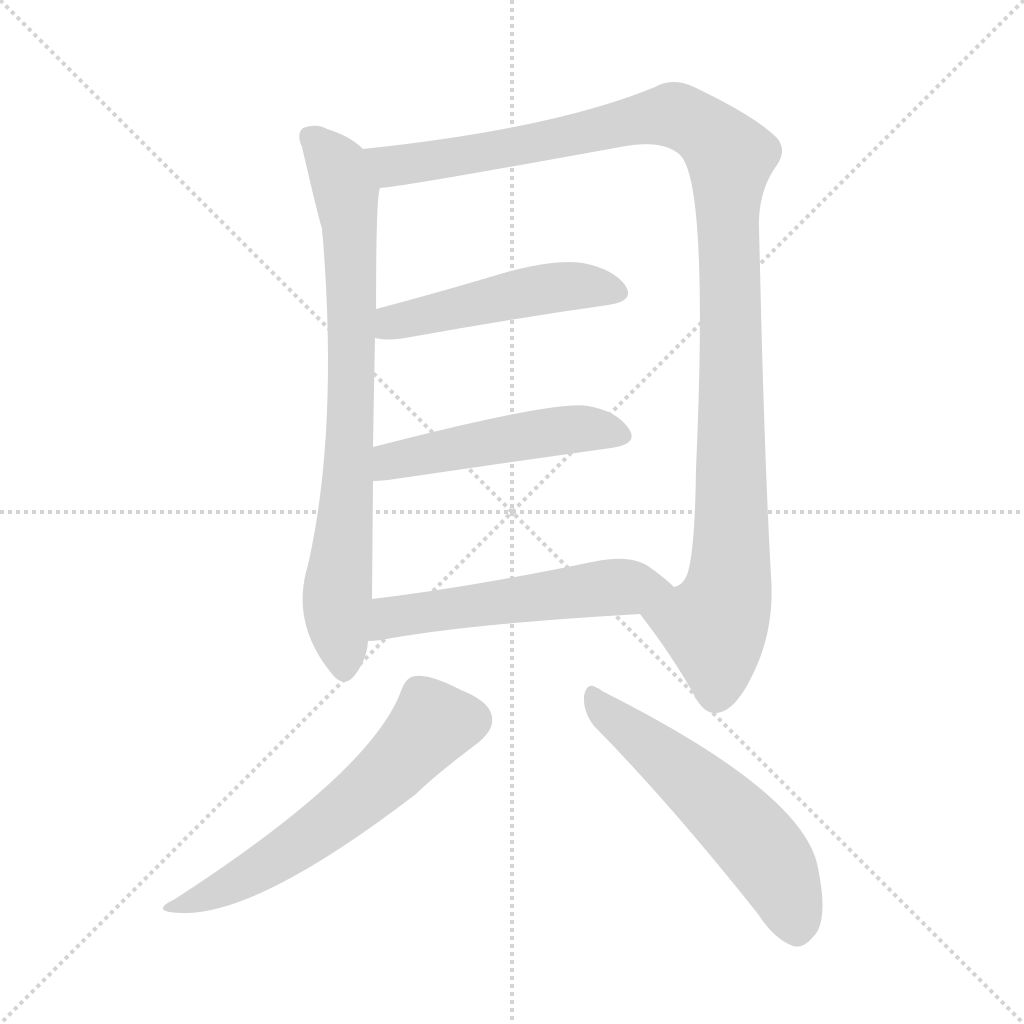
Radical: Shell (bèi)
Kangxi Strokes: 7
Page 1204, Entry 01
Tang Rhyme (Tangyun), Collected Rhymes (Jiyun), Dictionary of Rhymes (Yunhui): Pronounced bo-gai. According to Pi Ya (Amplified Encyclopedia), the shell is so named because its back is utilized. According to Shuo Wen (Explaining Graphs), it is a shelled animal found in the sea. In ancient times, shells were used as currency, and tortoise shells were considered treasures. During the Zhou Dynasty, coin currency began to appear, and by the Qin Dynasty, shell currency was abolished in favor of standard metal coins. According to Erya (Approaching Elegance), section on fish, shells found on land are called biao, those in water are called dian, large ones are called hang, and small ones are called. Note: Large shells are as big as a giant clam. There are also small purple shells. Also, yu-chi shells have a yellow background with white markings. Note: Yellow background with white spots. Also, yu-quan shells have a white background with yellow markings. Note: White background with yellow patterned spots, which are the current purple shells. Also, ba shells are wide in the middle and pointed at both ends. Note: Kui, meaning wide in the middle and narrow at the ends. Also, kui shells are large with thin edges. Note: Xian, referring to edges that are thin and flat. Commentary: This distinguishes the names of shells based on whether they are on land or in water, as well as their size and color patterns. According to the Classic of Shells (Xiangbei Jing), Zhu Zhong received teachings from Qin Gao and passed them to Yan Zhu, the Governor of Kuaiji. It summarizes that shells reaching one foot in length, shaped like red lightning with black clouds, are called purple shells; those with red backgrounds and red patterns are called pearl shells; those with blue backgrounds and green patterns are called ribbon shells; and those with black patterns and yellow designs are called mist shells. Of lower quality are the floating shells, washed shells, pure shells, and wisdom shells. Also, Classic of Mountains and Seas (Shanhai Jing) states that in the Yu River of Yin Mountain, there are many patterned shells, and in the Meng River of Gui Mountain, there are many yellow shells. Book of Changes (Yijing), Zhen Hexagram: Great loss of shell currency. Note: Shells refer to assets, goods, and grains. Book of Documents (Shujing), Pan Geng: Prepare your shells and jade. Commentary: Shells are water animals. Ancients used their shells as currency, just as money is used today. Also, Gu Ming: Large shells. Commentary: Large shells are as large as a giant clam. Records of the Grand Historian (Shiji), Treatise on the Balance of Standards and Rites: Trade among farmers, artisans, and merchants flowed freely, and currency such as tortoise shells, shell currency, gold coins, knife money, and cloth became popular. Note: The Treatise on Food and Money records ten peng and five shells, all used as currency with varying values; two shells make one peng, equivalent to two hundred and sixteen cash. Also, a type of silk textile. Book of Documents (Shujing), Tribute of Yu: That basket holds woven shells. Commentary: Shell is a name for a type of brocade. Book of Odes (Shijing), Xiaoya: Patterns are mixed and colors alternate, woven into this shell-patterned damask. Also, a musical instrument. Zhengzitong (True Character Guide): Buddhist shell, large ones can hold several pecks; they are large conch shells, which southern minority tribes play to regulate music. Also, a decorative item. Book of Odes (Shijing), Lusong: A helmet decorated with shells, with red cord. Commentary: Shell helmet, a helmet decorated with shells. Commentary: Shells have patterns, hence they are used for decoration. Also, a province name. Guangyun (Broad Rhymes): During the Zhou Dynasty, Bei Prefecture was established, named after the hill of Bei. Also, a surname. Yupian (Jade Chapter): The Bei clan, originating from the Bei Hill in Qinghe. The Surname Garden (Xingyuan) records: In ancient times there was a sage named Bei Duzuo; in the Tang Dynasty, there was Bei Tao. Also, Zheng Yun (Correct Rhymes): Pronounced bang-mei, with the same meaning as above. Also, Collected Rhymes (Jiyun): An ancient form of the character for defeat (bai) is written as shell. See the note under the Radical: Strike (pū), seven strokes.