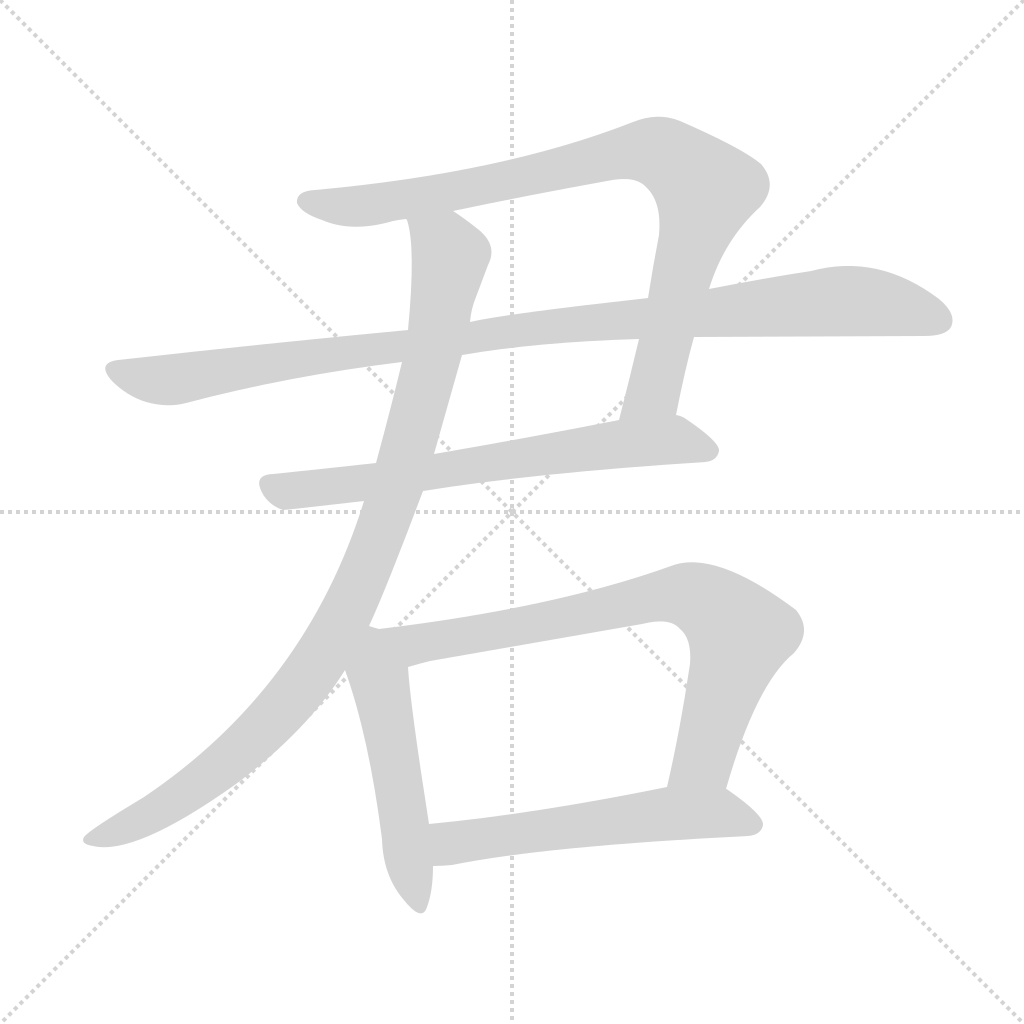
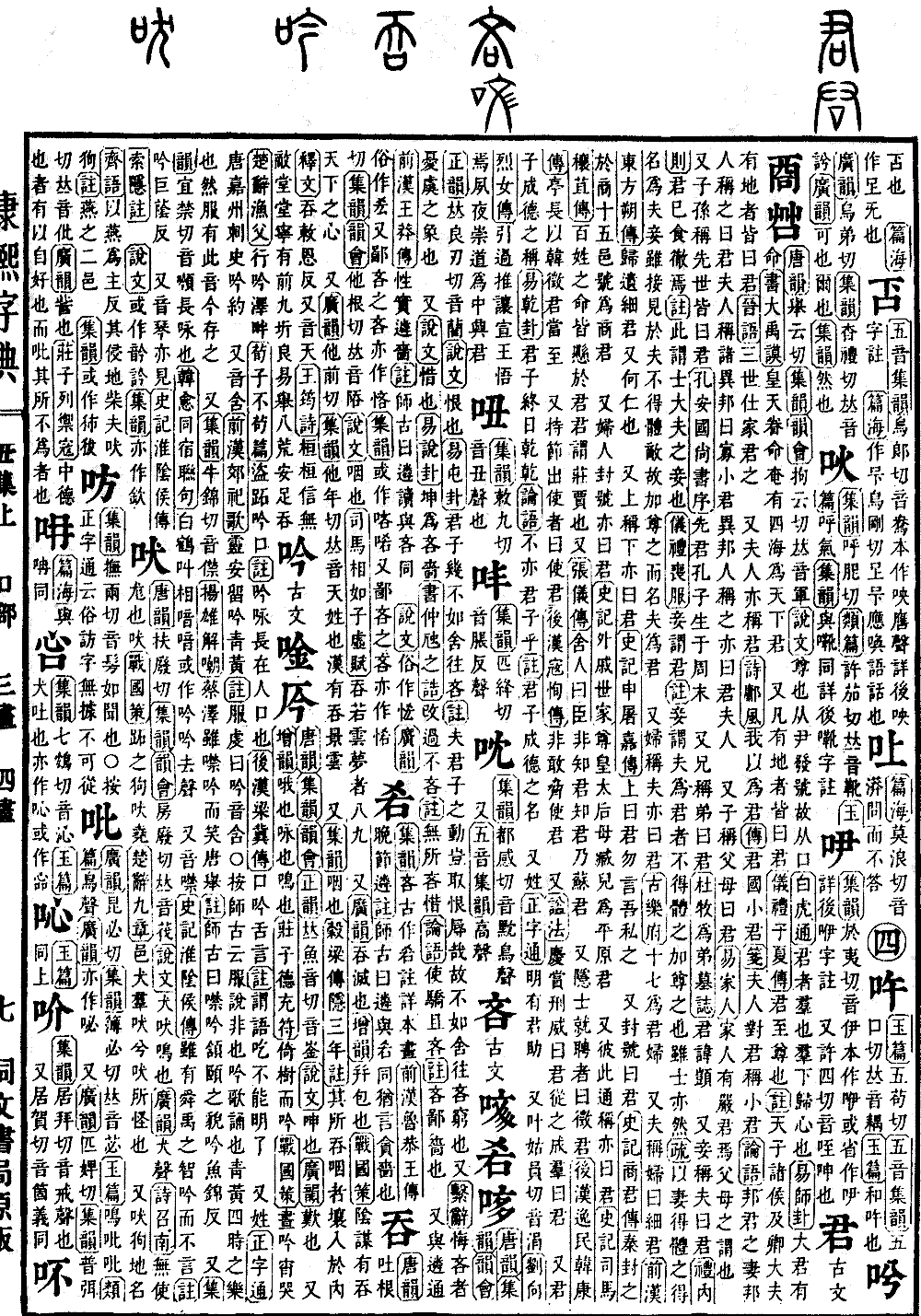
Chou Collection, Upper Volume, Radical: Mouth (kǒu), Kangxi Stroke Count: 7, Page 177, Entry 07
Ancient Phonology: Pronounced jun. According to Explaining Graphs and Analyzing Characters (Shuowen Jiezi), it means noble. The character structure is derived from the component representing those who issue orders, therefore it includes the mouth radical. According to the Comprehensive Discussions in the White Tiger Hall (Baihu Tong), a ruler is one who acts as the center for the group, meaning the one to whom the masses incline. In the Book of Changes (Yijing), in the Army hexagram, it states: The great ruler has a mandate. In the Book of Documents (Shangshu), in the Counsels of the Great Yu, it states: August Heaven bestowed the mandate, possessing the four seas, becoming the ruler of all under Heaven. Furthermore, anyone who possesses a fief is referred to as a ruler. In the Book of Etiquette and Ceremonial (Yili), in the Zixia Commentary, it states: The ruler is the most noble. The commentary notes: The Son of Heaven, feudal lords, and noble officials with fiefs are all referred to as ruler. In the Discourses of the States (Guoyu), in the Jin Discourses, it states: During the Three Dynasties, one served the ruler as an official within the family. Also, the wife of a ruler is referred to as ruler. In the Book of Odes (Shijing), in the Odes of Yong, it states: I take him as my ruler. The commentary explains: Ruler refers to the state sovereign, while small ruler refers to the wife of the state sovereign. The sub-commentary notes: A wife refers to herself as small ruler when speaking to her husband. In the Analects (Lunyu), the wife of a state ruler is called ruler-wife by her own people, while she refers to herself as the widowed small ruler when speaking to people of other states, and people of other states also refer to her as ruler-wife. Furthermore, children refer to their parents as ruler. In the Book of Changes (Yijing), in the Family hexagram, it states: There is a stern ruler in the home, which refers to the parents. Descendants also refer to their ancestors as ruler. In the preface to the Book of Documents (Shangshu) by Kong Anguo, it states: Our late ruler Confucius was born at the end of the Zhou Dynasty. Elder brothers refer to their younger brothers as ruler. In the funerary inscription written for his brother by Du Mu, it states: The ruler, whose name was Yi. Concubines refer to their husband as ruler. In the Book of Rites (Liji), in the Internal Regulations, it states: When the ruler has finished eating, the dishes are cleared away. The commentary notes: This refers to the concubine of an official. In the Book of Etiquette and Ceremonial (Yili), in the Funeral Rites, it states: The concubine refers to the master as ruler. The commentary notes: A concubine refers to her husband as ruler because she cannot be treated as an equal, thus she uses an honorific, even if he is only a scholar. The sub-commentary explains: Because a wife can be treated as an equal to her husband, she can be called spouse; a concubine, while she may see her husband, cannot be treated as an equal, so she uses an honorific, calling the husband ruler. Wives also refer to their husbands as ruler. In the Ancient Music Bureau (Gu Yuefu), it states: At seventeen, I became your wife. Husbands refer to their wives as small ruler. In the History of the Former Han (Qian Hanshu), in the Biography of Dongfang Shuo, it states: Returning home to present it to his small ruler, what benevolence! Superiors refer to subordinates as ruler. In the History of the Former Han (Shiji), in the Biography of Shen Tu-jia, it states: The Emperor said: Do not say that I told you this privately. It also refers to titles. In the History of the Former Han (Shiji), in the Biography of Lord Shang, it states: The State of Qin enfeoffed him with fifteen cities in the Shang region, and he was known as Lord Shang. Women were also granted titles as ruler. In the History of the Former Han (Shiji), in the Biography of External Relatives, it states: The Empress Dowager’s mother Zang Er was honored as the Lady of Pingyuan. It is also used as a mutual honorific. In the History of the Former Han (Shiji), in the Biography of Sima Rangju, it states: The lives of the common people all depend on you. Here, ruler refers to Zhuang Jia. In the History of the Former Han (Shiji), in the Biography of Zhang Yi, it states: The guest said: I do not understand you; the one who understands you is Lord Su. Hermits who accept a summons to court are known as summoned rulers. In the History of the Later Han (Hou Hanshu), in the Biography of the Hermit Han Kang, it states: The station master thought the summoned ruler Han should have arrived. Officials who hold a tally and go on missions are known as emissary-rulers. In the History of the Later Han (Hou Hanshu), in the Biography of Xun, it states: Do not dare to coerce the emissary-ruler. According to the Principles of Posthumous Titles, one who can bestow celebrations and rewards and establish majesty is called a ruler; one who can cause the masses to follow and form a group is called a ruler. Furthermore, a gentleman is a term for a person with perfect character. In the Book of Changes (Yijing), in the Qian hexagram, it states: The gentleman is diligent and untiring all day. In the Analects (Lunyu), it states: Is he not a gentleman? The commentary notes: Gentleman is the name for one whose virtue is complete. Also a surname. According to the Zhengzitong, there was a person named Jun Zhu during the Ming Dynasty. Also, for the rhyming form, pronounced juan. In Biographies of Exemplary Women (Lienü Zhuan) by Liu Xiang, it states: Withdrawing from blame and yielding, King Xuan was awakened. Day and night honoring morality, he became a restorative ruler.