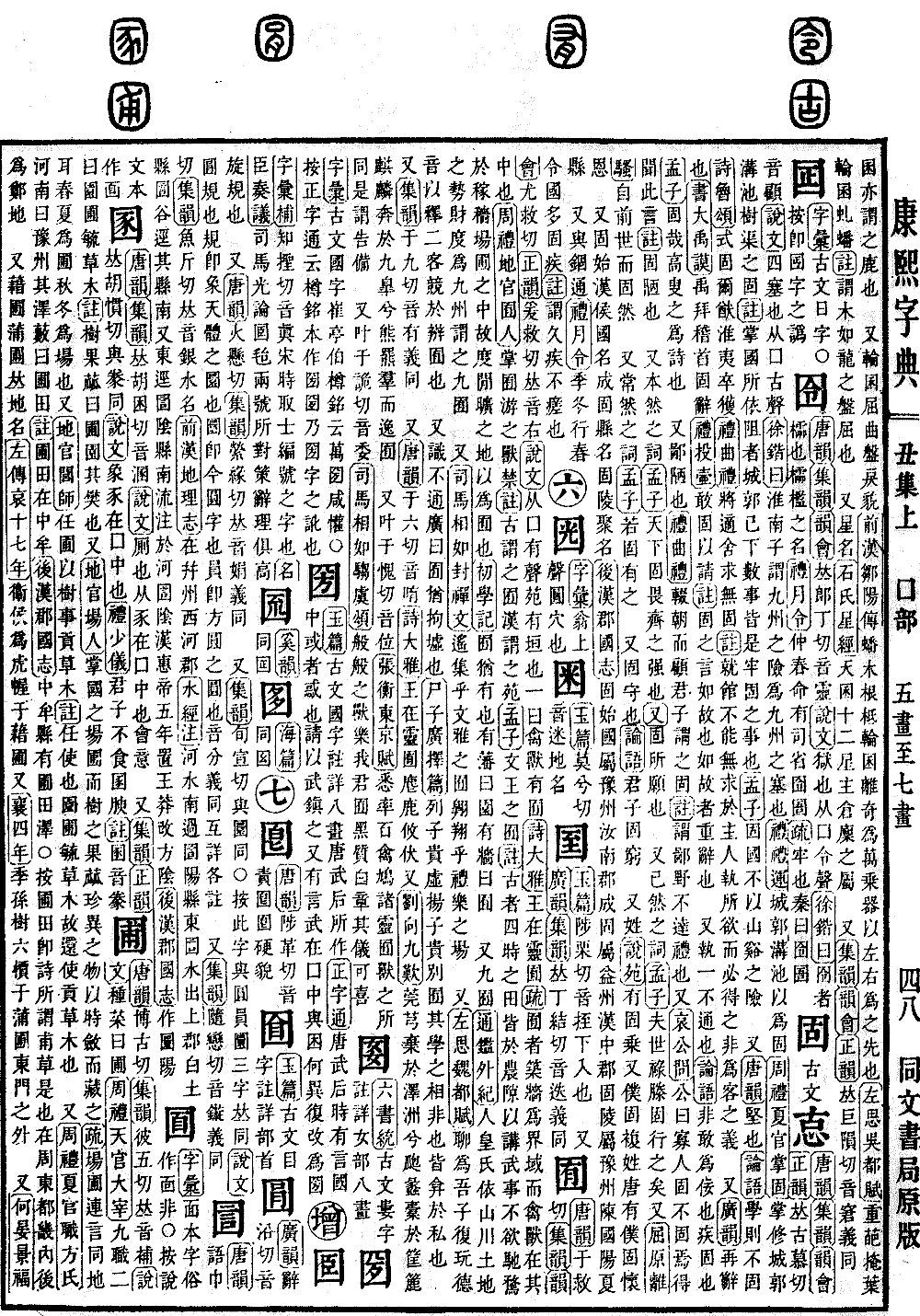
Chou Collection, Upper Volume
Radical: Enclosure (wéi)
Kangxi Strokes: 8
Page 218, Entry 03
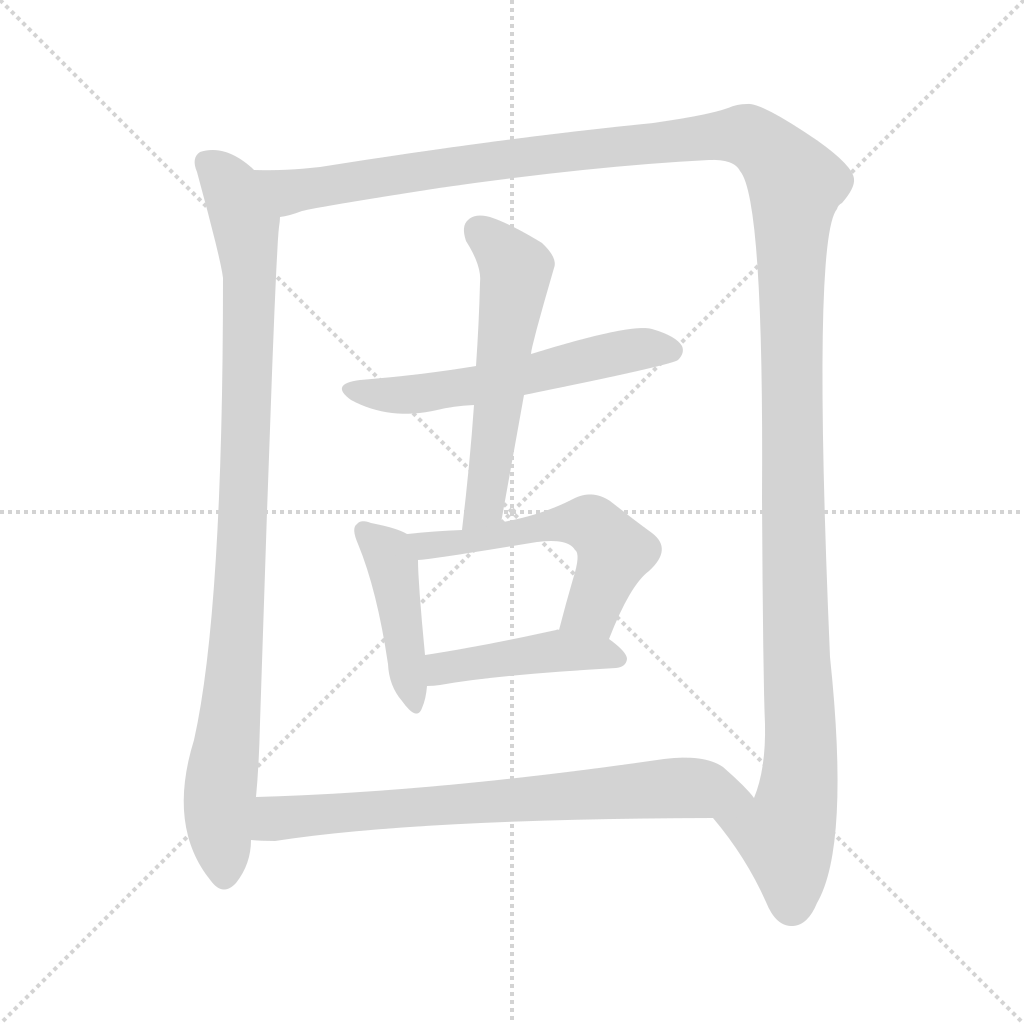
In ancient texts, it is written as the variant form (gù).
According to Tang Rhyme (Tangyun), Collection of Rhymes (Jiyun), Rhyme Compilation (Yunhui), and Orthodox Rhymes (Zhengyun), it is pronounced gu.
Explaining Graphs and Analyzing Characters (Shuowen Jiezi) defines it as: blocked on all four sides. The graph is composed of the Enclosure radical with the character for ancient (gǔ) providing the phonetic element.
Xu Kai says: Huainan Masters (Huainanzi) refers to the strategic passes of the Nine Provinces as the places where the Nine Provinces are blocked.
Book of Rites (Liji) states: City walls, moats, and defensive trenches are used to consolidate defense.
Rites of Zhou (Zhouli), Summer Official, "Overseer of Fortifications" records: In charge of maintaining city walls, moats, defensive trenches, trees, and water channels for the purpose of strengthening defensive works.
Annotation: In charge of the strategic barriers upon which the state relies. The items listed below city walls are all matters that make a state secure.
Mencius says: Consolidating national defense cannot rely solely on the strategic dangers of mountains and rivers.
Tang Rhyme (Tangyun) also defines it as: solid or firm.
Analects (Lunyu) says: If one learns, one will not be obstinate and ignorant.
Book of Odes (Shijing) says: Make your strategies firm, and the Huai Yi tribes will eventually be subdued.
Book of Rites (Liji), "Summary of Propriety" says: When intending to lodge at another person's home, one must not stubbornly insist on one's own demands.
Annotation: When arriving at a guesthouse, it is improper not to make requests of the host, but if one insists upon one's demands and demands they be met, it does not accord with the principles of being a guest.
Guangyun also defines it as: to decline again.
Classic of History (Shangshu), "Counsels of Great Yu" records: Yu bowed and knocked his head, firmly declining.
Book of Rites (Liji), "Pitch-pot Game" says: Presumptuously requesting again.
Annotation: The meaning of gu is like the word for formerly, a word indicating repetition.
Also refers to being obstinate and unreasonable.
Analects (Lunyu) says: Not daring to rely on clever speech, I despise those who are stubborn and unreasonable.
Mencius says: How obstinate, the old gentleman Master Gao, to interpret the Odes in this way.
Also refers to being vulgar or ignorant.
Book of Rites (Liji), "Summary of Propriety" says: Looking back after leaving the court, the noble person considers this to be vulgar.
Annotation: Refers to being crude and not understanding etiquette.
Ai Gong Questioning (Aigong Wen) records: Duke Ai said: I am naturally shallow and ignorant, not firm in virtue, how could I have heard such words.
Annotation: Gu refers to being shallow and ignorant.
Also acts as an initial particle denoting that something is fundamentally the case.
Mencius says: The world has always feared the strength of the Qi state.
He also says: It has always been my wish.
Also acts as an initial particle denoting that something is already as such.
Mencius says: The system of hereditary salaries, the state of Teng has already implemented it.
Also in Qu Yuan's Encountering Sorrow (Lisao): It has been this way since ancient times.
Also acts as an initial particle denoting that something is usually the case.
Mencius says: It is as if it were always there.
Also refers to holding fast.
Analects (Lunyu) says: The noble person can remain steadfast in poverty.
Also a surname.
Garden of Stories (Shuoyuan) records a person named Gu Cheng.
Also a compound surname, Pugu. During the Tang dynasty, there was Pugu Huai'en.
Also Gushi, the name of a marquisate in the Han dynasty; Chenggu, the name of a county; Guling, the name of a settlement.
History of the Later Han (Hou Hanshu), "Treatise on Geography" records: Gushi state belonged to Runan Commandery in Yu Province. Chenggu belonged to Hanzhong Commandery in Yi Province. Guling belonged to Yangxia County in Yu Province.
Also used as a variant of the character for chronic disease (gù).
Book of Rites (Liji), "Monthly Ordinances" records: If spring weather appears during the end of winter, the state will suffer from many chronic illnesses.
Annotation: Refers to illnesses that are long-lasting and difficult to cure.