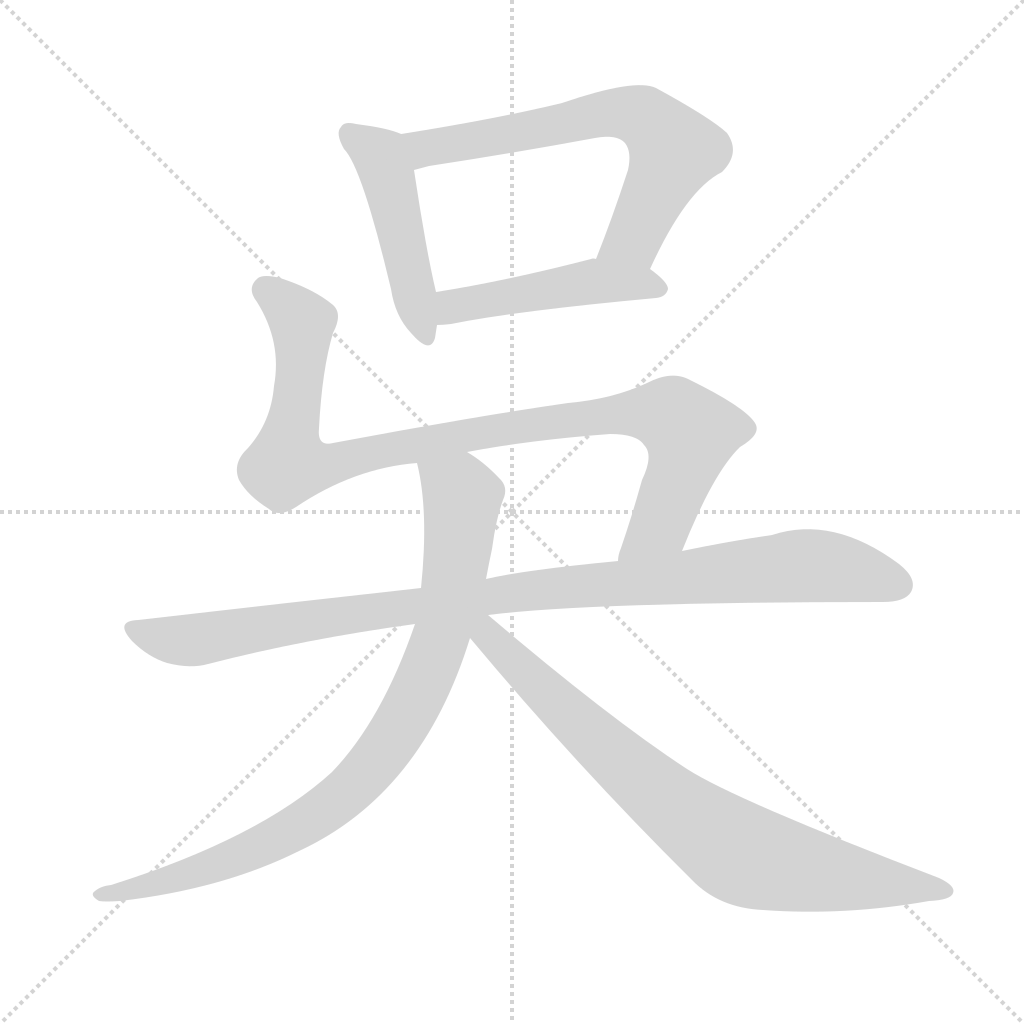
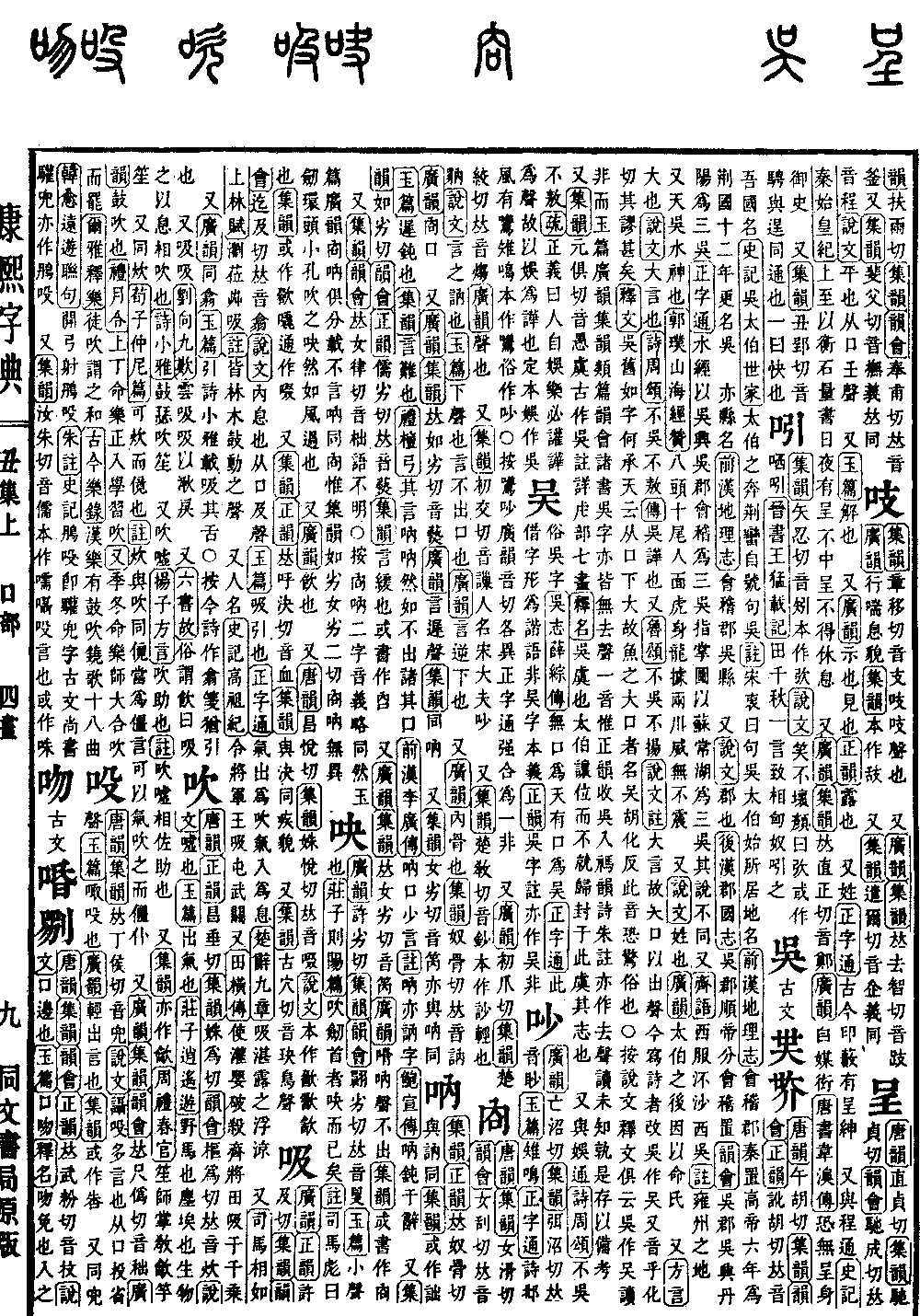
Chou Collection, Upper Volume. Radical: Mouth (kǒu). Kangxi strokes: 7. Page 179, Entry 04.
Ancient form. Pronounced wú. Name of a state. Records of the Grand Historian (Shiji), House of Wu Taibo: Taibo fled to the Jing-Man region and called himself Gou Wu. Commentary: Song Zhong states that Gou Wu was the name of the place where Taibo first resided. Book of Han (Hanshu), Treatise on Geography: Kuaiji Commandery was established during the Qin dynasty. In the sixth year of Emperor Gaozu of Han, it was renamed Jing State, and in the twelfth year, it was renamed Wu. It is also the name of a county. Book of Han, Treatise on Geography: Kuaiji Commandery contains Wu County.
Also, per Explaining and Analyzing Characters (Shuowen Jiezi), it is the name of a commandery. Book of the Later Han (Houhanshu), Treatise on Commandery and States: Wu Commandery was established during the reign of Emperor Shun of Han by dividing Kuaiji Commandery. Collection of Rhymes (Yunhui): Wu Commandery, Wuxing, and Danyang are collectively known as the Three Wu. Zhengzitong: The Commentary on the Water Classic (Shuijing Zhu) considers Wuxing, Wu Commandery, and Kuaiji to be the Three Wu. The Zhizhang Tu considers Suzhou, Changzhou, and Huzhou to be the Three Wu, indicating differing opinions.
Also, from the Discourses of the States (Guoyu): In the west, the states were conquered and the Sha-xi Wu was taken. Commentary: This refers to a location in Yong Province.
There is also Tianwu, a water deity. Guo Pu, Commentary on the Classic of Mountains and Seas (Shanhaijing Zan): It has eight heads and ten tails, a human face, and a tiger's body. It dwells upon two rivers, and its majesty is such that none are not shaken by it.
Also, per Explaining and Analyzing Characters, it is a surname. Expanded Rhymes (Guangyun): It is the descendants of Taibo, who then took this as their surname.
Also, per Regional Speech (Fangyan), it means big. Explaining and Analyzing Characters: It means to speak in a loud voice. Book of Odes (Shijing), Zhou Odes: Neither boisterous nor arrogant. Commentary: Wu means boisterous. Also, Lu Odes: Neither boisterous nor flamboyant. Commentary on Explaining and Analyzing Characters: Because the voice is loud, the head is tilted and the mouth is opened wide to produce the sound. Modern copyists of the Book of Odes change the character Wu to a variant form and read it with a different pronunciation, which is a serious error. The Textual Commentary (Shiwen) states that the character Wu should be read with its original pronunciation. He Chengtian stated: Because it is composed of a mouth over the character for big, a fish with a large mouth is called by this name, pronounced hu. This pronunciation is likely to disturb common customs. According to the Explaining and Analyzing Characters and the Textual Commentary, writing the character Wu with a variant form and giving it that reading is incorrect. Books such as the Jade Chapter (Yupian), Expanded Rhymes, Collection of Rhymes, Classified Characters (Leipian), and the aforementioned Collection of Rhymes do not contain the departing tone for the character Wu; only the Zheng Yun records it under the departing tone, and Zhu Xi's commentary on the Book of Odes also reads it in the departing tone. It is unclear which is correct, so it is recorded here for reference.
Also, per Collection of Rhymes, pronounced yú. The character Yu was anciently written as Wu. Detailed explanation is found in the entry for the Tiger radical, seven strokes.
Explication of Names (Shiming): Wu is the same as Yu. Taibo yielded the throne and did not accept it, returning here to receive a fief, thus realizing his ambition.
Also, it is interchangeable with the character Yu (to amuse). Book of Odes, Zhou Odes: Neither boisterous nor arrogant. Exegesis: The righteous meaning states: When people amuse themselves, they will inevitably be boisterous and produce sound. Therefore, Yu is interpreted as boisterous. In the definitive edition, Yu is written as Wu.