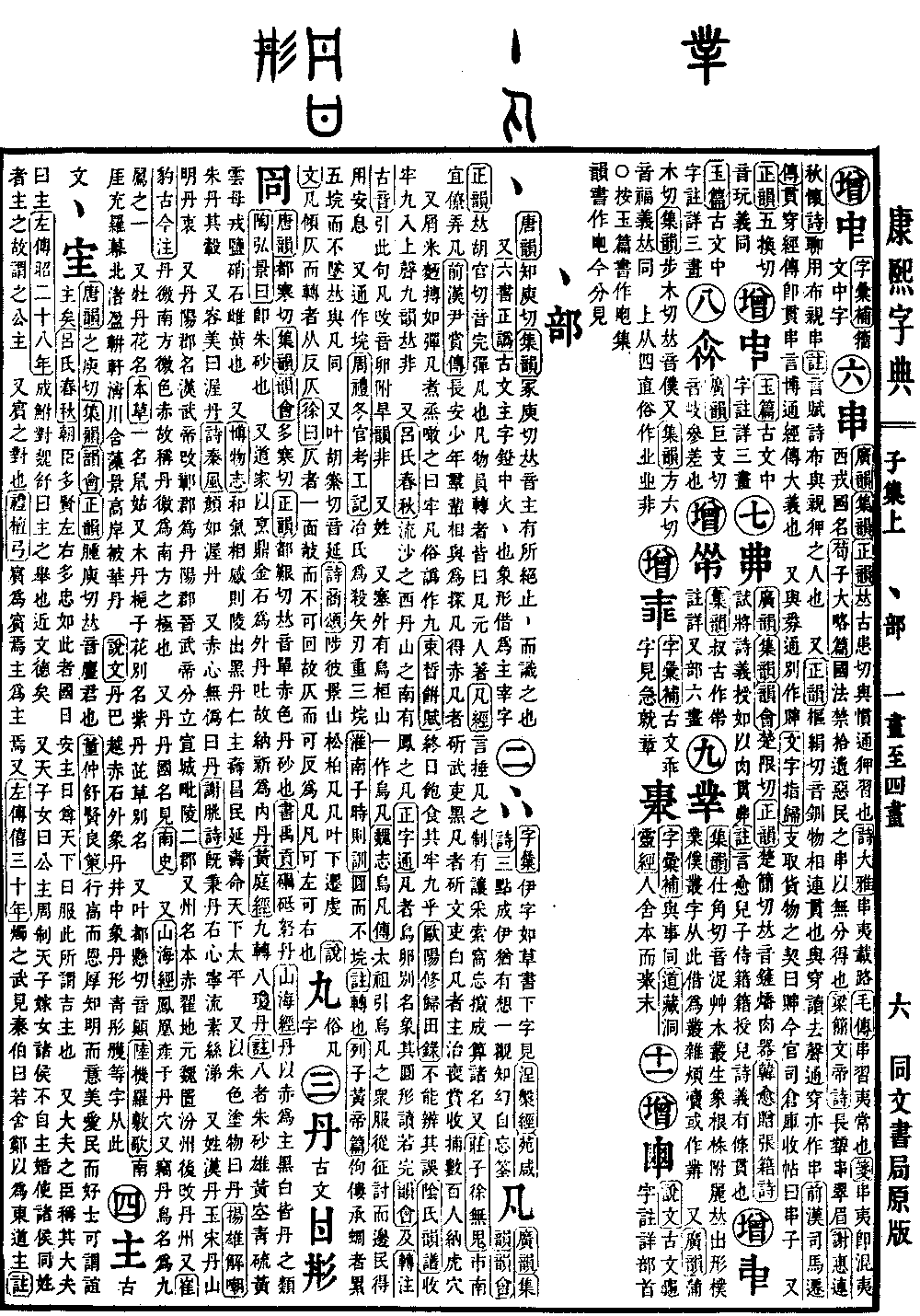
Zi Collection, Page Position: Upper
Radical: Line (gǔn)
Character: chuàn
Kangxi Stroke Count: 7
Page 80, Number 02
According to the Broad Rhymes (Guangyun), Collected Rhymes (Jiyun), and Correct Rhymes (Zhengyun), it is pronounced with the initial gǔ and the final huàn, and is interchangeable with the character for habit or familiarity (guàn). It means to be close to or familiar with.
In the Greater Odes (Daya) section of the Book of Odes (Shijing), it says, "The Chuan-yi people occupied the roads." The Commentary of Mao (Maozhuan) explains the character as meaning habit or custom, and the term yi as meaning constant. The Annotation of Zheng Xuan (Zheng Xuan Jian) states that Chuan-yi refers to the Hun-yi, which is the name of a state of the Western Rong people.
In the Great Innovations (Dalue) chapter of Xunzi, it is noted that national laws prohibit picking up items lost by others because the state dislikes the common people becoming accustomed to such behavior, as it leads to profiting without fulfilling one's proper duties.
A poem by Emperor Jianwen of the Liang Dynasty (Liang Wendi) contains the line, "A long frown has become habitual to her emerald eyebrows."
In the poem Autumn Sentiments (Qiuhuai) by Xie Huilian, it says, "I shall use this to distribute among my close relatives and friends." The commentary explains this as writing poetry to share with those who are close and familiar.
Also, according to the Correct Rhymes, it is pronounced with the initial shū and the final juàn, sounding like the character for bracelet (chuàn). It refers to things being connected or strung together. It is interchangeable with the character for pierce (chuān) when read in the falling tone. The character for pierce is also sometimes written as this character.
In the Biography of Sima Qian in the Book of the Former Han (Qian Hanshu), the phrase "to penetrate and connect the classics and commentaries" uses a term equivalent to connecting things together, meaning to have a thorough and comprehensive understanding of the great principles within the classics and their commentaries.
It is also synonymous with the character for through or communicate (tōng), and is alternatively written in a variant form pronounced chuàn.
According to the Origin of Characters (Wenzi Zhigui), a certificate for withdrawing goods is called a chuàn, and currently, a receipt from a government warehouse is called a chuànzi.
Also, according to the Correct Rhymes, it is pronounced with the initial wǔ and the final huàn, sounding like the character for play (wán). The meaning remains the same.