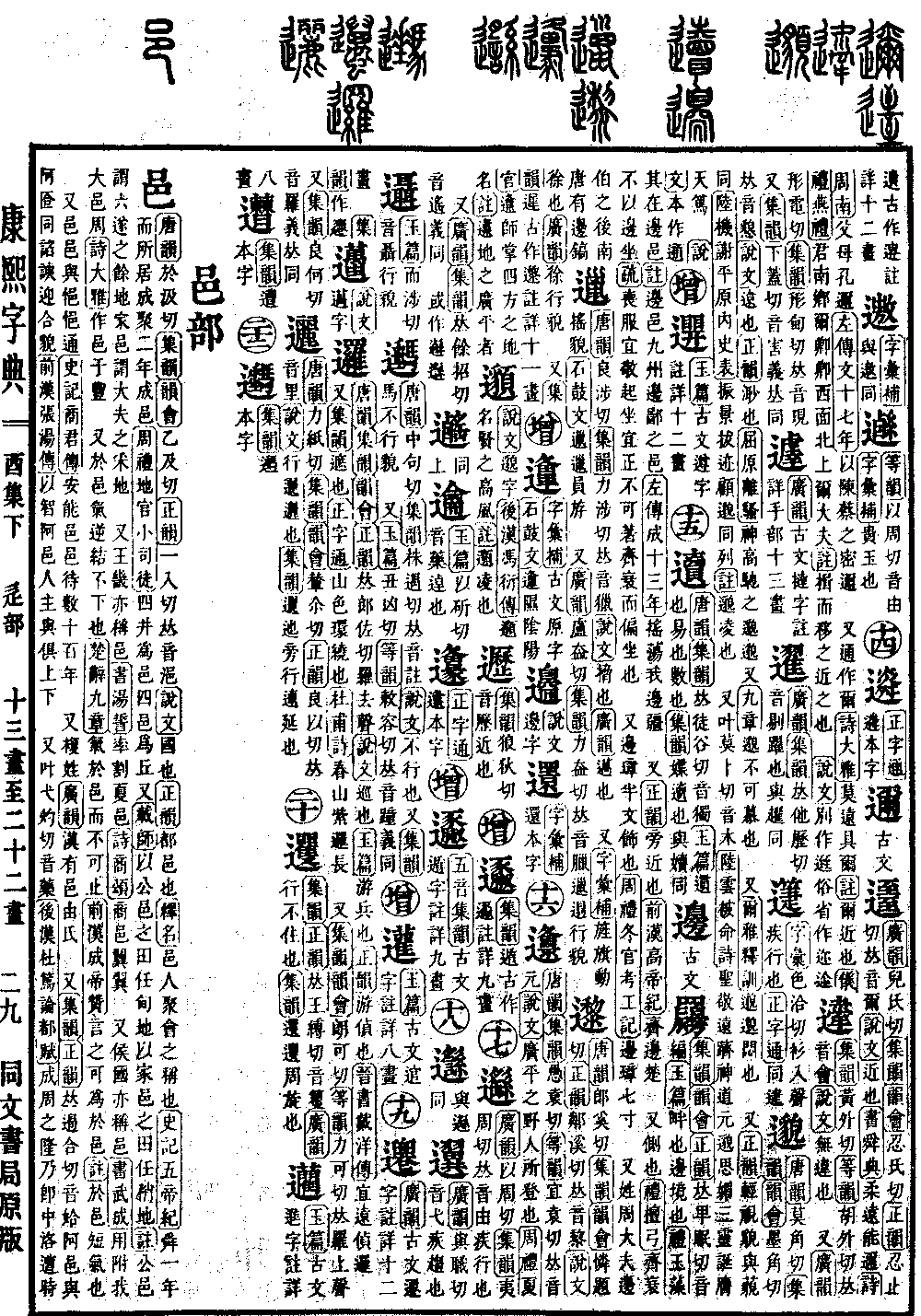
You Collection, Lower Volume
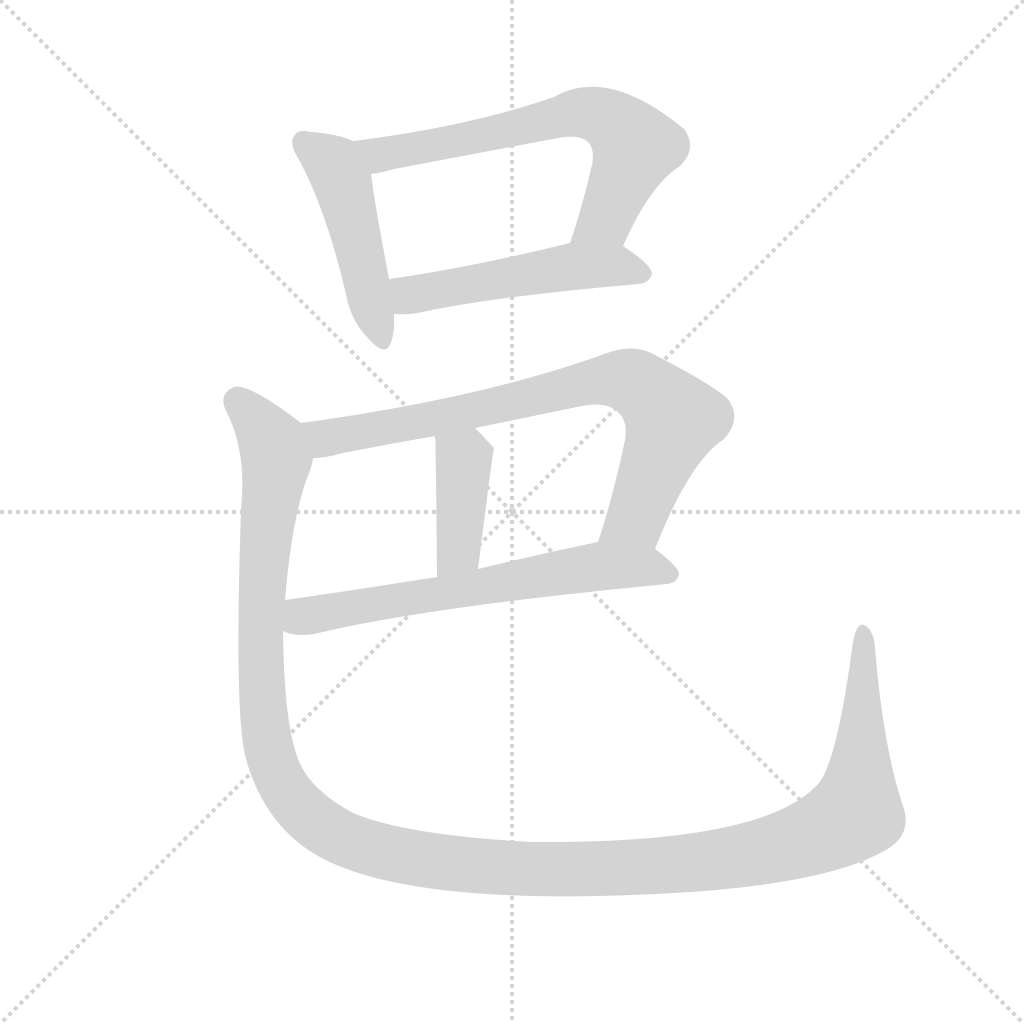
Radical: City (yì)
Page 1267, Entry 42
Pronounced yi.
Shuowen Jiezi (Explanation of Simple and Compound Characters): A country.
Zheng Yun (Correct Rhymes): A capital or city.
Shiming (Explanations of Names): Yi means a place where people gather.
Records of the Grand Historian (Shiji), Annals of the Five Emperors: In one year, the place where Shun lived became a hamlet; in two years, it became a city.
Rites of Zhou (Zhouli), Earth Offices, Minor Minister of Education: Four wells make a city, four cities make a hill.
Also, in Zai Shi: Use the land of the public city to be responsible for the suburban land; use the land of the family city to be responsible for the slight land. Commentary: Public city refers to the remaining land of the six districts. Family city refers to the fiefs of the grand masters.
Also, the royal domain is also called a city.
Book of Documents (Shangshu), Oaths of Tang: Led them to cut down the Xia city.
Book of Odes (Shijing), Eulogies of Shang: The city of Shang is orderly.
Also, feudal states are also called cities.
Book of Documents (Shangshu), Successful Completion of the War: Used to submit to our great city of Zhou.
Book of Odes (Shijing), Greater Odes: Built a city at Feng.
Also, yu yi, means breath obstructed and not descending.
Songs of Chu (Chu Ci), Nine Pieces: My breath is obstructed and cannot be stopped.
History of the Former Han (Qian Hanshu), Praise of Emperor Cheng: Words that can cause one to be short of breath. Commentary: Yu yi means shortness of breath.
Also, yi yi, interchangeable with yi yi (melancholy).
Records of the Grand Historian (Shiji), Biography of Shang Yang: How can one spend decades or a hundred years in melancholy?
Also, a compound surname. Guang Yun (Extended Rhymes): There was the Yiyou clan in the Han dynasty.
Also, pronounced e. E yi, synonymous with e ke, meaning to flatter and ingratiate oneself.
History of the Former Han (Qian Hanshu), Biography of Zhang Tang: Using his intelligence to flatter the ruler and align with his ups and downs.
Also, rhymes with the sound of yao. History of the Later Han (Hou Hanshu), Du Du, Discussion on Capitals Rhapsody: During the prosperity of the Zhou dynasty, they moved to the center in Luo. Responding to the times to establish a capital, they did not stick to one city.
Shuowen Jiezi (Explanation of Simple and Compound Characters): Formed from the character for mouth (wei, enclosure), representing four boundaries. The jie component provides the sound. Because there are ranks of size and status, it is a compound ideograph using the jie component. The radical is written as a cliff (bu), though common usage incorrectly writes it as mouth (kou) and ba.
Appendix: Pianhai Leibian (Collection of Character Categories): Same as the character yi.