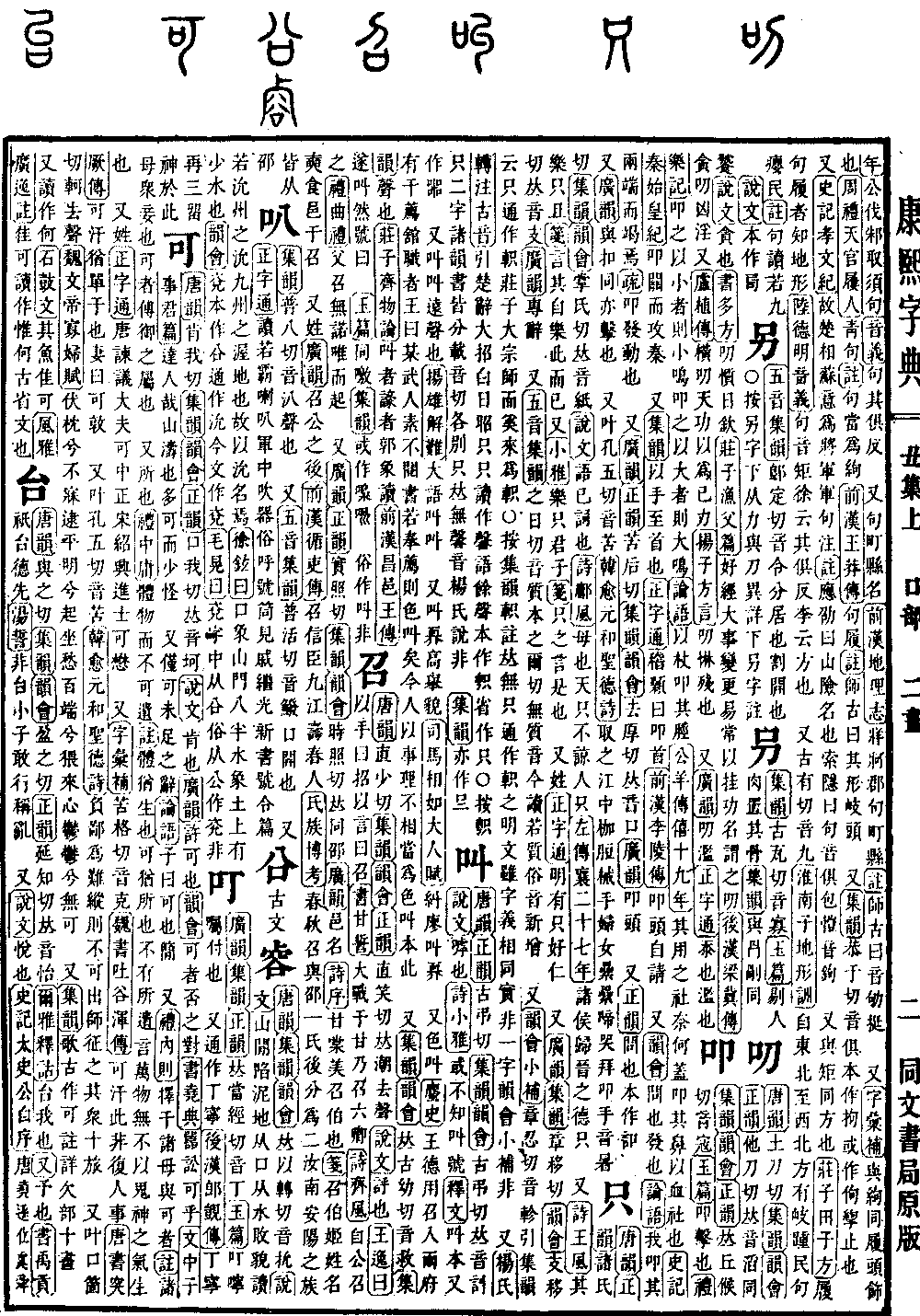
Chou Collection, Upper Volume
Radical: Mouth (kǒu)
叫
Kangxi stroke count: 5
Page 172, Entry 06
Pronounced jiào.
Shuowen Jiezi (Shuowen): To call out or shout.
Book of Odes (Shijing), Lesser Odes (Xiao Ya): There are those who do not know how to call out and wail.
Explanatory Text (Shiwen): The original form of this character is also written as jiào.
Also, the reduplicated form jiào jiào refers to a sound arriving from a distance.
Yang Xiong, Explanation of Difficulties (Jienan): To speak in a loud voice that carries far away.
Also written as jiào ào, describing an appearance of being held high.
Sima Xiangru, Rhapsody on the Great Man (Daren fu): Coiled and lifted high.
Also sé jiào.
Zhu History (Zhushi): When Wang Deyong was summoned to the two directorates, someone recommended a candidate for an official post to him. Wang said: I am a military man and have never studied books; if I were ordered to make a recommendation, I would appear awkward (sé jiào). The contemporary use of the term sé jiào to describe something inconsistent with reason and logic originates from this.
Pronounced jiù.
Jiyun: Refers to a sound.
Zhuangzi, Discourse on Making All Things Equal (Qiwulun): Those that shout and those that wail, this is how Guo Xiang reads it.
History of the Former Han (Qian Han Shu), Biography of the Prince of Changyi: Thereupon he cried out in a loud voice.
Yupian: Same as jiào.
Jiyun: Sometimes written as jiào. The common form jiào is incorrect.
Textual verification: Sima Xiangru, Rhapsody on the Great Man (Daren fu): jiū liǎo jiào ào. Corrected based on the original text, changing jiū liào to jiū liǎo.