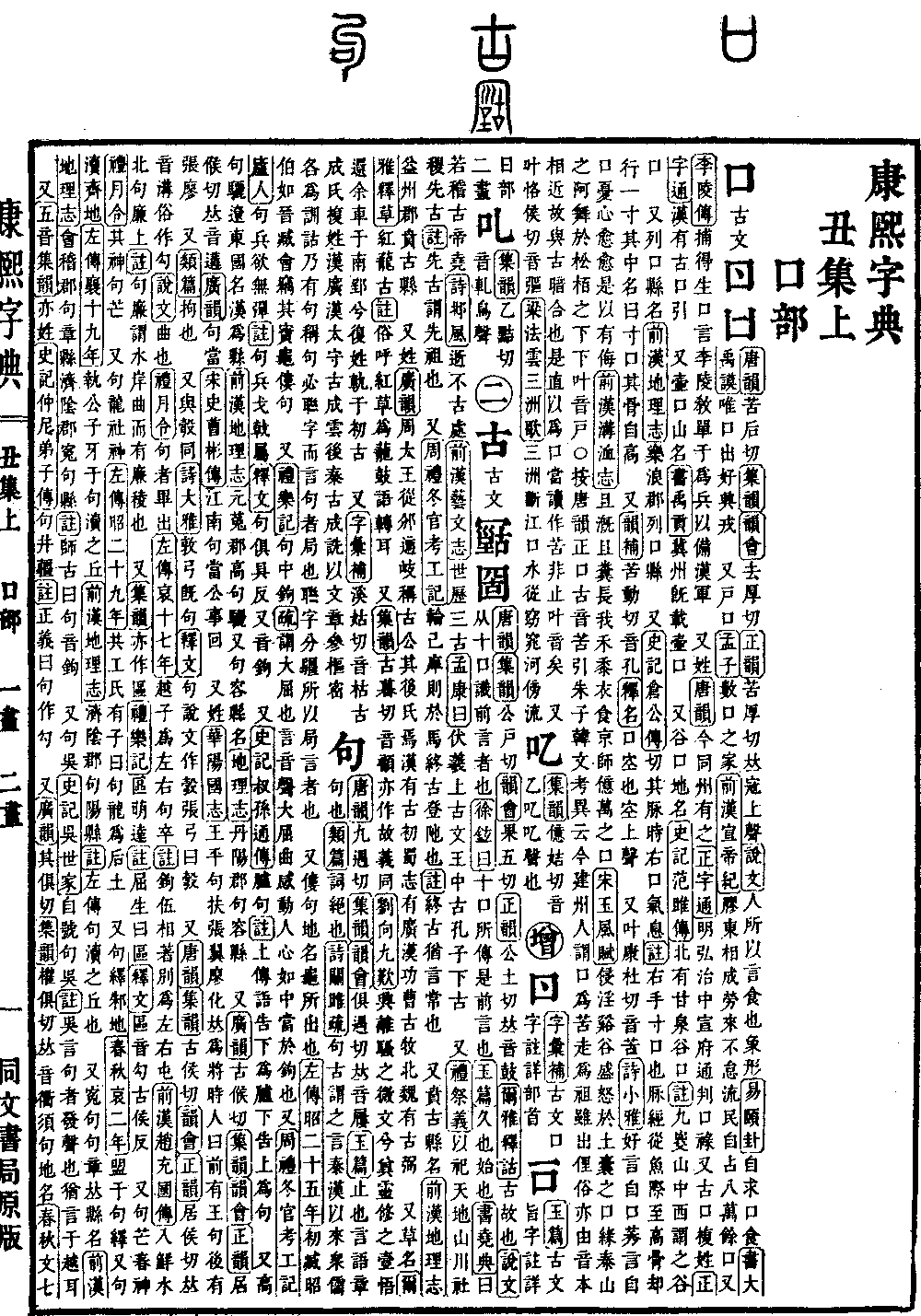
Chou Collection, Upper Volume
Radical: Mouth (kǒu)
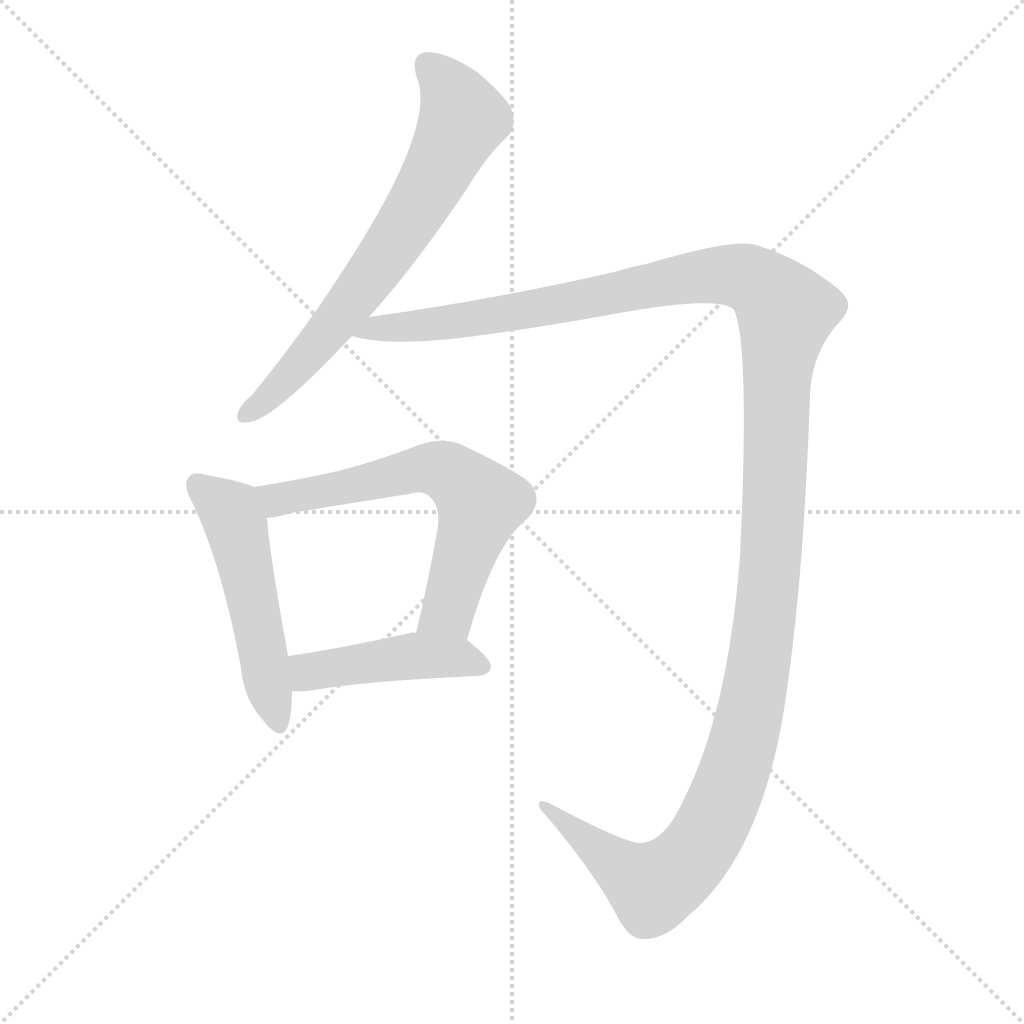
Character: 句
Kangxi Strokes: 5
Page 171, Entry 11
Pronounced ju.
In Tang Yun (Tang Rhyme), Jiyun (Collection of Rhymes), and Yunhui (Collection of Rhymes), it is pronounced ju (falling tone).
In Yupian (Jade Tablet), it means to stop; it also refers to the clauses of speech. In Leipian (Categorized Collection), it means the cessation of words.
In the Commentary on the Book of Odes (Shijing), it is noted that in ancient times, the term for words was ju. From the Qin and Han dynasties onward, various scholars provided explanations, and the term ju came into use. A clause (ju) must consist of connected characters; the term ju implies to restrain. By connecting characters to divide boundaries, one constrains speech.
Also, Louju, a place name, the origin of tortoises. In Zuo Zhuan (Zuo Commentary), it is recorded that Zang Zhaobo went to Jin, and Zang Hui stole his precious tortoise, Louju.
In Book of Rites (Liji), specifically the Record of Music (Yueji), it refers to a hook. The commentary explains this as a great curve, meaning that the sounds are highly curved, moving the human heart as if catching it on a hook.
In Book of Rites (Liji), specifically the Offices of Zhou (Zhouli), it states that hooked weapons should not be springy. The commentary identifies these as belonging to the category of spears and halberds. In the phonetic commentary, the pronunciation is given as gou.
It is also pronounced gou.
In Records of the Grand Historian (Shiji), it refers to a luju. The commentary explains that transferring words upward is called lu, and transferring words downward is called ju.
Also, Goguryeo, a name of a state in Liaodong, established as a county during the Han dynasty. In the Book of Han (Hanshu) Geography section, it is listed under Xuantu Commandery.
Also, Juyong, a county name. In the Geography section, it is listed as Juyong County, Danyang Commandery.
In Guangyun (Broad Rhymes), Jiyun, Yunhui, and Zhengyun (Correct Rhymes), it is pronounced gou (falling tone).
In Guangyun, it means to manage affairs. In the History of Song (Songshi), it is recorded that Cao Bin returned after managing official business in Jiangnan.
Also a surname. In the Chronicles of Huayang (Huayang Guozhi), it mentions Wang Ping, Ju Fu, Zhang Yi, and Liao Hua as generals. People of the time said: "Formerly there were Wang and Ju, latterly there were Zhang and Liao."
In Leipian, it means to restrain.
It is also the same as the character gou (to draw a bow). In Book of Odes (Shijing), it is written that the bow is already drawn. The phonetic commentary notes that the original character in the Shuowen Jiezi is gou, and to draw a bow is called gou.
In Tang Yun and Jiyun, it is pronounced gou. In Yunhui and Zhengyun, it is also pronounced gou. It is commonly written as a variant form.
According to the Shuowen Jiezi, it means to curve. In Book of Rites (Liji), specifically the Monthly Ordinances (Yueling), it states that curved things appear fully.
In Zuo Zhuan (Zuo Commentary), it mentions the troops of Yue forming left and right wings. The commentary explains this as hooks and ranks set against each other, forming separate left and right units.
In the Book of Han (Hanshu), specifically the Zhao Chongguo biography, it mentions the banks of the Xian River. The commentary notes this refers to the curves and edges of the riverbank.
In Jiyun, it is also written as the character qu. In Book of Rites (Liji), specifically the Record of Music (Yueji), it refers to the sprouts of plants. The commentary explains that bent growth is called qu. The phonetic commentary notes the pronunciation is gou.
Also, Jumang, the god of spring. In Book of Rites (Liji), specifically the Monthly Ordinances (Yueling), it names this god.
Also, Julong, the god of the soil. In Zuo Zhuan (Zuo Commentary), it is recorded that the Gonggong clan had a son named Julong, who became the god of the earth (Houtu).
Also, Juyi, a place in Zhu. In the Spring and Autumn Annals (Chunqiu), it mentions an alliance at Juyi.
Also, Judu, a place in Qi. In Zuo Zhuan (Zuo Commentary), it records the capture of Prince Ya at the hills of Judu. In the Book of Han (Hanshu) Geography section, it is Juyang County, Jiyin Commandery. The commentary links this to the hills of Judu mentioned in Zuo Zhuan.
Also, the county names Yuanju and Juzhang. In the Book of Han (Hanshu) Geography section, it lists Juzhang County, Kuaiji Commandery, and Yuanju County, Jiyin Commandery. The commentary states the pronunciation is gou.
Also, Juwu. In Records of the Grand Historian (Shiji), it is written that the state called itself Juwu. The commentary notes that the word ju is a sound-filler, similar to the word for the Yue people.
In Wuyin Jiyun (Collection of Rhymes in Five Sounds), it is also a surname. In Records of the Grand Historian (Shiji), it mentions Ju Jingjiang. The commentary corrects the character used for ju to the character meaning "to fish."
In Guangyun, it is pronounced qu. Xuju is a place name. In the Spring and Autumn Annals (Chunqiu), it records the Duke attacking Zhu and taking Xuju. The phonetic commentary gives the pronunciation as qu.
Also, Jutiao, a county name. In the Book of Han (Hanshu) Geography section, it is listed as Jutiao County, Zangke Commandery. The commentary notes the pronunciation as qu-ting.
In Zihui Bu (Supplement to the Character Dictionary), it is synonymous with the character qu, a decoration on the head of a shoe. In Book of Rites (Liji), specifically the Offices of Zhou (Zhouli), it mentions blue shoes. The commentary notes the character should be read as qu. In the Book of Han (Hanshu), it mentions shoes; the commentary explains their shape is forked at the toe.
In Jiyun, it is pronounced ju. It is a variant of the character meaning to stop, or sometimes written as a variant form.
In Records of the Grand Historian (Shiji), specifically the Annals of Emperor Xiao Wen, it mentions General Su Yi being in the army at Juzhu. The commentary notes this is the name of a dangerous mountain. The explanation of mysteries indicates the pronunciation is ju, while Bao Kai reads it as gou.
It is also the same as the character for a carpenter's square, meaning square. In Zhuangzi, it mentions that one who wears square shoes knows the terrain. The phonetic commentary says the pronunciation is ju; Xu says it is pronounced ju; Li says it means square.
Also, it is pronounced jiu. In Huainanzi, specifically the Chapter on Geography (Dixing Xun), it mentions that from the northeast to the northwest, there are the bifurcated-heel people and the goiter-people. The commentary notes the character should be read as jiu.
According to the Shuowen Jiezi, the original character is written with a mouth and the sound-component jiu.