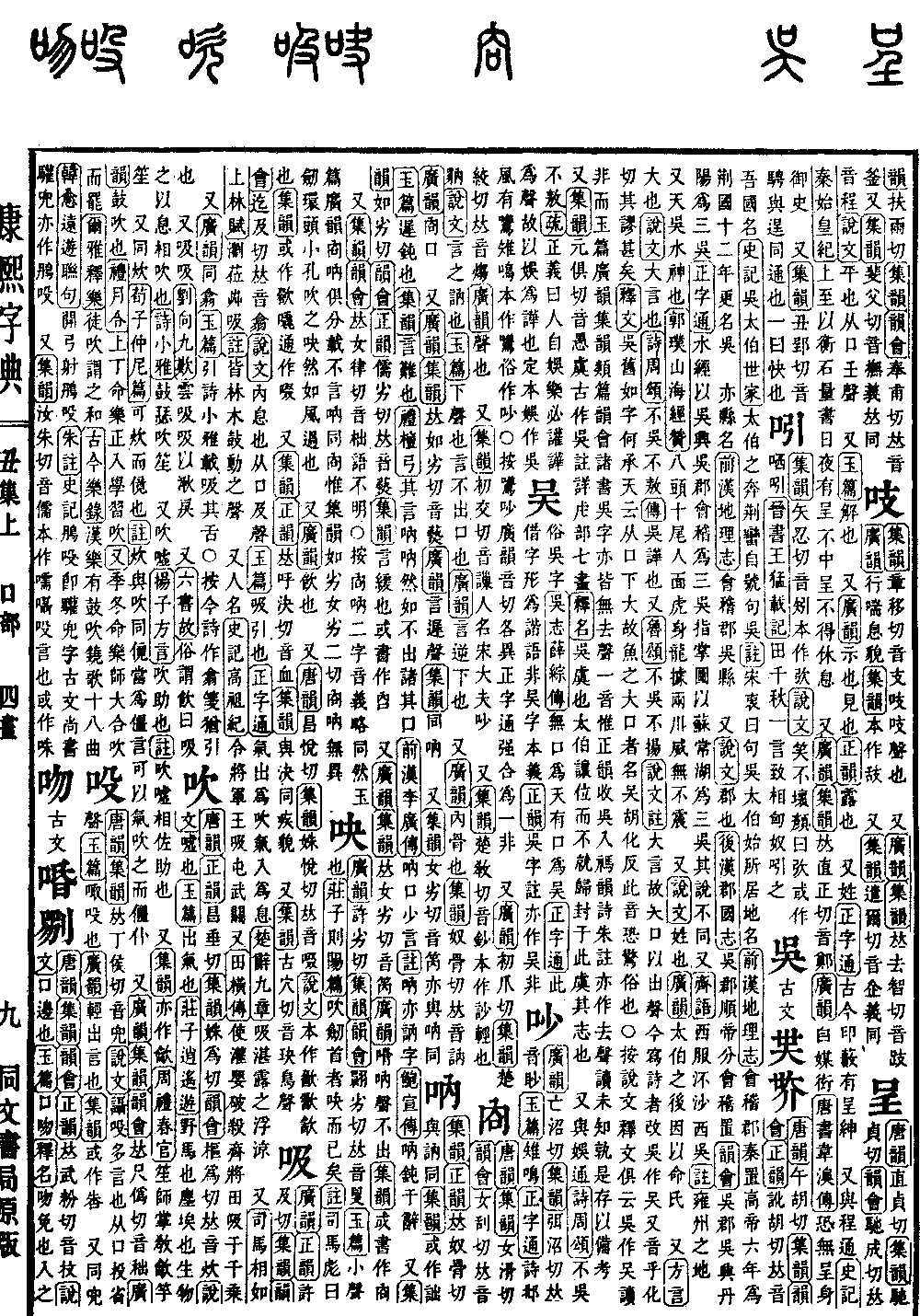
Chou Collection, Upper Volume
Radical: Mouth (kǒu)
Character: chui
Kangxi strokes: 7
Page 179, Entry 13
Pronounced chui.
In the Shuowen Jiezi (Shuowen), it means to exhale.
In the Yupian, it means to emit breath.
In the Zhuangzi (Zhuangzi), it is said: The wild horses, the dust, all living things blow against one another with their breath.
In the Book of Odes (Shijing), it says: Playing the zither and blowing the reed organ.
It also refers to boasting or recommending.
In the Fangyan (Fangyan), it states: Chui means to assist. The commentary explains: To boast or recommend is to assist one another.
It is also written in a variant form (chui).
In the Rites of Zhou (Zhouli), it says: The Master of Reed Organs is in charge of teaching the blowing of the pipes and the reed organs.
It is also the same as chui (to cook).
In the Xunzi (Xunzi), it says: One can cook until rigid. The commentary notes: Chui is the same as chui (to blow). The word meaning rigid should be interpreted as to fall over. It means it can be blown upon with breath until it falls over.
Pronounced chui.
In the Guangyun (Guangyun), it refers to drum and wind music.
In the Book of Rites (Liji), it says: On the day of the first Ding, the Music Master is ordered to enter and practice blowing.
It also says: In the last month of winter, the Music Master is ordered to hold a grand performance of blowing before dismissing.
In the Erya (Erya), it states: Blowing without accompaniment is called he.
In the Ancient and Modern Music Records (Gujin yuelu), it mentions: Han dynasty music included eighteen pieces of drum and wind music, including the brass horn songs.