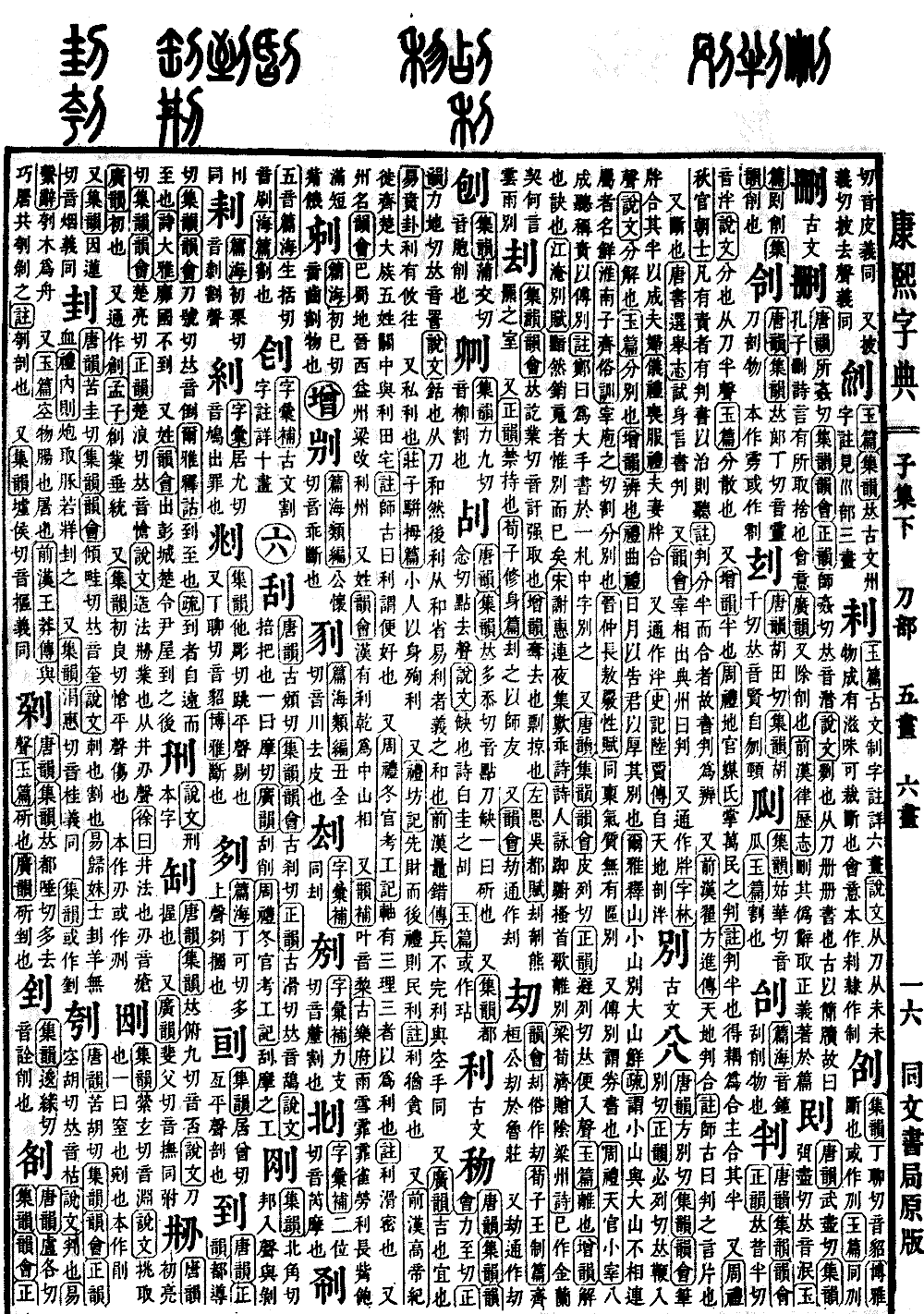
Zi Collection, Page Position: Lower
Radical: Knife (dāo)
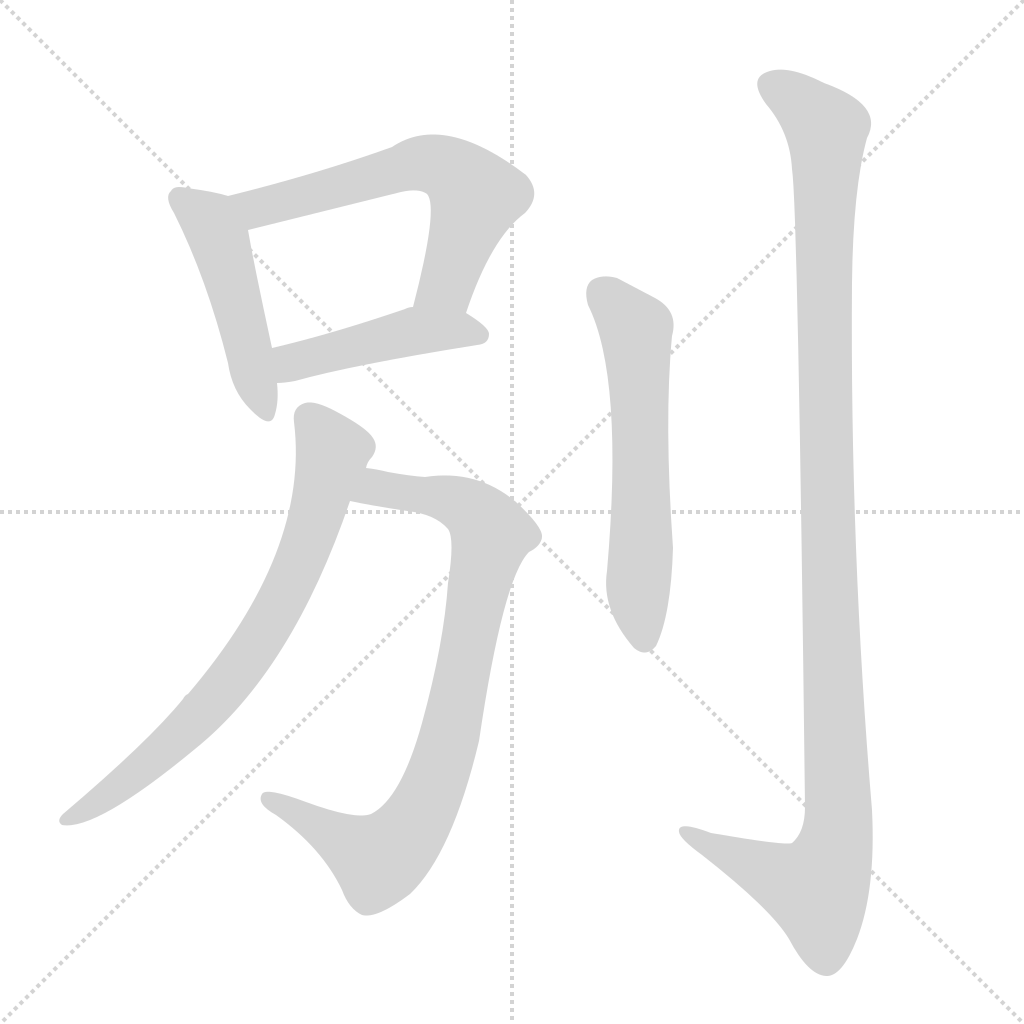
Entry: 别 (bié)
Kangxi Strokes: 7
Page 138, Entry 12
Classical Chinese:
Pronounced bié (entering tone) according to Tang Yun, Ji Yun, Yun Hui, and Zheng Yun.
Shuowen defines it as the meaning of "to separate."
Yupian defines it as the meaning of "to distinguish."
Zeng Yun defines it as the meaning of "to discern."
"The sun and moon inform the ruler, to strengthen their separation." — Book of Rites (Liji)
"Small mountains separate large mountains, called xian." — Erya (Shishan)
(Gloss: Refers to small mountains not being connected to large mountains, which is called xian.)
"The cutting and separating of the butcher." — Huainanzi (Qisu Xun)
"Though receiving the same temperament, there is no distinction." — Jin (Zhongchang Ao, Hexing Fu)
Also, "fù bié" refers to a bond or deed.
"Eight accomplishments: listen to the charges and pass them on." — Zhou Li (Tianguan, Xiaozai)
(Note: Zheng says: Make a large character on one piece of bamboo, and separate it with a character in the middle.)
Also, pronounced liè (entering tone) according to Tang Yun, Ji Yun, Yun Hui, and Zheng Yun.
Yupian defines it as the meaning of "to separate" or "to leave."
Zeng Yun defines it as the meaning of "to resolve" or "to part."
"Fading away sadly, there is only parting." — Jiang Yan (Bie Fu)
"The poet sings of lingering, scratching his head and singing of parting." — Song (Xie Huilian, Ye Ji Tan Guai Shi)
"Already formed a bond of gold and orchids, why speak of parting like clouds and rain." — Liang (Xun Ji, Zeng Yin Liangzhou Shi)