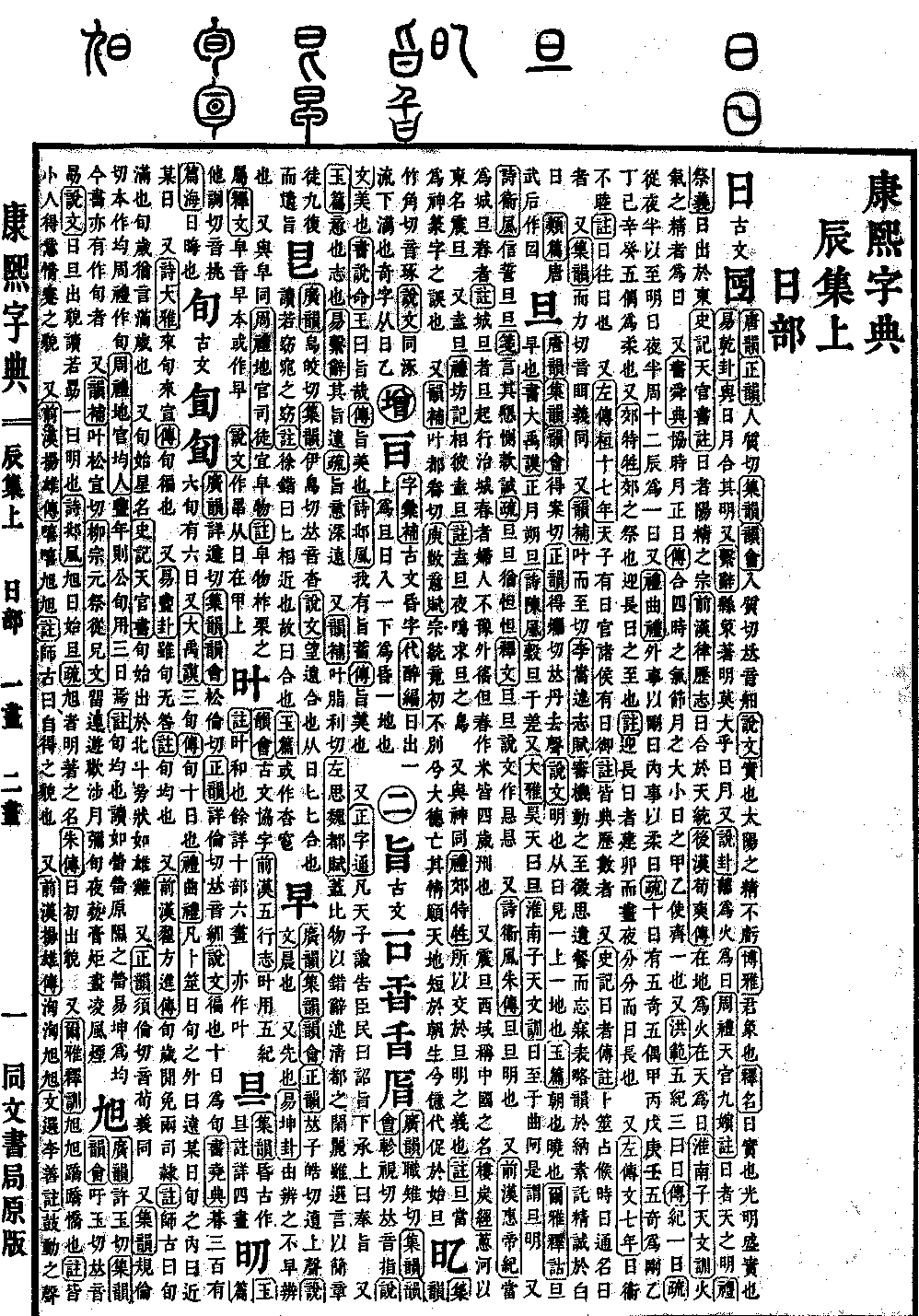
Chen Collection, Upper Volume
Radical: Sun (rì)
Kangxi stroke count: 4
Page 489, Entry 01
Pronounced rì
Pronounced rì
Shuowen Jiezi (Explaining Graphs and Analyzing Characters): To be substantial. The essence of the sun never diminishes.
Guangya (Broad Refinements): Symbolizes the monarch.
Shiming (Explanation of Names): Sun means to be filled; it is bright, grand, and substantial.
Book of Changes (Yijing), Qian Hexagram: To be in harmony with the light of the sun and the moon.
Xici (Appended Remarks): Hanging symbols in the sky to reveal brightness, nothing is greater than the sun and the moon.
Shuogua (Discussion of Trigrams): The Li trigram represents fire and represents the sun.
Rites of Zhou (Zhouli), Offices of Heaven, Nine Commentaries: The sun is the brightness of the sky.
Book of Rites (Liji), Meaning of Sacrifices: The sun rises in the east.
Records of the Grand Historian (Shiji), Treatise on Celestial Offices Commentary: The sun is the ancestor of the essence of yang energy.
History of the Former Han (Qian Hanshu), Treatise on Harmonics and Calendars: The sun accords with the celestial order.
History of the Later Han (Hou Hanshu), Biography of Xun Shuang: On earth it is fire, in the sky it is the sun.
Huainanzi, Treatise on Astronomy: The essence of fire is the sun.
Book of Documents (Shangshu), Canon of Shun: Coordinate the four seasons, the months, and the days.
Commentary: Harmonize the solar terms of the four seasons, the length of the months, and the stems and branches of the days to make them orderly and consistent.
Hongfan (Great Plan): The five methods of measuring time; the third is the day.
Commentary: Using the day as a unit for recording.
Sub-commentary: From midnight to the following midnight, a cycle of twelve double-hours constitutes one day.
Book of Rites (Liji), Summary of the Rules of Propriety: External affairs are conducted on yang days, internal affairs are conducted on yin days.
Sub-commentary: Among the ten heavenly stems, there are five odd numbers (yang stems) and five even numbers (yin stems). Jia, Bing, Wu, Geng, and Ren are the five odd numbers, representing yang days; Yi, Ding, Ji, Xin, and Gui are the five even numbers, representing yin days.
Jiao Tesheng (Special Sacrifices at the Suburban Altars): The suburban sacrifice is held to welcome the arrival of the long day.
Commentary: Welcome the long day refers to the spring equinox (in the second lunar month), when day and night are of equal length, after which the daylight gradually becomes longer.
Zuo Tradition (Zuozhuan), Seventh Year of Duke Wen: In past days, the State of Wei was not in harmony.
Commentary: Day refers to the past.
Zuo Tradition (Zuozhuan), Seventeenth Year of Duke Huan: The Son of Heaven appoints sun officials, and the feudal lords appoint sun attendants.
Commentary: Both refer to those in charge of the calendar and astronomy.
Records of the Grand Historian (Shiji), Biography of Diviners Commentary: Those who perform divination, cast lots, and select auspicious days are collectively known as sun-men.
Pronounced rì. The meaning is the same.
Phonetic supplement: Rhymes with zhi.
Li Song, Shu Zhi Fu (Rhapsody on Stating My Intentions): Carefully observing the subtle changes of the times, contemplating affairs without sleep or food. Expressing great intent within simplicity, entrusting sincerity to the bright sun.
Leipian (Categorized Dictionary): This character was created by Empress Wu Zetian during the Tang Dynasty.