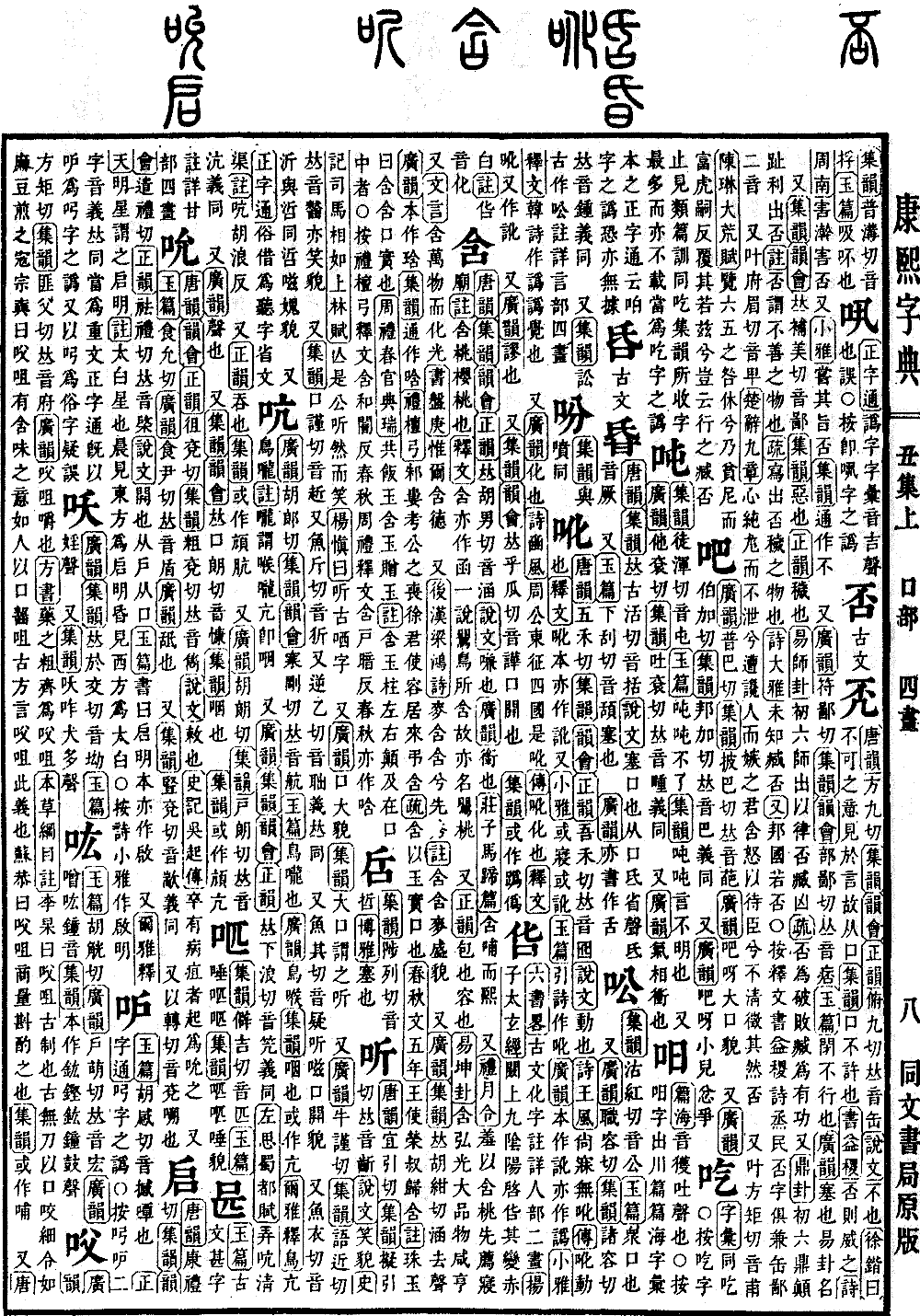
Chou Collection, Upper Volume
Radical: Mouth (kǒu)
Character: 含
Kangxi Stroke Count: 7
Page 178, Entry 14
Pronounced han.
In the Shuowen Jiezi (Shuowen), it means to hold in the mouth. According to the Guangyun, it means to hold in the beak or mouth. In the Zhuangzi, it is written: To hold food in the mouth and be happy.
Also, in the Book of Rites (Liji), it states: Present offerings of cherries, first to the ancestral temple. The commentary explains that the cherry is the bird-held fruit. The explanatory notes state that it is also written as han (the character for contain). Another theory suggests that because birds hold them, they are also called oriole-pecked fruit.
In the Zheng Yun, it means to wrap or to contain. In the Book of Changes (Yijing), it states: Containing greatness and brilliance, all things are fully successful. The commentary says: Containing all things and transforming them with light. In the Book of Documents (Shujing), it says: Only you contain virtue. In the poetry of Liang Hong from the Later Han, it says: The wheat is flourishing and elegant. The commentary explains that hanhan describes the lush appearance of wheat.
Pronounced han (falling-rising tone).
Originally written as han (the character for jade placed in a corpse's mouth). In the Jiyun, it is interchangeably written as han (the character for murmuring).
In the Book of Rites (Liji), it is recorded: During the funeral of the Duke of Zhulou, the ruler of Xu sent Rong Ju to offer condolences and provide the jade for the deceased's mouth. The commentary explains that the han is the jade placed inside the mouth. In the Spring and Autumn Annals (Chunqiu), it says: The King sent Rong Shu to provide the jade for the mouth. The commentary notes that beads and jade are called han, which refers to the object placed in the mouth. In the Rites of Zhou (Zhouli), it says: Providing the rice, the jade for the mouth, and the jade for burial gifts. The commentary explains that the jade for the mouth is placed at the sides and within the mouth. Note: In the explanatory notes to the Book of Rites and the Spring and Autumn Annals, it is also pronounced he (falling-rising tone). The Spring and Autumn Annals also uses the variant form han (the character for murmuring).