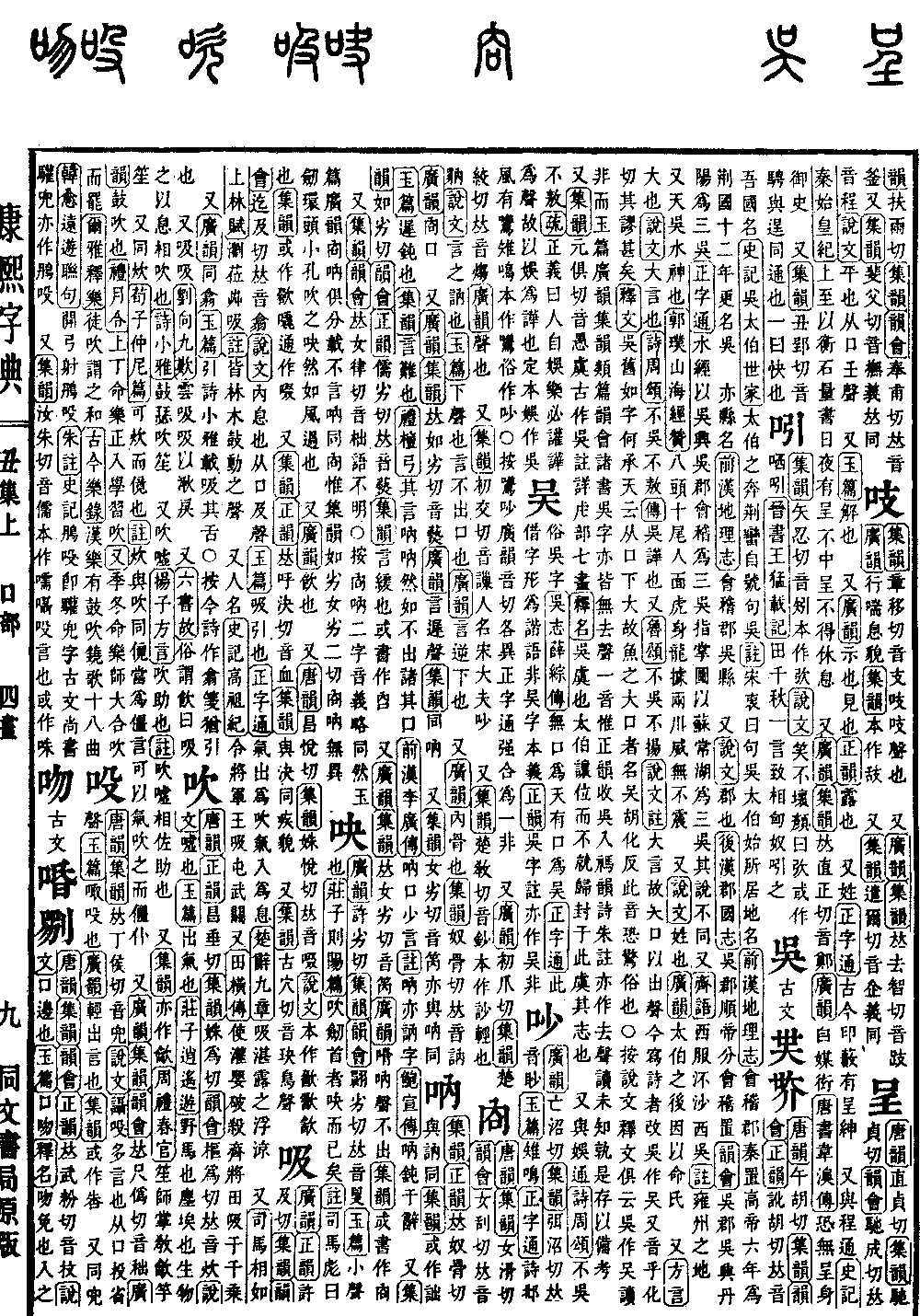
Chou Collection, Upper Volume
Radical: Mouth (kǒu)
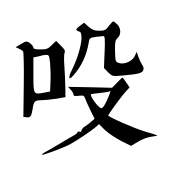
Character: dou
Kangxi stroke count: 7
Page 179, Entry 14
According to the Tang Dynasty Rhyme Dictionary (Tangyun) and the Collected Rhymes (Jiyun), the pronunciation is dou.
Per the Explaining Graphs and Analyzing Characters (Shuowen), nie-dou refers to excessive speech. It is composed of the radical for mouth, with the abbreviated character for throw (tou) acting as the phonetic component.
According to the Jade Chapters (Yupian), it means dou.
According to the Broad Rhymes (Guangyun), it refers to speaking carelessly.
According to the Collected Rhymes (Jiyun), it is also written as a variant form. It is also synonymous with dou.
In the joint poem Remote Travels (Yuanyou Lianju) by Han Yu, it is written: drawing a bow to shoot the huan-dou.
The commentary by Zhu notes that in the Records of the Grand Historian (Shiji), huan-dou is the same as the character for huan-dou. In the Ancient Text Classic of History (Shangshu), huan-dou is also written as huan-dou.
According to the Collected Rhymes (Jiyun), it is also pronounced ru. It is the original form of the character ru. Nie-dou refers to speech. It is also sometimes written as a variant form.