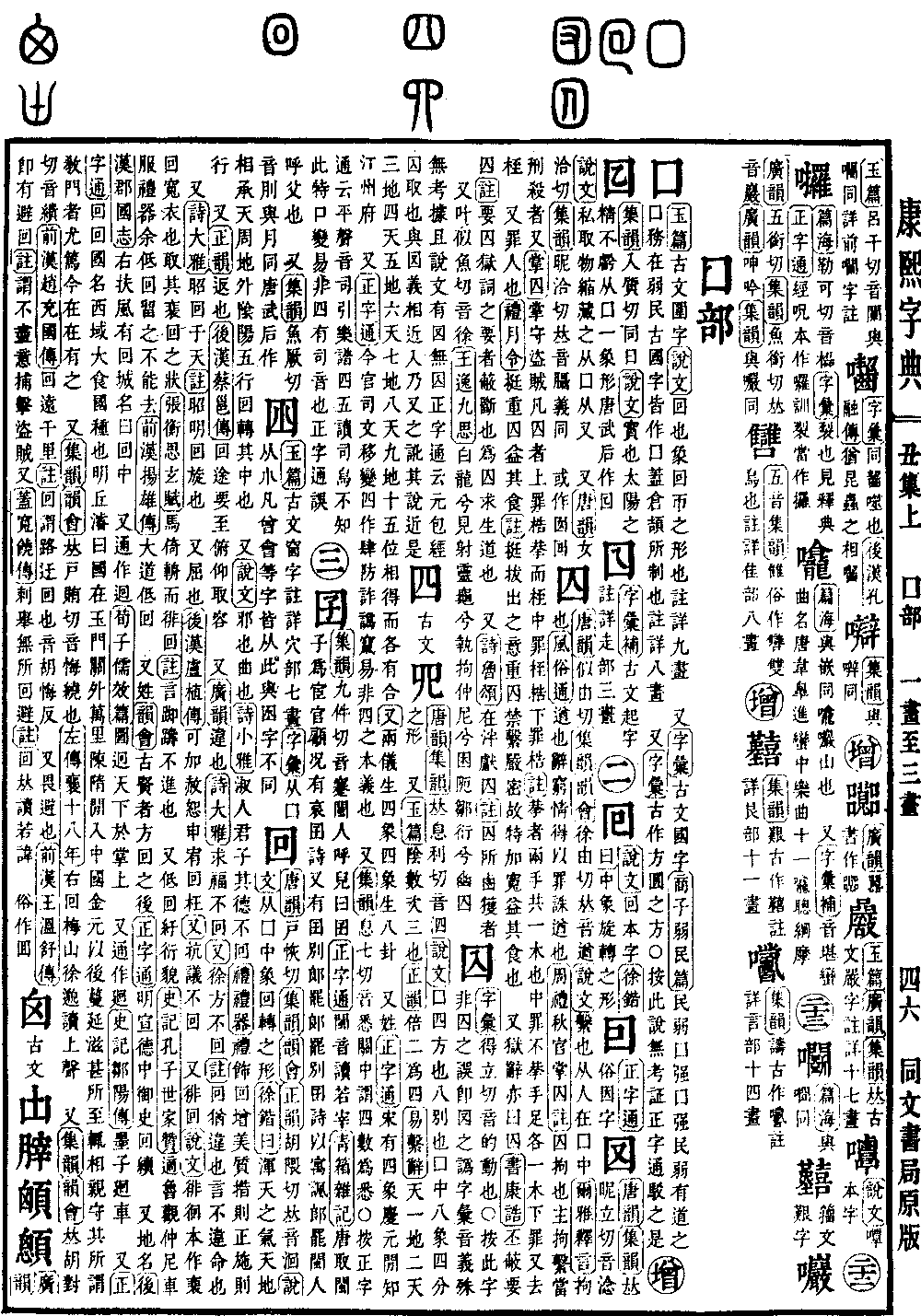
Chou Collection, Upper Volume
Radical: Enclosure (wéi)
Kangxi Strokes: 6
Page 216, Entry 26
Pronounced hui.
According to the Explaining Graphs and Analyzing Characters (Shuowen Jiezi), it is composed of the Enclosure radical, with the center representing the shape of revolving. Xu Kai stated: The energy of the heavens is all-encompassing, with heaven and earth supporting each other. Heaven surrounds the outside of the earth, and the five phases of yin and yang revolve within it.
Also, according to the Explaining Graphs and Analyzing Characters (Shuowen Jiezi), it means devious or curved.
Book of Odes (Shijing), Lesser Odes: The virtuous gentleman, his character is not devious.
Book of Rites (Liji), Ritual Vessels: Rituals decorate what is curved, enhancing the beautiful quality; when placed, they are upright, and when applied, they proceed.
Also, according to the Correct Rhymes (Zhengyun), it means to return.
History of the Later Han (Hou Hanshu), Biography of Cai Yong: Returning on the path to reach the destination, adjusting one's behavior to find acceptance.
Also, according to the Extensive Rhymes (Guangyun), it means to go against.
Book of Odes (Shijing), Greater Odes: Seeking blessings without defiance.
Also: The Xu region did not defy. Commentary: This means it is like defying, saying they did not disobey the orders.
Also, Book of Odes (Shijing), Greater Odes: Shining and revolving in the heavens. Commentary: Zhao means bright. Hui means to spin.
Also, it means to bend.
History of the Later Han (Hou Hanshu), Biography of Lu Zhi: One may grant amnesty and pardon to rectify those who are bent or crooked.
Also: Resisting with protest without yielding.
Also, lingering (paihuai).
According to the Explaining Graphs and Analyzing Characters (Shuowen Jiezi), the original form of lingering was written with different characters. It refers to wide robes, taking the shape of lingering.
Zhang Heng, Rhapsody on Thinking (Si Fu): The horse leans against the shafts and lingers. Commentary: This means hesitating and not advancing.
Also, low and circling, describing a winding appearance.
Records of the Grand Historian (Shiji), Eulogium on the Hereditary House of Confucius: Arriving in Lu, I observed the carriages, garments, and ritual vessels of Confucius; I lingered there, unable to leave.
History of the Former Han (Hanshu), Biography of Yang Xiong: The great path winds low.
Also a surname.
Rhyme Anthology (Yunhui): Descendants of the ancient sage Fang Hui.
General Clarification of Characters (Zhengzitong): During the Xuande period of the Ming Dynasty, there was an investigating censor named Hui Xu.
Also a place name.
History of the Later Han (Hou Hanshu), Treatise on Administrative Geography: In Youfufeng there is a Hui City, known as Huizhong.
Also written interchangeably as hui.
Xunzi, Chapter on the Efficacy of Scholars (Ruxiao): Planning to revolve the world upon one's palm.
Also written interchangeably as hui.
Records of the Grand Historian (Shiji), Biography of Zou Yang: Mozi turned back the carriage.
Also, General Clarification of Characters (Zhengzitong): Huihui, a country name. It is a tribe from the Dashi country in the Western Regions. Qiu Jun of the Ming Dynasty said: The country is ten thousand miles outside the Yumen Pass, and it entered China during the Sui Dynasty. After the Jin and Yuan dynasties, it spread extensively; wherever they went, they would unite to support each other. Their so-called religious sect is particularly devout, and now they are found everywhere.
Pronounced hui (rising tone).
To encircle.
Zuo Tradition (Zuo Zhuan), Eighteenth Year of Duke Xiang: They circled to the right of Mount Mei. Xu Miao reads this in the rising tone.
Pronounced hui (departing tone).
History of the Former Han (Hanshu), Biography of Zhao Chongguo: Far and circuitous by a thousand miles. Commentary: Hui means the road is winding; pronounced like hui in the reverse.
Also, to avoid or evade.
History of the Former Han (Hanshu), Biography of Wang Wenshu: If there was evasion. Commentary: This means not using one's full intent to capture and strike thieves.
Also, Biography of Gai Kuanrao: Probing and reporting without any avoidance. Commentary: Hui is read like the word for taboo (hui).
Commonly written in the variant form hui.