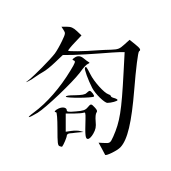
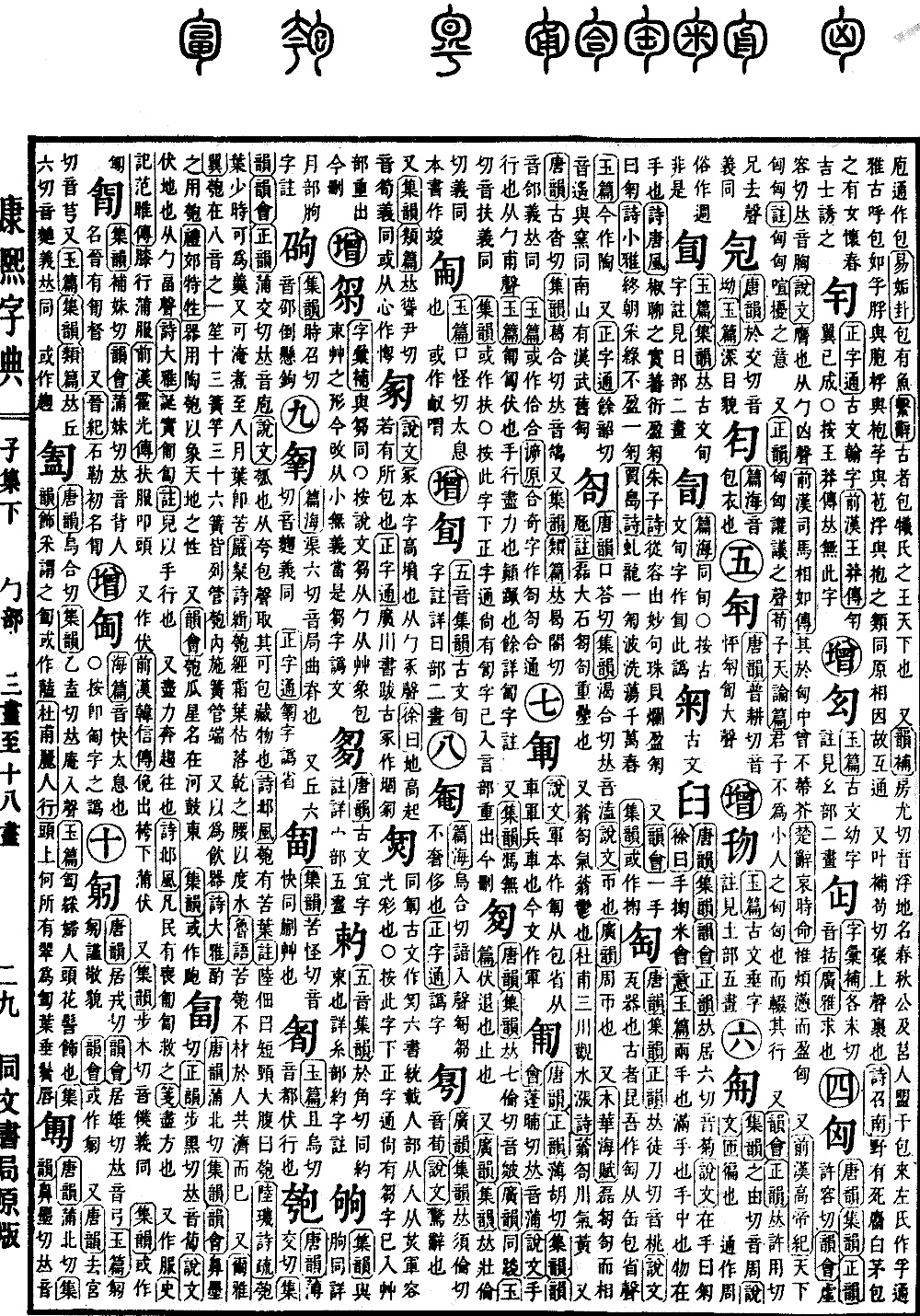
Zi Collection, Page Position: Lower. Radical: Wrap (bāo). Ge. Kangxi stroke count: 8. Page 151, Number 15.
In the Tang Rhymes (Tangyun), the pronunciation is recorded via the fanqie method as k-ou and d-a. In the Collected Rhymes (Jiyun), it is recorded as k-e and h-e, sounding similar to kè. The Explaining Graphs and Analyzing Characters (Shuowen Jiezi) defines it as zā, meaning to encircle or to be all-encompassing. The Expanded Rhymes (Guangyun) defines it as zhōuzā, meaning to surround on all sides. It also appears in the Rhapsody on the Ocean (Haifu) by Mu Hua in the phrase "large stones piled up and clashing together," where the commentary explains that lěi refers to large stones and dágé describes the appearance of being piled up or overlapping. Another term is wěnggé, referring to a dense, pervading atmosphere or mist, as in the poem Watching the River Rise at Sanchuan (Sanchuan guan shuizhang shi) by Du Fu: "The dense river mist turns yellow." In the Tang Rhymes, it is also recorded as g-u and d-a, and in the Collected Rhymes as g-e and h-e, sounding similar to gē. In the Collected Rhymes and the Classified Chapters (Leipian), it is recorded as h-e and g-e, sounding similar to hé. All the aforementioned pronunciations share the same meaning. The Jade Chapters (Yupian) records that this character is sometimes written as the variant forms gé or hé. An original note states that the variant form of hé is written as gé, and that gé and hé are interchangeable.