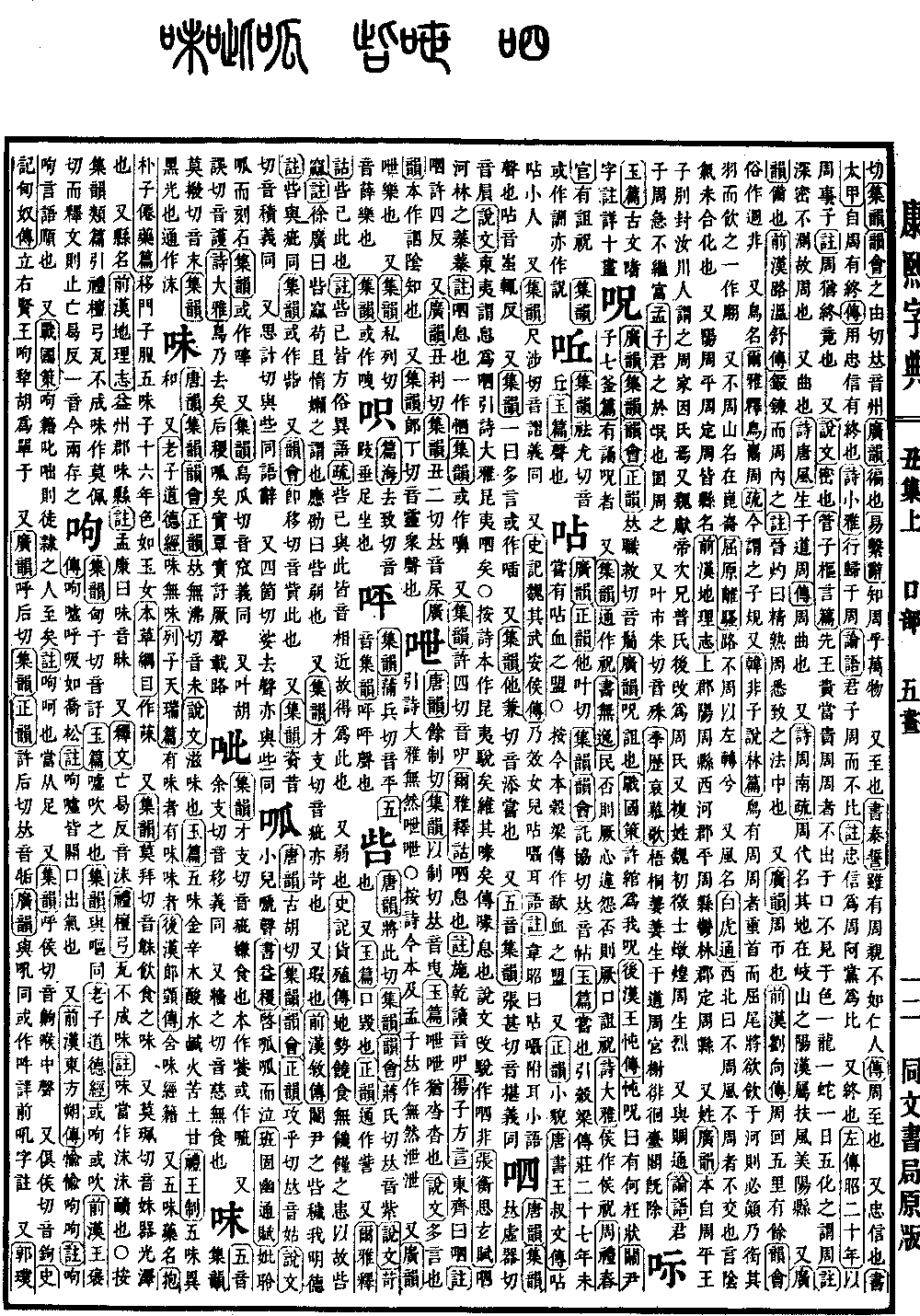
Chou Collection, Upper Volume
Radical: Mouth (kǒu)
Character: Zhan
Kangxi strokes: 8
Page 182, Entry 04
Pronounced tie.
In the Extensive Rhymes (Guangyun) and Standard Rhymes (Zhengyun), the pronunciation is listed as tie. In the Collected Rhymes (Jiyun) and Rhyme Anthology (Yunhui), the pronunciation is listed as tie.
According to the Jade Chapters (Yupian), it means to taste. It cites the Commentary of Gongyang (Guliang zhuan) for the twenty-seventh year of Duke Zhuang: There had not yet been an oath of tasting blood. Note that the current version of the Commentary of Gongyang (Guliang zhuan) uses the character for smear blood instead.
According to the Standard Rhymes (Zhengyun), it describes a small appearance. In the Book of Tang (Tangshu), Biography of Wang Shuwen, it appears as small-minded people.
According to the Collected Rhymes (Jiyun), it is also pronounced zhe, with the same meaning.
According to the Records of the Grand Historian (Shiji), Biography of Marquis Weiqi and Wu'an, it says: Like a young woman whispering. The commentary by Wei Zhao says: This refers to the sound of whispering in someone's ear, pronounced chi.
According to the Collected Rhymes (Jiyun), it also means to talk a lot. Sometimes written in a variant form.
According to the Collected Rhymes (Jiyun), it is also pronounced tian, meaning to taste.
According to the Five Sounds Collected Rhymes (Wuyin Jiyun), it is pronounced zhen, with the same meaning.