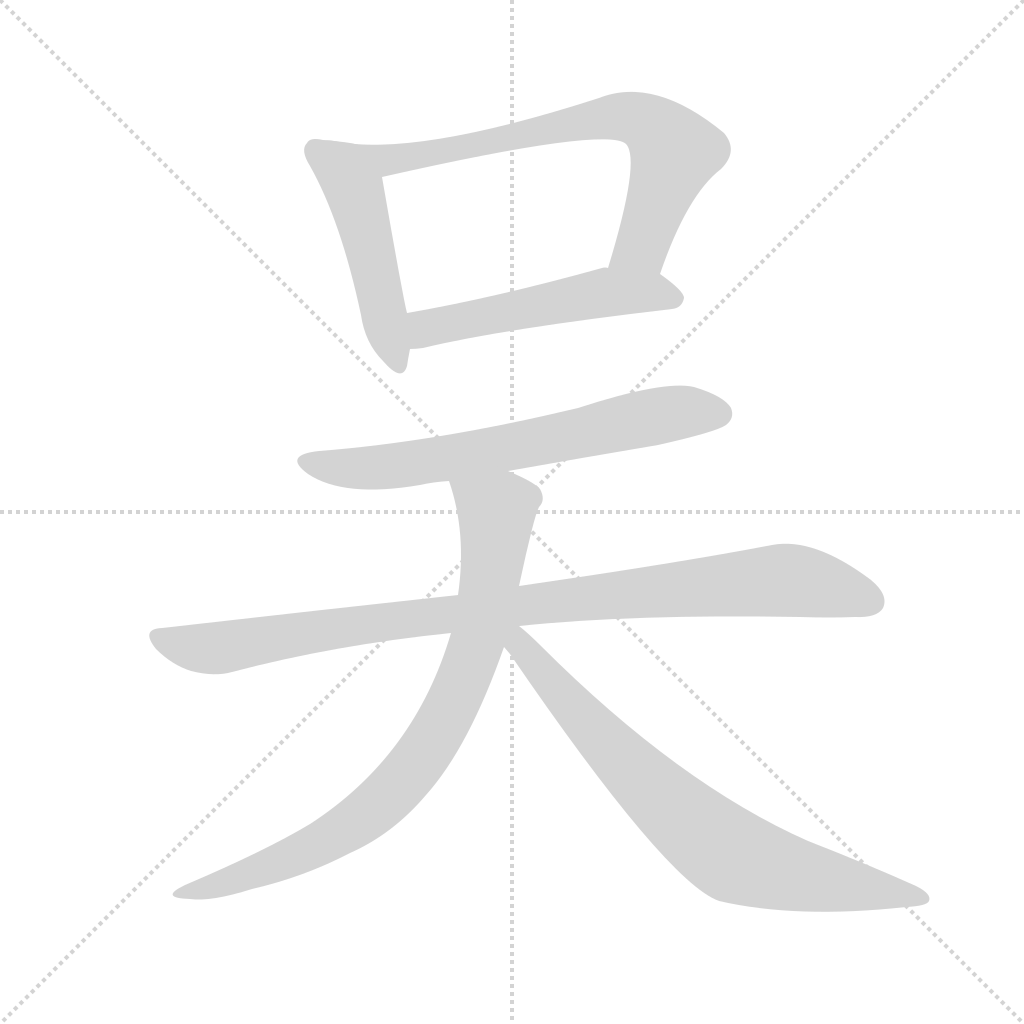
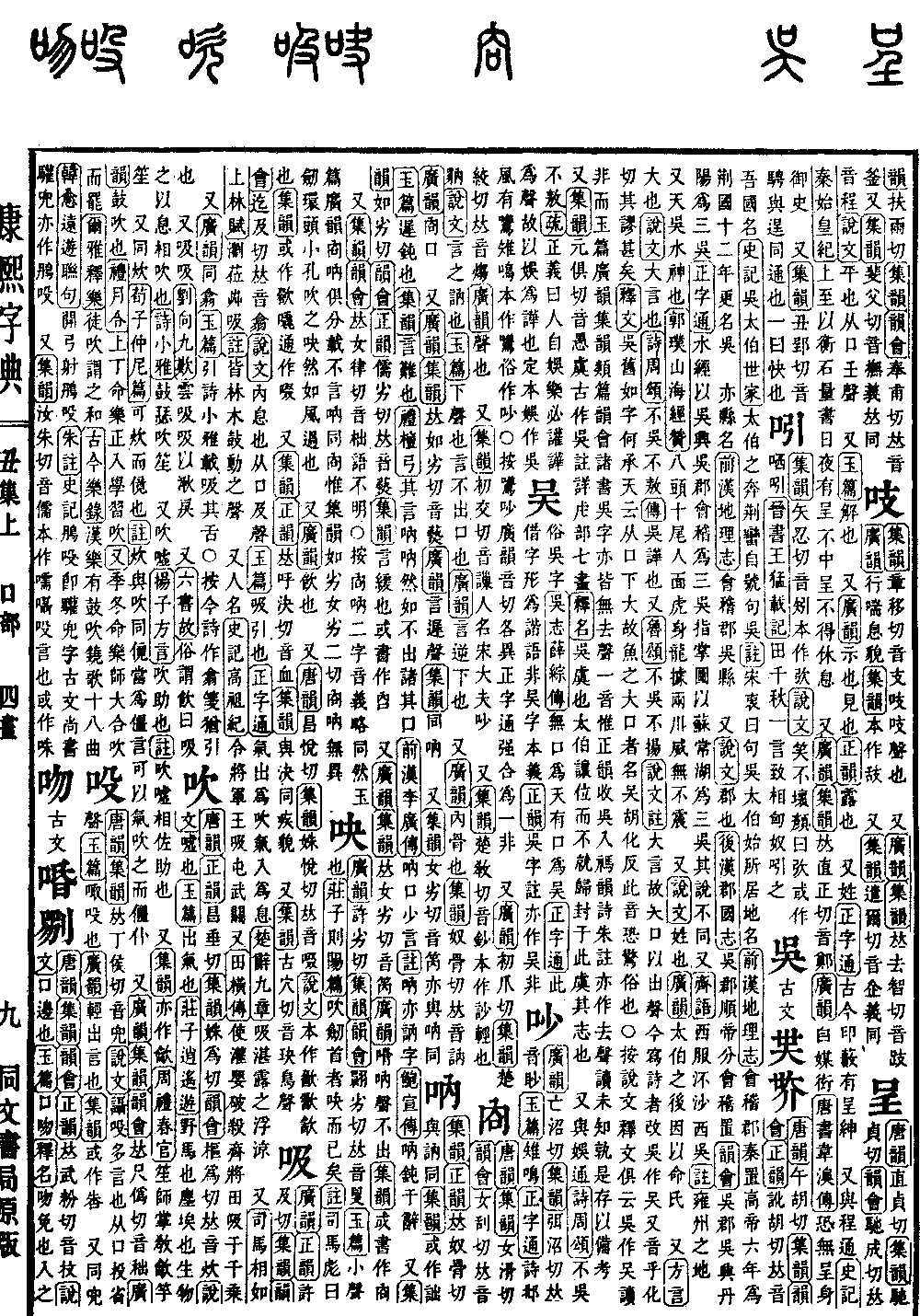
Chou Collection, Upper Volume. Radical: Mouth (kǒu). Kangxi stroke count: 7. Page 179, Entry 07.
This is a common variant form of the character for Wu. Records of the Three Kingdoms (Wu Zhi), Biography of Xue Zong, states: "Without a mouth is 'heaven', with a mouth is 'Wu'." Proper Character Guide (Zhengzitong) points out that this is a playful remark based on the shape of the character and is not the original meaning of Wu. Correct Rhymes (Zhengyun) claims the annotation for Wu is also written as Wu, which is incorrect.
The ancient form of writing for Wu: Tang Rhymes (Tangyun) states the pronunciation is wu. Collected Rhymes (Jiyun), Rhyme Compendium (Yunhui), and Correct Rhymes (Zhengyun) state the pronunciation is wu. The reading is the same as wu.
Meanings:
1. Name of a state. Records of the Grand Historian (Shiji), Hereditary House of Tai Bo, records: Tai Bo fled to the land of the Jingman tribes and called himself Gouwu. Annotation by Song Zhong: Gouwu is the name of the place where Tai Bo first resided. Book of the Former Han (Qianhan), Treatise on Geography, records: Kuaiji Commandery was established during the Qin dynasty; in the sixth year of Emperor Gaozu of Han, it was changed to the Kingdom of Jing, and in the twelfth year, it was renamed Wu.
2. Name of a county. Book of the Former Han (Qianhan), Treatise on Geography, records: Under Kuaiji Commandery, there is Wu County.
3. Discussion of Writing (Shuowen Jiezi) identifies it as a commandery name. Book of the Later Han (Houhan), Treatise on Commanderies and Kingdoms, records: Wu Commandery was established during the reign of Emperor Shun of Han by dividing Kuaiji Commandery. Rhyme Compendium (Yunhui) states that Wu Commandery, Wuxing, and Danyang are collectively known as the Three Wu. Proper Character Guide (Zhengzitong) states that the Commentary on the Water Classic (Shuijing Zhu) identifies Wuxing, Wu Commandery, and Kuaiji as the Three Wu. The Illustrated Handbook (Zhizhang Tu) identifies Suzhou, Changzhou, and Huzhou as the Three Wu; opinions differ.
4. Discourses of the States (Qiyu) mentions the Western and Southern Wu in Western attire. Annotation: Refers to the land of Yongzhou.
5. Tianwu is the name of a water god. Guo Pu’s Praise for the Classic of Mountains and Seas (Shanhaijing Zan) describes it: eight heads and ten tails, a human face and tiger body. It dwells in two rivers, and its majesty is formidable.
6. Discussion of Writing (Shuowen Jiezi) identifies it as a surname. Extensive Rhymes (Guangyun) states that it comes from the descendants of Tai Bo, who then used the state name as their surname.
7. Dialects (Fangyan) defines it as large. Discussion of Writing (Shuowen Jiezi) defines it as speaking in a loud voice. Book of Odes (Shijing), Odes of Zhou, contains the phrase not loud and not arrogant. Commentary: Wu means noisy. Odes of Lu contains the phrase not loud and not flamboyant. Notes on the Discussion of Writing (Shuowen Zhu) states: Because it refers to speaking in a loud voice, the shape of the character resembles a person with their head tilted and mouth wide open making a sound. Current transcribers of the Book of Odes (Shijing) have changed Wu to a variant form, pronouncing it as hua (departing tone), which is a serious error. The Stone Classics (Shimen) states: The character Wu should be read according to its original pronunciation. He Cheng tian stated: The character is formed by adding large under the mouth, so a fish with a large mouth is called by this variant form, pronounced hua (departing tone), but this pronunciation may cause public confusion. Note: Both the Discussion of Writing (Shuowen Jiezi) and the Stone Classics (Shimen) claim that writing Wu as this variant form is incorrect. Furthermore, in books such as the Jade Chapter (Yupian), Extensive Rhymes (Guangyun), Collected Rhymes (Jiyun), Classified Characters (Leipian), and Rhyme Compendium (Yunhui), the character Wu does not have a departing tone. Only Correct Rhymes (Zhengyun) classifies Wu under the ma rhyme (a departing tone), and Zhu Xi’s Collected Commentaries on the Book of Odes (Shi Jizhuan) also uses the departing tone. It is unclear which is correct; this is recorded here for future reference.
8. Collected Rhymes (Jiyun) also provides the pronunciation yu. The ancient form of Yu is written as Wu. See the detailed annotation under the Tiger (hu) radical, seven strokes. Explaining Names (Shiming) explains: Wu is Yu. Tai Bo relinquished the throne and did not accept it, returning here to be enfeoffed, in order to make his heart happy (Yu and yu are synonymous).
9. It is also interchangeable with the character for amuse/entertain. Book of Odes (Shijing), Odes of Zhou: Not noisy and not arrogant. The Sub-commentary (Shu) states: When a person entertains themselves, they must make a loud noise. Therefore, the character for amuse is used to explain noise. In the established version of the Book of Odes (Shijing), the character for amuse is written as Wu.