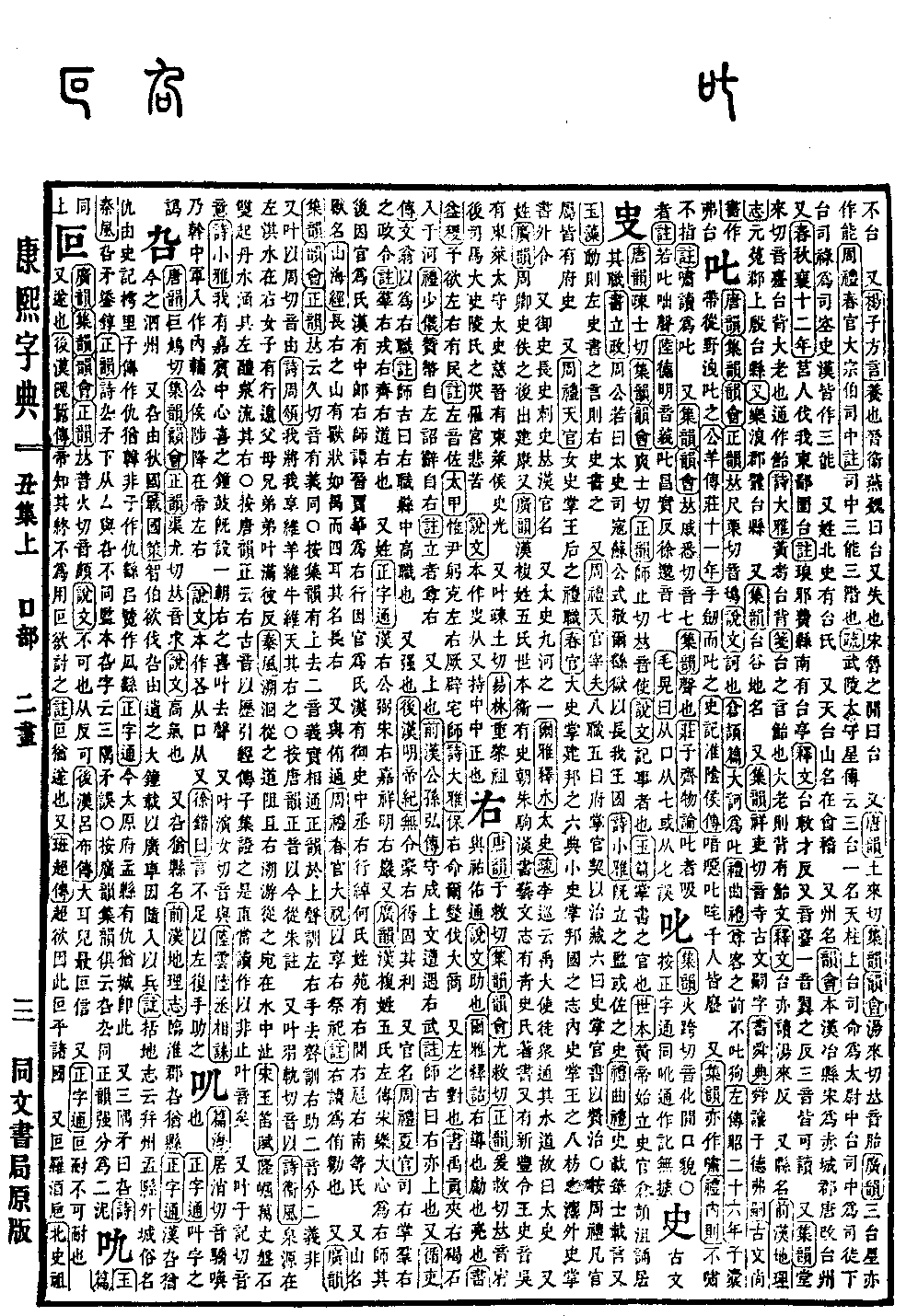
Chou Collection, Upper Volume
Radical: Mouth (kǒu)
Kangxi stroke count: 5
Page 173, Entry 07
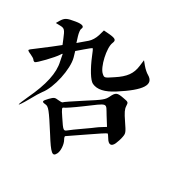
Pronounced qiu (rising tone).
According to the Explanation of Graphs and Analysis of Characters (Shuowen Jiezi), it refers to an elevated spirit.
Also, Qiuyou, the name of a county. According to the History of the Former Han (Qian Hanshu) Geographical Treatise, there was a Qiuyou County in Linhuai Commandery. According to the Correct Meaning of Characters (Zhengzitong), the Han dynasty Qiuyou is the present-day Sizhou.
Also, Qiuyou, an ancient Di tribal state. According to the Strategies of the Warring States (Zhanguoce), Zhi Bo wished to attack Qiuyou, so he sent them a large bell, transporting it on a wide carriage, and followed it into the state with his troops. The commentary on the Comprehensive Geography (Kuodizhi) states that outside the walls of Meng County in Bingzhou, there is a place commonly known as Qiuyou. In the Biography of Chu Li Zi within the Records of the Grand Historian (Shiji), it is written as Qiuyou. In the Han Feizi, it is written as Qiuyou. In the Master Lu's Spring and Autumn Annals (Lushi Chunqiu), it is written as Yao. The Correct Meaning of Characters (Zhengzitong) states that there is currently a Qiuyou city in Meng County, Taiyuan Prefecture, which refers to this place.
Also, a spear with three corners is called qiu. In the Book of Odes (Shijing), Qin Wind section, it mentions: "A three-cornered spear with white metal ferrules." The Correct Dictionary (Zhengyun) states that in the Book of Odes it is written with the character qiu (composed of a lower component si), which is different from this character. The imperial edition erroneously claims the character qiu refers to a three-cornered spear. Note that the Rhyme Dictionary (Guangyun) and the Collected Rhymes (Jiyun) both state that qiu and qiu are the same. The Correct Dictionary (Zhengyun) stubbornly separates them into two, which is pedantic.
Also, it is the same as the character rou.