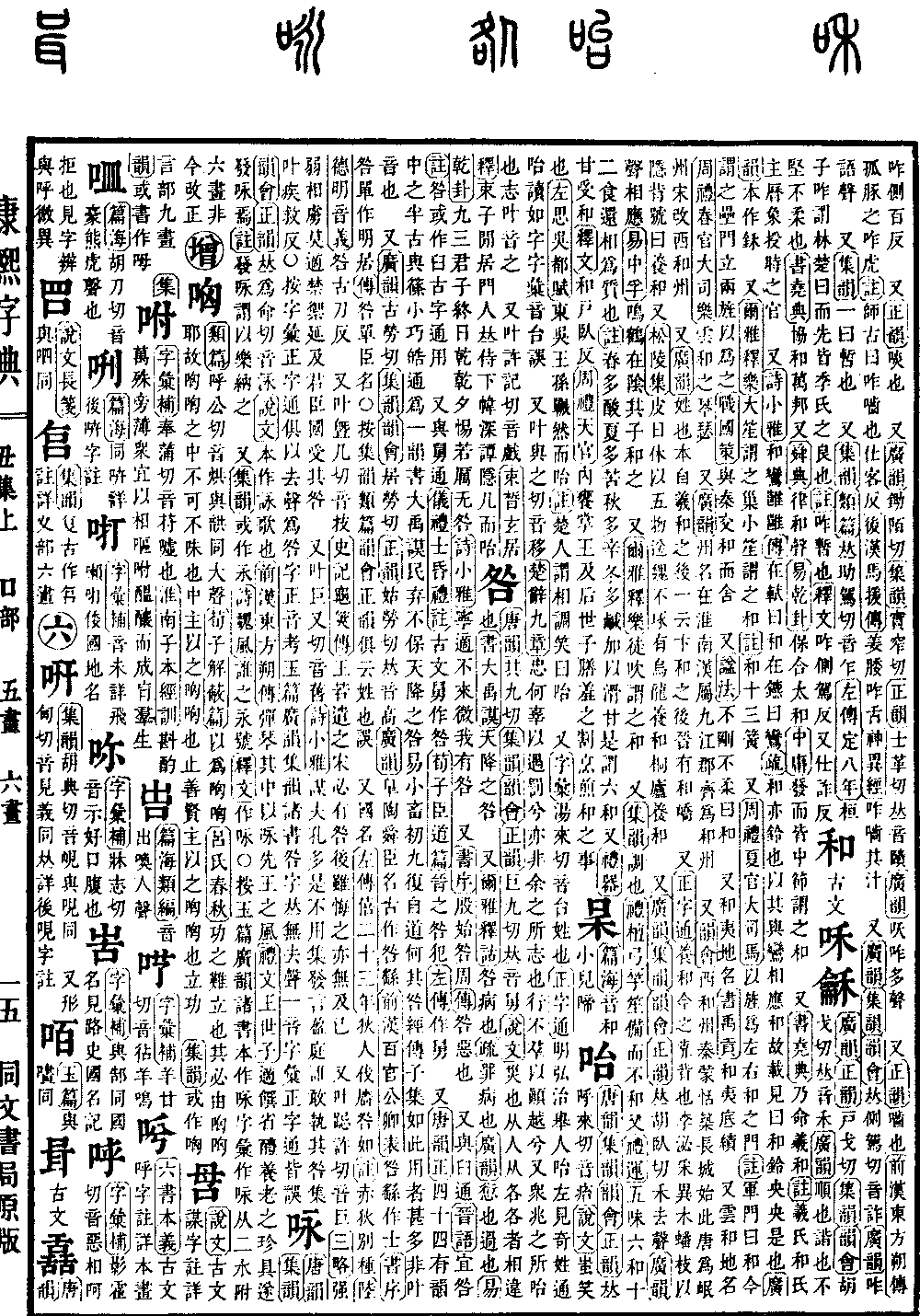
Chou Collection, Upper Volume
Radical: Mouth (kǒu)
Kangxi Strokes: 8
Page 185, Entry 01
Ancient script variants: 咊, 龢
Pronounced he.
Broad Rimes (Guangyun) and Correct Rimes (Zhengyun) state pronunciation is hu plus ge, while Collected Rimes (Jiyun) and Rime Compendium (Yunhui) state hu plus ge; pronounced he.
Broad Rimes (Guangyun): To follow, to harmonize, neither hard nor soft.
Book of Documents (Shujing), Canon of Yao: Harmonize the ten thousand states.
Book of Documents (Shujing), Canon of Shun: Regulate the sounds.
Book of Changes (Yijing), Qian Hexagram: Preserve the great harmony.
Doctrine of the Mean (Zhongyong): To manifest in a way that perfectly accords with the proper measure is called harmony.
Book of Documents (Shujing), Canon of Yao: Then he commanded Xi and He.
Commentary: The Xi clan and the He clan were officials in charge of calendrical calculations and timing.
Book of Odes (Shijing), Lesser Odes (Xiaoya): Harmonious are the sounds of the he and luan bells.
Commentary: When located on the crossbar, they are called he; when on the bit, they are called luan.
Sub-commentary: The he is also a bell; because it responds to the luan, it is described as such, as in the reference to the he bells ringing clearly.
Broad Rimes (Guangyun): Originally written as a character composed of metal and he.
Erya, Explanation of Music: The large sheng (mouth organ) is called chao, the small sheng is called he.
Commentary: The he has thirteen reeds.
Rites of Zhou (Zhouli), Summer Offices, Grand Marshal: Use banners to form the left and right gates of harmony.
Commentary: The military gate is called he; today it is called a defensive gate, where two banners are erected to form it.
Strategies of the Warring States (Zhanguoce): To make peace with the state of Qin and lodge there.
Rules of Posthumous Titles: Neither rigid nor yielding is called harmonious.
He Yi, a place name.
Book of Documents (Shujing), Tribute of Yu: The work on the Yi river in the He region was successfully completed.
Yunhe, a place name.
Rites of Zhou (Zhouli), Spring Offices, Grand Musician: The qin and se zithers of Yunhe.
Broad Rimes (Guangyun): Name of a prefecture, located in Huainan, belonging to Jiujiang Commandery during the Han dynasty, becoming He Prefecture during the Qi dynasty.
Rime Compendium (Yunhui): Western He Prefecture; Qin general Meng Tian began building the Great Wall here. During the Tang dynasty, it was Min Prefecture; during the Song dynasty, it was renamed Western He Prefecture.
Broad Rimes (Guangyun): A surname. Originally descended from Xihe; another account says descended from Bian He; there was He Qiao in the Jin dynasty.
Correct Character Compendium (Zhengzitong): Yanghe, a type of backrest used today. Li Mi gathered curiously shaped tree branches to serve as a backrest, calling it Yanghe.
Songling Collection (Songlingji): Pi Rixiu sent five objects to Wei Buzhuo, including a black dragon backrest and a paulownia wood backrest.
Broad Rimes (Guangyun), Collected Rimes (Jiyun), Rime Compendium (Yunhui), and Correct Rimes (Zhengyun): Pronounced he (departing tone).
Broad Rimes (Guangyun): Sounds responding to each other.
Book of Changes (Yijing), Central Sincerity: The calling crane is in the shade, its young answer it.
Erya, Explanation of Music: Blowing without accompanying instruments is called he.
Collected Rimes (Jiyun): To season or harmonize.
Book of Rites (Liji), Tanguan: The yu and sheng mouth organs are prepared but not in harmony.
Book of Rites (Liji), Liyun: Five flavors, six harmonies, and twelve foods all serve as the substance of one another.
Commentary: In spring, there is more sour; in summer, more bitter; in autumn, more pungent; in winter, more salty; when combined with slippery and sweet, these are called the six harmonies.
Book of Rites (Liji), Liqi: Pleasantly receive the harmony.
Explanation of Texts (Shiewen): Pronounced he.
Rites of Zhou (Zhouli), Heavenly Offices: The inner kitchen manages the cutting, cooking, frying, and seasoning of the meals for the king, the queen, and the crown prince.