Chou Collection, Upper Volume
Radical: Mouth (kǒu)
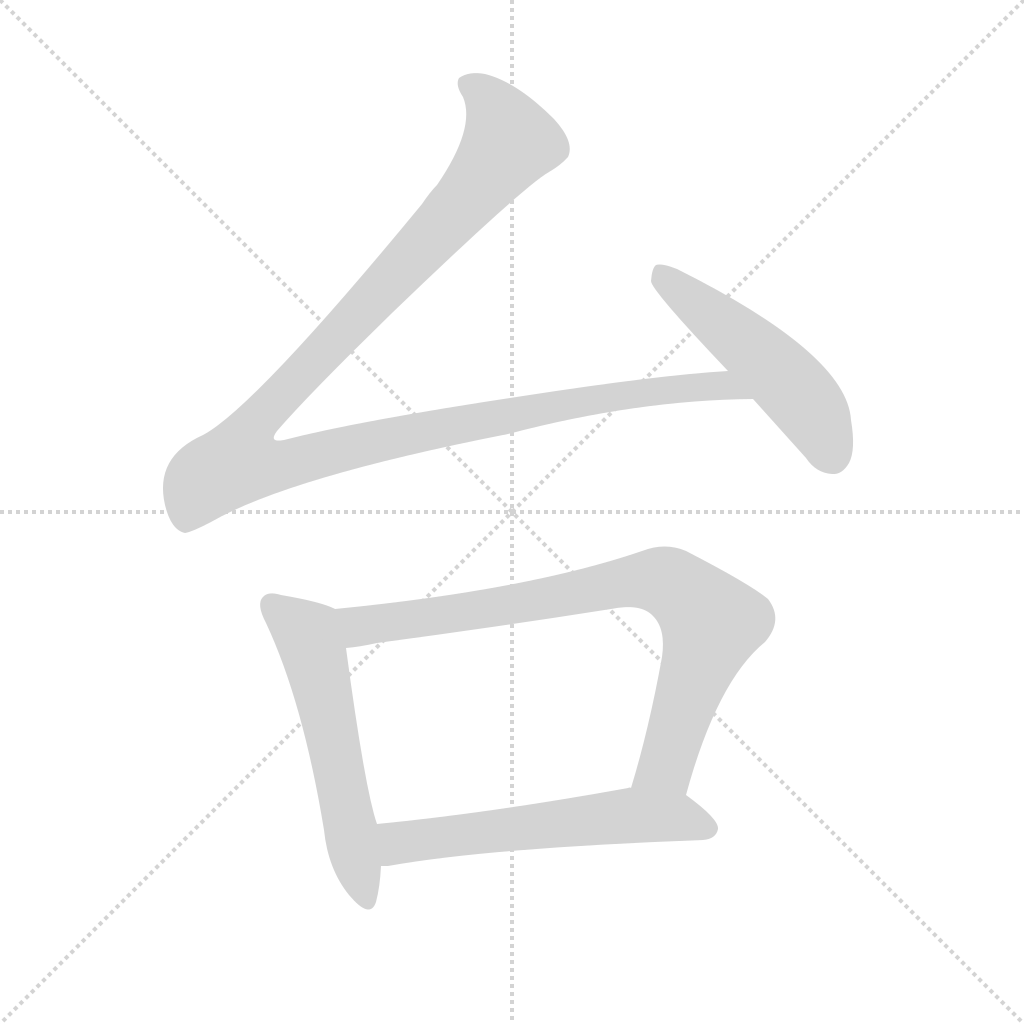
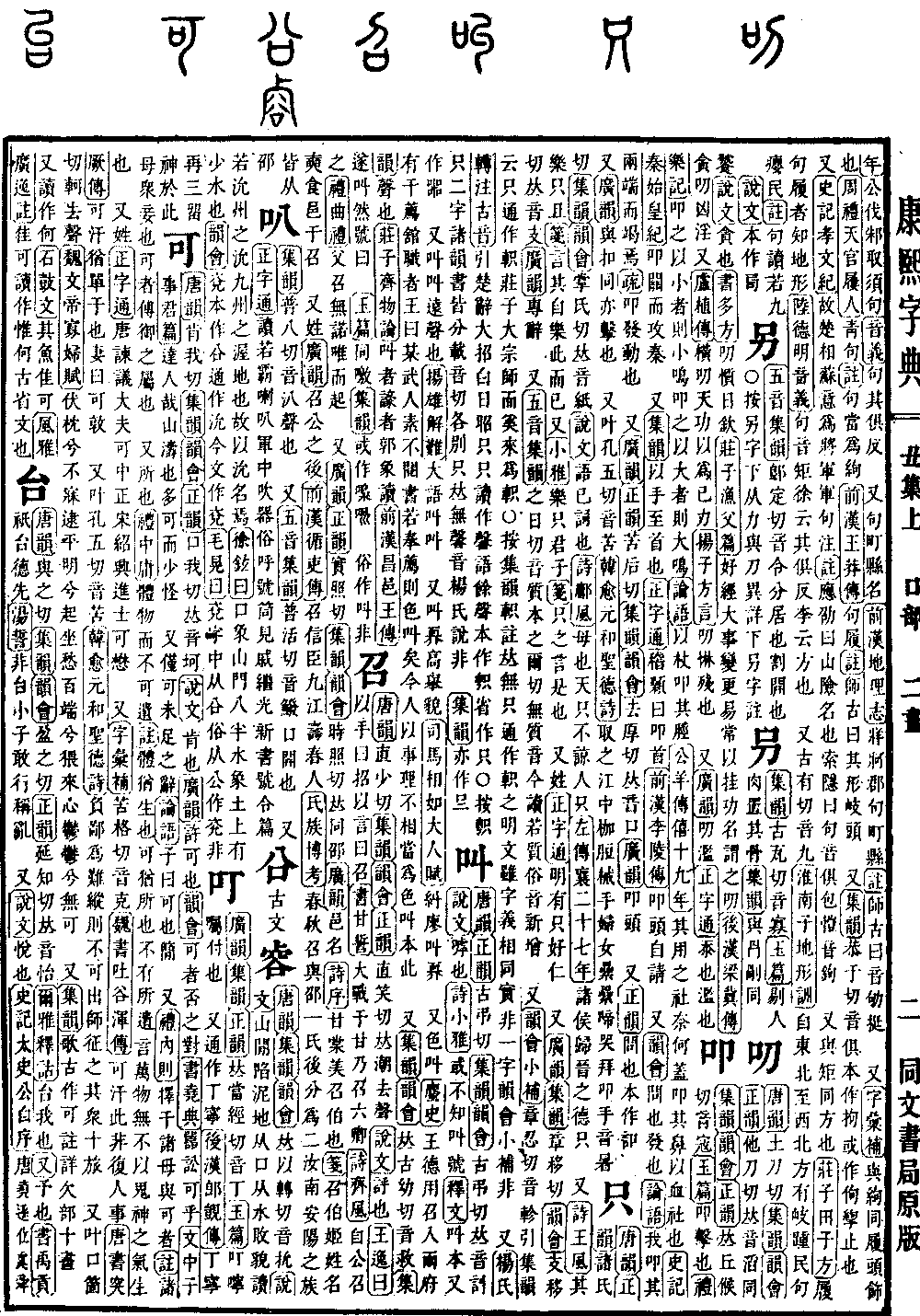
Tai; Kangxi strokes: 5; Page 172, Entry 13
Pronounced yi.
In Approaching the Standard (Erya), it means "I."
Also means "I" (yǔ).
In Book of Documents (Shujing): "Respect my virtues first."
In Oaths of Tang (Tangshi): "It is not I, the young one, who dares to initiate rebellion."
Also means joy.
In Records of the Grand Historian (Shiji), Author's Preface: "Tang Yao abdicated, and Yu Shun was not joyful."
In Yangzi's Regional Dialects (Fangyan), it means to nurture; in the regions of Jin, Wei, Yan, and Wei, it is called "tai."
Also means to lose; in the regions between Song and Lu, it is called "tai."
Pronounced tai.
In Universal Rhymes (Guangyun), it refers to the Three Tai stars. Also written as the character "neng."
In Rites of Zhou (Zhouli), Spring Offices, Notes on the Minister of Personnel: The Minister of Personnel oversees the Three Neng, which are the Three Stairs.
Commentary: The Star Transmission of Wuling Prefect says: The Three Tai are also called Heaven's Pillars. The Upper Tai, Controller of Fate, is the Minister of War; the Middle Tai, Controller of the Center, is the Minister of Works; the Lower Tai, Controller of Rank, is the Minister of Works. Official histories and the Book of Han (Hanshu) write it as "Three Neng."
Also a surname. The History of the Northern Dynasties (Beishi) mentions a person with the surname Tai.
Also refers to Tiantai, a mountain name in Kuaiji.
Also a prefecture name.
In Comprehensive Rhymes (Yunhui): Originally Ye County of the Han dynasty, it was Chicheng Commandery in the Song, and changed to Taizhou in the Tang.
In Spring and Autumn Annals (Chunqiu), 12th year of Duke Xiang: The people of Ju attacked our eastern border and surrounded the Tai region.
Note: There is a Tai Pavilion south of Fei County in Langye.
Commentary: Tai is pronounced as in the reverse of chi cai; it is also read as tai, and another reading is the reverse of yi zhi; all three are acceptable.
Also pronounced tai. Tai-bei refers to the elderly; interchangeable with the character for "pacific mackerel" (tái).
In Book of Odes (Shijing), Greater Odes: "The elderly with yellow hair and mackerel-patterned backs."
Note: "Tai" means mackerel; when people grow old, their backs develop spots like those of a mackerel.
Commentary: "Tai" can also be pronounced as the reverse of tang lai.
Also a county name.
In Book of Han, Treatise on Geography: Xuan-tu Commandery had Shangyintai County.
Also: Le-lang Commandery had Cantai County.
Also: Taigu is a place name.
Also pronounced si. An ancient form of the character for "heir" (sì).
In Book of Documents (Shujing), Canon of Shun: Shun abdicated to the virtuous and would not succeed to the throne.
Modern Text Book of Documents writes it as "bu tai."
Note: The original text was changed from "ancient form of heir" to "heir was anciently written as tai." "Modern Text Book of Documents" was changed from "ancient" to "modern" and "fu" to "bu."
Ancient form of the character "terrace" (tái).
Pronounced tai.
In Analytical Dictionary of Characters (Shuowen): Refers to a high structure built for observation in all directions.
In Explanations of Names (Shiming): Tai means to hold; built firmly and high with earth, it maintains its own stability.
In Approaching the Standard (Erya), Explanations of Palaces: A raised earthen platform is called a tai.
Note: Refers to earth piled into a square shape.
In Book of Rites (Liji), Monthly Ordinances: In the month of mid-summer, one may reside in terraces and pavilions.
Commentary: Made by piling earth to facilitate climbing high to look into the distance.
In Essentials of the Five Classics: The Son of Heaven has three terraces: the Spirit Terrace for observing astronomy, the Time Terrace for observing the changes of the four seasons, and the Park Terrace for observing birds and beasts.
Also, in Collected Records of Ancient and Modern Times (Gujin Zhu): City gates are all built of earth. Piled earth is called tai, hence it is also called a gate-terrace.
Also an official title.
In Comprehensive Pronunciation (Zhengzitong): The "Three Tai" in the Biography of Yuan Shao denotes: in the Han dynasty, the Secretariat was the Central Terrace, the Censorate was the Constitutional Terrace, and the Attendants were the Outer Terrace.
Also, in Notes on the Tables of Han Officials: The Rites and Music officials understood etiquette and demeanor, so the Ministry of Rites was called the Demeanor Terrace.
Also: Wang Yanwei authored the thirty-volume New Rites of the Curved Terrace; thus the Court of Imperial Sacrifices is called the Curved Terrace.
Also: The Han dynasty Secretary Supervisor was called the Art Terrace; the Tang dynasty changed the Secretariat to the Unicorn Terrace; the Tang Records of Officials calls the Chancellery the Luan Terrace; the Song dynasty Silver Terrace Office managed the receipt of memorials from the empire.
Also, in Guangya Dictionary: Tai means to support.
Also a term of address for those of low status.
In Zuo Commentary (Zuozhuan), 7th year of Duke Zhao: "I, a humble servant (tai)."
Note: Refers to those like stable-men and carriage-men, the lowest among the servile laborers.
In Mencius: "Perhaps from then on, that low official responsible for errands had no one to bring him food."
Note: Tai refers to a lowly official in charge of executing orders.
Also, in Records of Idle Time (Chuigenglu): A servant serving under another servant is called a double-tai.
In Su Shi's Plum Blossom Poem: "Heaven treats the peach and plum as low laborers."
Also, in Guangya: Tai means peer.
Also, in Yangzi's Regional Dialects: Tai means to rival or be equivalent. Between Eastern Qi and the sea/mountains, it is called "tai," and west of the passes in Qin and Jin, things of equal capacity are called "tai-di" (tai-rivals).
In Zhuangzi, Gengsangchu: "Cannot let it enter the Spirit Terrace."
Note: The Spirit Terrace is the heart.
Also a surname. The Han dynasty had Attendant Tai Tong.
Also Dantai, a double-character surname.
In Additions to the Dictionary (Zihui Bu): Anciently, burial mounds were called tai, such as the Three Tai of Ye Capital, or the Emperor Yao Terrace and Emperor Ku Terrace in the Classic of Mountains and Seas (Shanhaijing).
Also, haitai is the sound of snoring.
In A New Account of Tales of the World (Shishuo Xinyu): Xu Zao was noisy in the Prime Minister's tent, snoring loudly.
In Extensive Reflections (Tongya): Haitai was a term commonly used in the Jin dynasty.
Also a mountain name.
In Gazetteer: Wutai Mountain in Yanmen Commandery.
In Classic of Mountains and Seas (Shanhaijing): Lutai Mountain.
Note: Now called Lutai Mountain.
In Huainanzi: The Ji River originates at Wangwu Mountain; the Shi, Si, and Yi rivers originate at Taitai-shu Mountain.
Note: Shi, Si, and Yi are river names. Taitai-shu is a mountain name.
In Baopuzi: Zhang Gaite and Ou Gaocheng both cultivated themselves in the stone chambers of Yuntai Mountain.
Also a god name.
In Zuo Commentary (Zuozhuan), 1st year of Duke Zhao: A descendant of the Golden Heaven clan named Mei served as Water Official and bore Yunge and Taidai. Taidai is the god of the Fen River.
In Classic of Mountains and Seas (Shanhaijing): On Xiuyu Mountain, there is a stone called the Emperor Tai game piece.
Note: Guo Pu said: Emperor Tai is the name of a divine person.
Also, Jiantai is a constellation name.
Also a palace name.
In Zou Yang, Memorial to the King of Wu: The Qin state relied on the Curved Terrace Palace to control the empire.
In Maps and Records of the Three Prefectures: Weiyang Palace has a Curved Terrace Hall.
Also a grass name.
In Approaching the Standard (Erya): Wormwood is also called ice-tai.
Commentary: Another name for wormwood is ice-tai, which is the mugwort of today.
In Book of Odes (Shijing): "South Mountain has sedge grass (tai)."
Note: Tai is the fu-xu grass.
Commentary: Fu-xu is sedge, which can be used to make rain capes and hats.
Also: "Those city officials wear sedge hats and black cloth caps."
Note: Tai (sedge hat) is used to protect against heat. The hat is used for rain.
Note: Tai is fu-xu. City officials use sedge skin to make hats.
Also, in Dictionary (Zihui): Pronounced hu. Taidai is a place name in the State of Zhu.
In Book of Rites (Liji), Tan Gong: "Defeated at Taidai."
Note: Tai is pronounced hu, dai is pronounced tai. "Tai" should be a scribal error for the character "hu." Some versions write it as "Hudai" or "Hudai."
In Comprehensive Pronunciation (Zhengzitong): "Tai" has the pronunciation "hu," but this does not mean "tai" and "hu" are the same. The Dictionary (Zihui) assumes "tai" is the ancient form of "hu," which is incorrect.
Also, in Additions to the Dictionary (Zihui Bu): The "Taidai" in Zuo Commentary. Checking various commentaries, there is no such pronunciation as "hu." It is unknown on what basis the Dictionary (Zihui) asserts this: it is also an error.
Also, in Rhyme Supplement (Yunbu): Rhymes as ti.
In The Seal of the Unity of the Three (Cantongqi): "Pure as lifting a curtain, close the eyes and ascend the high terrace; the six hundred chapters of the Fire Records—the sought-after principles will not be lost."
Also rhymes as tu.
In Forest of Changes (Yilin): "Canonized books and legal texts, stored on the Orchid Terrace."