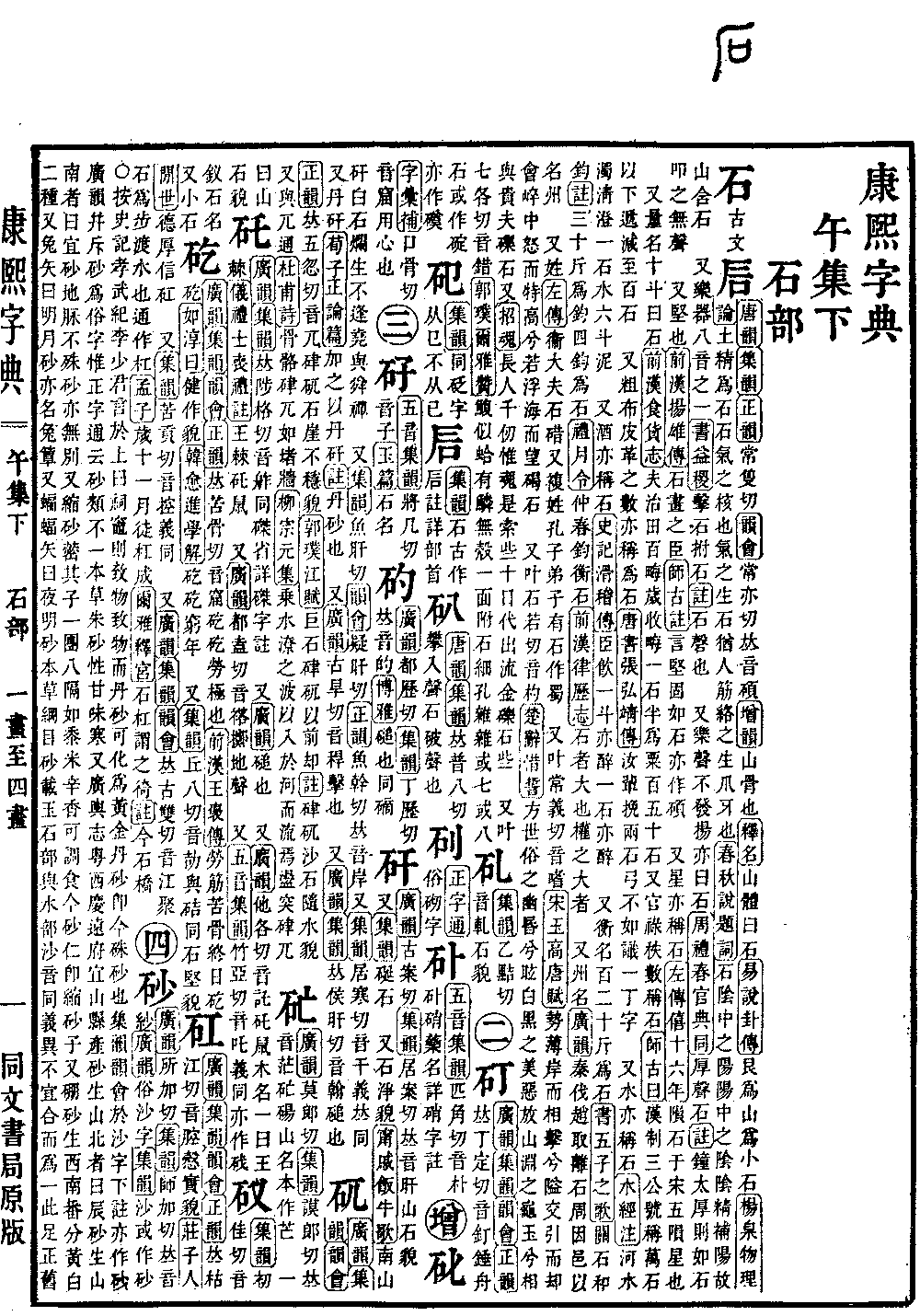
Wu Collection, Lower Volume
Radical: Stone (shí)
Page 827, Entry 01
The ancient texts record its pronunciation. According to the Tang Rhymes (Tangyun), the Collected Rhymes (Jiyun), and the Correct Rhymes (Zhengyun), it is pronounced shi. According to the Rhyme Collection (Yunhui), it is also pronounced shi. The pronunciation is the same as the word for large. The Expanded Rhymes (Zengyun) defines it as the skeletal structure of a mountain. The Explanation of Names (Shiming) states that the substance of a mountain is called stone. The Book of Changes (Yijing), in the Commentary on the Trigrams, states that the Gen trigram represents a mountain and also represents small stones. The Physical Theory by Yang Quan (Yangquan Wuli Lun) states that the essence of earth congeals to form stone, and that stone is the core of the earth's energy. The earth's energy produces stone, just as the tendons and vessels of a person produce fingernails and teeth. The Spring and Autumn Annals' Discourse on the Topics (Chunqiu Shuoticil) states that stone is the yang within the yin and the yin within the yang; the yin essence supplements the yang energy, which is why mountains contain stone.
It also refers to a musical instrument, one of the eight categories of sound. The Book of Documents (Shangshu), in the Beneficial Grain (Yiji) chapter, records, "Striking the stone chimes, gently tapping the stone chimes." The commentary states: Stone here refers to the chimes. Additionally, a sound that is dull and not resonant is also called stone. The Rites of Zhou (Zhouli), in the Office of Spring, Department of Music Officials (Dian tong), mentions, "Heavy and thick sounds are like stone." The commentary says: If a bell is cast too thickly, its sound is like stone, and striking it produces no resonance.
It also denotes firmness. The History of the Former Han (Qian Hanshu), in the Biography of Yang Xiong, mentions "officials of stone-like integrity." The scholar Yan Shigu notes: This means they are as firm as stone. It is also written in a variant form (shuo).
Celestial bodies are also called stones. The Zuo Commentary (Zuozhuan), in the sixteenth year of Duke Xi, records, "Five stones fell in the state of Song," which refers to falling stars.
It is also a unit of capacity. Ten dou equals one stone. The History of the Former Han (Qian Hanshu), in the Treatise on Food and Commodities, states: For every hundred mu of land cultivated, the annual yield is one and a half stone per mu, totaling one hundred and fifty stone of grain.
The salary levels of officials are also called stone. Yan Shigu states: According to the Han dynasty system, the Three Excellencies were designated as ten-thousand-stone officials, with levels decreasing down to one hundred stone.
Quantities of coarse cloth or leather are also called stone. The Book of Tang (Tangshu), in the Biography of Zhang Hongjing, states: You people can pull a bow of two stone of strength, yet you cannot even recognize a single character.
Quantities of water are also called stone. The Commentary on the Water Classic (Shuijing Zhu) states that the Yellow River is turbid; clarifying one stone of water yields six dou of mud.
The quantity of wine is also called stone. The Records of the Grand Historian (Shiji), in the Biographies of the Jesters, states: I get drunk after one dou, and I get drunk after one stone.
It is also a unit of weight. One hundred and twenty jin equals one stone. The Book of Documents (Shangshu), in the Song of the Five Sons, mentions "balancing the stone and the jun." The commentary states: Thirty jin equals one jun, and four jun equals one stone. The Book of Rites (Liji), in the Monthly Ordinances, states that in the second month of spring, one should calibrate the balance and the stone weight. The History of the Former Han (Qian Hanshu), in the Treatise on Harmonics and Calendars, states: Stone signifies greatness, representing the largest of the weights (for a balance scale).
It is also the name of a prefecture. The Extensive Rhymes (Guangyun) records: The state of Qin attacked the state of Zhao and seized Lishi; the Zhou dynasty named the prefecture based on the city name.
It is also a surname. The Zuo Commentary (Zuozhuan) records the Wei official Shi Que.
There is also a compound surname. Among the disciples of Confucius was Shizuo Shu.
It also has the rhyme of the character chang and yi, pronounced like shi. Song Yu's Rhapsody on Gaotang (Gaotang Fu) writes: The water rushes toward the bank and crashes against it; it meets and pulls in the narrow passes before receding. In the swirling currents, the angry waves rise especially high, as if one were drifting on the sea gazing toward Jieshi Mountain.
It also has the rhyme of the characters shi and ruo, pronounced like shuo. The Songs of Chu (Chuci), in the Sorrow for the World (Xishi), writes: Look at how dark the secular world is, confusing black with white and beauty with ugliness. They discard the tortoise shells and precious jade of the deep mountains and ravines, yet they value fragmented stones. The Summoning of the Soul (Zhaohun) writes: The giants stand a thousand ren tall, specifically seeking the souls of men. Ten suns appear in turns, melting metal and burning stone.
It also has the rhyme of the characters qi and ge, pronounced like cuo. Guo Pu's Eulogy to the Erya (Erya Zan) writes: The abalone is like a clam; it has scales but no hard shell. One side adheres to the stone, and it has many tiny holes, some having seven and some having eight.