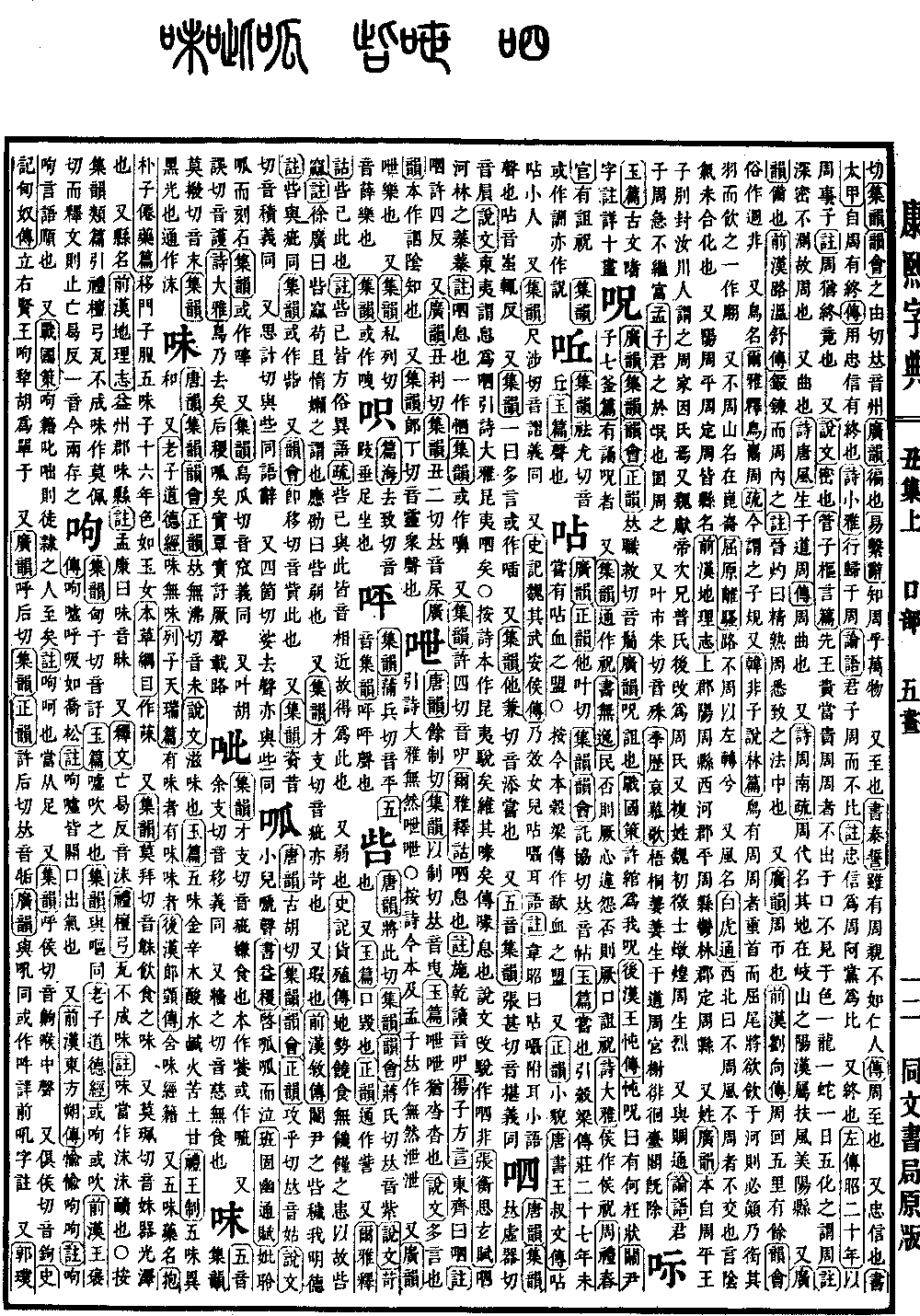
Chou Collection, Upper Volume
Radical: Mouth (kǒu)
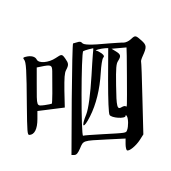
Character: xi
Kangxi stroke count: 8
Page 182, Entry 05
Pronounced xi.
According to the Explanation of Scripts and Picture Rarities (Shuowen Jiezi), people of the eastern tribes refer to breath as xi. It cites the Book of Odes (Shijing), Danya section: Kunyi breathing. Note: In the original Book of Odes, the text reads Kunyi tui yi, wei qi hui yi. The commentary states that hui means to breathe. The Explanation of Scripts and Picture Rarities alters tui to xi, which is incorrect.
In the poem Thinking Rhapsody (Si Fu) by Zhang Heng: Gazing at the dense forests by the river, I sigh. The commentary notes that xi means to breathe. It is also written in a variant form (xi).
The Collected Rhymes (Jiyun) notes it is sometimes written in a variant form (bi).
Also pronounced xi (falling tone).
In the Progressive Approach to the Classics (Erya), Shigu section: xi means to breathe. The commentary notes it is read as the sound of shi qian.
In the Regional Expressions (Fangyan) by Yang Xiong: The eastern Qi region calls it xi. The commentary notes that xi is pronounced as xi (falling tone).
Also pronounced chi.
The Collected Rhymes (Jiyun) notes it is pronounced zhi.
The Extensive Dictionary of Rhymes (Guangyun) notes the original form is zhi, meaning to know in secret.
Also pronounced ling.
The sound of a multitude.