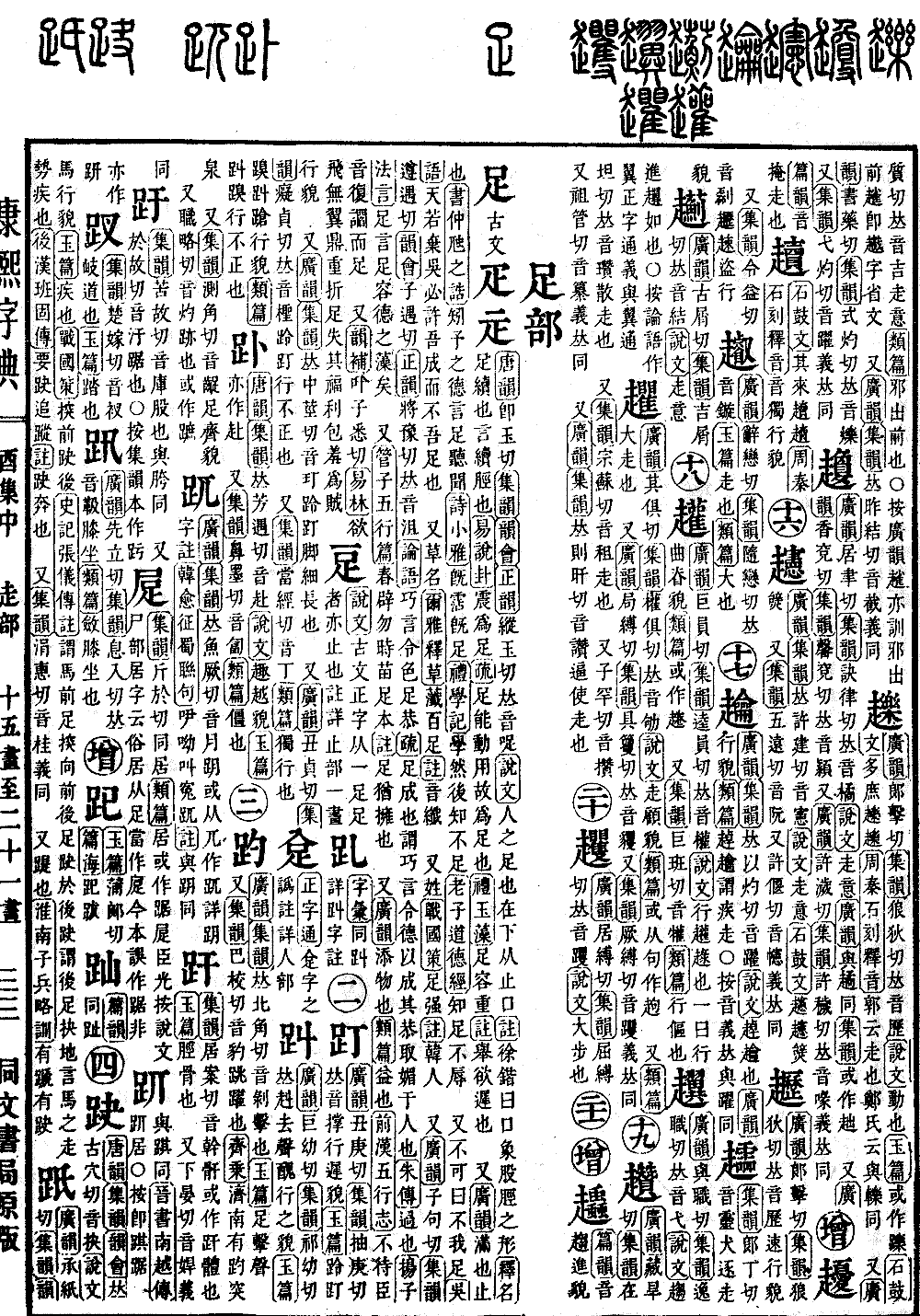
You Collection, Middle Volume
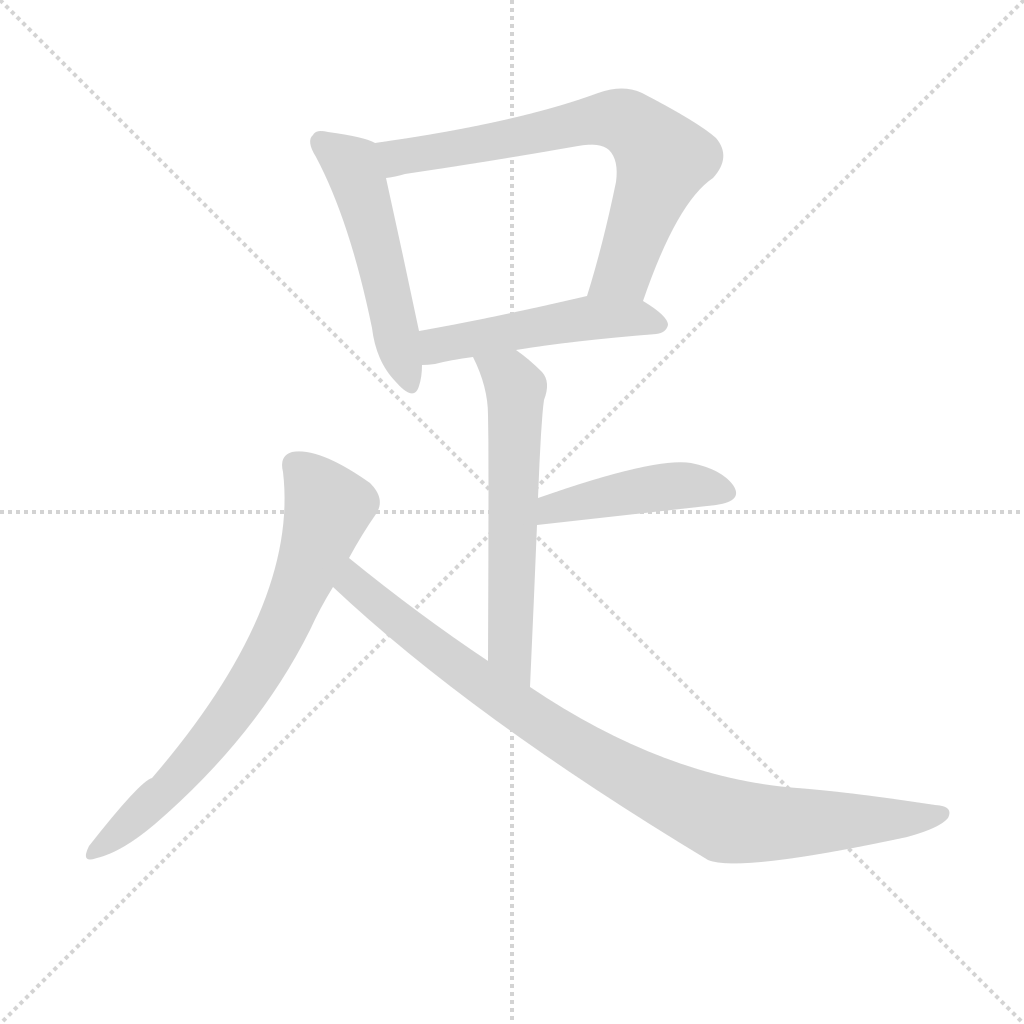
Radical: Foot (zú)
Kangxi Strokes: 7
Page 1221, Entry 17
Written in ancient script as (pǐ).
According to Tang Rhymes (Tangyun), pronounced ji (falling tone). According to Collected Rhymes (Jiyun), Rhyme Meetings (Yunhui), and Orthodox Rhymes (Zhengyun), pronounced zong (falling tone); the pronunciation is the same as (zú).
Shuowen Jiezi explains: The foot of a human. Located in the lower part of the body, the character is composed of stop and mouth. Note: Xu Kai states: The mouth represents the shape of the thigh and calf.
Shiming explains: Foot means continuation, referring to the part connected to the calf.
Book of Changes (Yijing), Explanation of Trigrams: The Zhen trigram symbolizes the foot. Commentary: The foot is able to move and be applied, therefore the foot is used to represent it.
Book of Rites (Liji), Jade Pattern: When walking, one's demeanor should be steady. Note: One should raise one's steps slowly.
Also, according to Guangyun, it means to be full or to stop.
Book of Documents (Shujing), Announcement of Zhong Hui: How much more so for my virtues, which are sufficient for people to hear.
Book of Odes (Shijing), Lesser Odes: Both moistened and sufficient.
Book of Rites (Liji), Record of Learning: Only after learning does one realize one's insufficiency.
Laozi, Classic of the Way and Virtue (Daodejing): He who knows contentment will not invite shame.
It also indicates approval, as in to say to approve of me; to not approve is to say not to approve of me.
Discourses of Wu (Wuyu): If Heaven were to abandon the State of Wu, it would surely agree to our peace negotiations without considering us worthy of attention.
It is also the name of a type of grass.
Erya, Explaining Plants: Qian grass, also called hundred-foot. Note: Pronounced xian.
It is also a surname.
Strategies of the Warring States (Zhan Guo Ce) mentions a person named Zu Qiang. Note: A person from the State of Han.
Also, according to Guangyun, pronounced zi (falling tone). According to Collected Rhymes (Jiyun), pronounced zun (falling tone). According to Rhyme Meetings (Yunhui), pronounced zi (falling tone). According to Orthodox Rhymes (Zhengyun), pronounced jiang (falling tone); the pronunciation is the same as (jǔ).
Analects (Lunyu): Fine words, an ingratiating countenance, and excessive reverence. Commentary: Zu means to complete. It refers to using fine words and hypocritical virtues to achieve reverence in order to ingratiate oneself with others. Zhu Xi's Commentary explains it as excessive.
Yangzi's Model Sayings (Fayan): Excessive speech and excessive outward appearance are decorations of virtue.
Also, in Guanzi, Five Elements Chapter: Do not delay farming in spring, and the seedlings will be able to protect their roots. Note: Zu is the same as yong, meaning to protect.
Also, according to Guangyun, it means to add items. According to Lei Pian, it means to increase.
History of the Former Han (Qianhan Shu), Treatise on the Five Elements: Before I (the minister) could finish speaking, he used flattering words to add to it.
Also, according to Rhyme Supplements (Yunbu), in rhymed verse it is pronounced zi (entering tone).
Forest of Changes (Yilin): Wishing to fly but having no wings, the cauldron is too heavy and breaks its foot. Losing its benefits, one endures shame and suffers disaster.