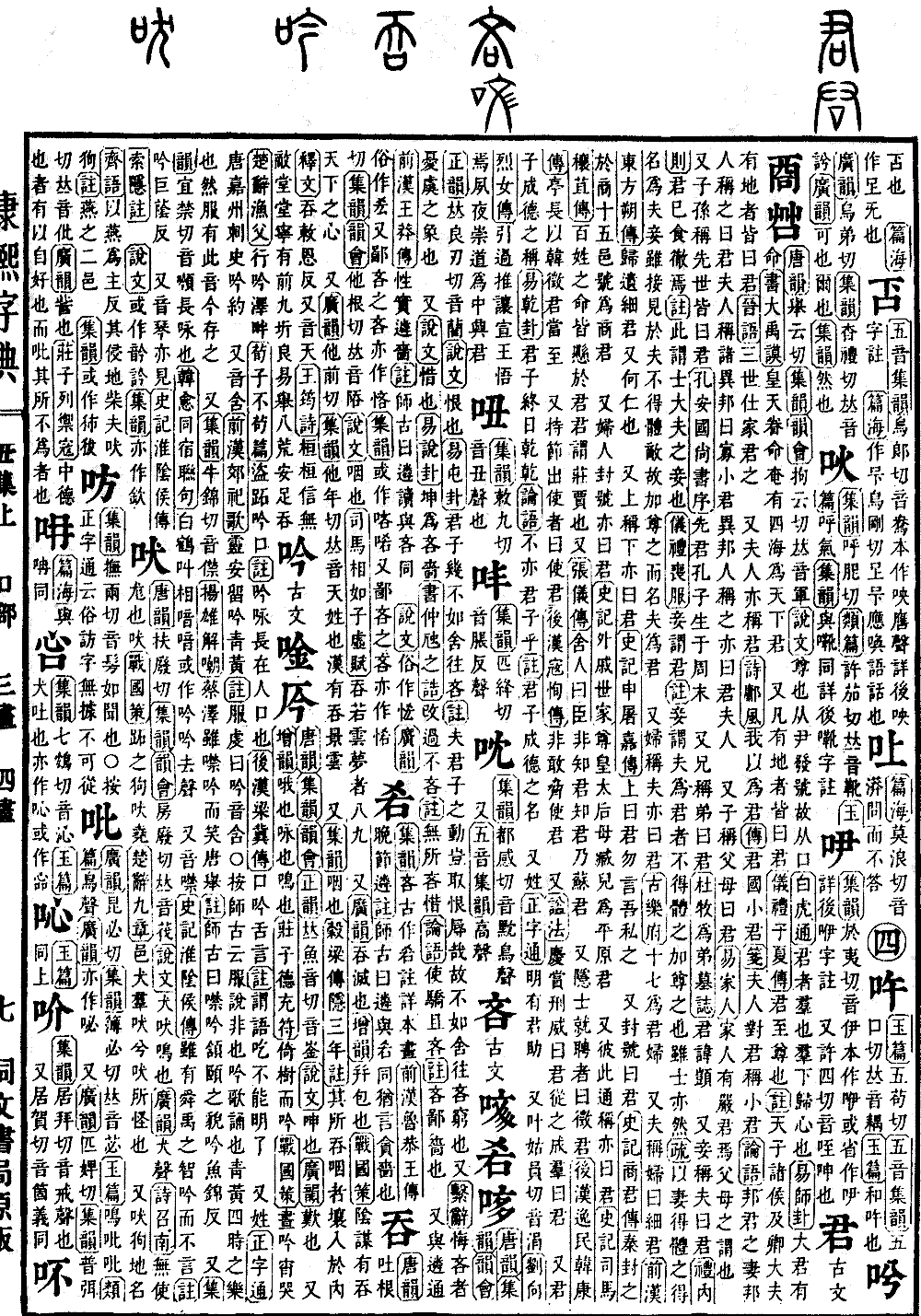
Chou Collection, Upper Volume
Radical: Mouth (kǒu)
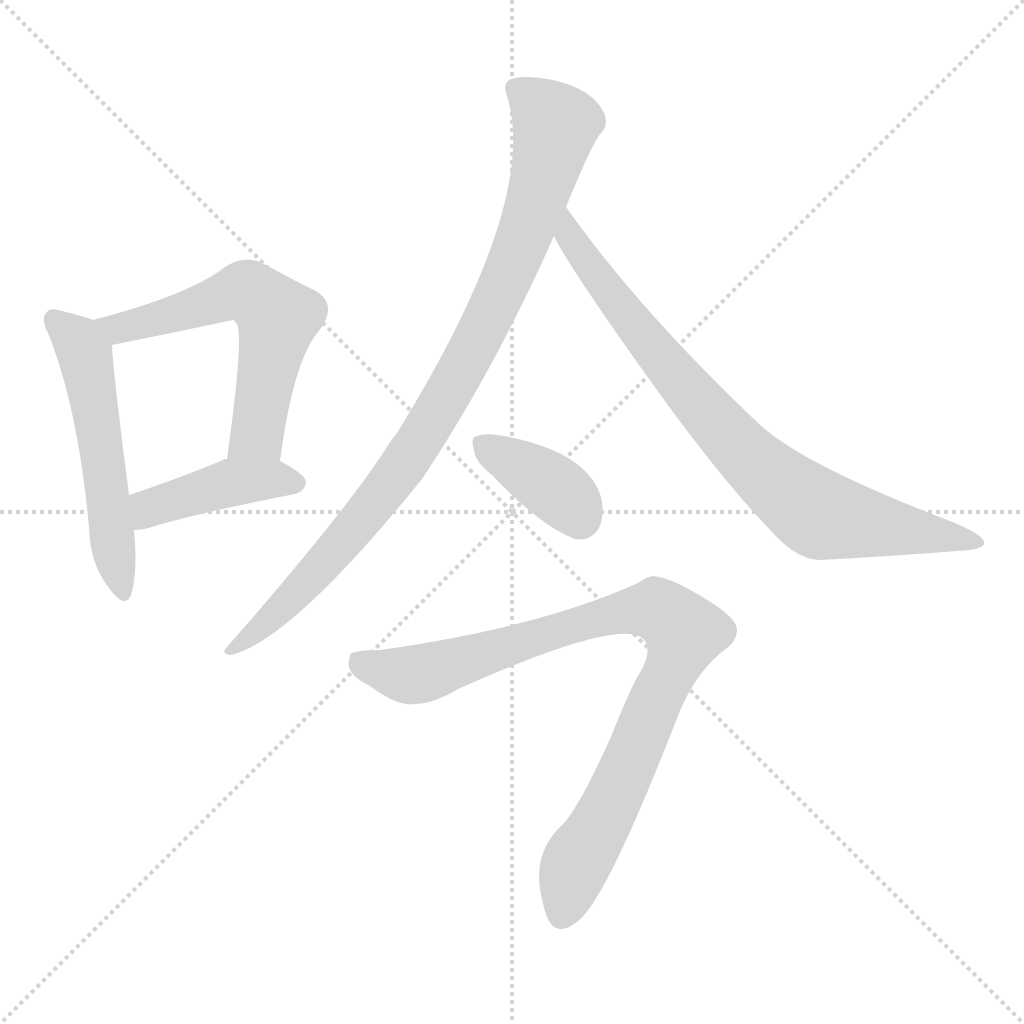
吟; Kangxi stroke count: 7; Page 177, Entry 19
In ancient scripts, written as a variant form (jīn).
According to Tang Rhyme (Tangyun), Collection Rhymes (Jiyun), Rhyme Compilation (Yunhui), and Rectified Rhymes (Zhengyun), pronounced yín. It is homophonous with yín.
Explained in Explaining Graphs and Analyzing Characters (Shuowen Jiezi) as moaning.
Explained in Broad Rhymes (Guangyun) as sighing.
Additionally, defined in Expanded Rhymes (Zengyun) as chanting, singing, or the cry of an animal.
Zhuangzi (Zhuangzi), Virtue’s Recompense (Dechongfu): Reciting while leaning against a tree.
Strategies of the Warring States (Zhanguoce): Sighing during the day and weeping at night.
Songs of Chu (Chuci), The Fisherman (Yufu): Chanting while walking along the lakeside.
Xunzi (Xunzi), On Not Being Indiscriminate (Bugou Pian): The name of Dao Zhi is constantly chanted by people. Note: Interpreted as his deeds being passed down through people’s mouths for a long time.
Book of the Later Han (Houhanshu), Biography of Liang Ji: Mouth and teeth obstructed, speech unclear. Note: Interpreted as stuttering and being unable to express oneself clearly.
Also a surname. Rectified Meaning (Zhengzitong) records that in the Tang Dynasty, there was a Governor of Jiazhou named Yin Yue.
Also pronounced hán. Former Book of Han (Qianhanshu), Songs of Suburban Sacrifices (Jiaosige): The divine spirits stay peacefully, chanting the music of the four seasons. Note: Fu Qian says: Yin is pronounced as hán. Yan Shigu states: Fu Qian’s explanation is incorrect. Yin means singing or reciting; qinghuang refers to the music of the four seasons. However, since Fu Qian provides this pronunciation, it is retained here.
Also, according to Collection Rhymes (Jiyun), pronounced jìn. Homophonous with jìn. Yang Xiong’s Explanation of Ridicule (Jiechao): Although Cai Ze kept his jaw tight and remained silent, he mocked Tang Ju. Note: Yan Shigu says: jìn yín is the appearance of a tight jaw. Yin is pronounced yín.
Also, according to Collection Rhymes (Jiyun), pronounced yì. Meaning a long, chanting sound. Han Yu’s Co-lodging Stanzas (Tongsulianju): White cranes calling and answering one another. Yin is sometimes written as yín, pronounced in the departing tone.
Also pronounced jìn. Records of the Grand Historian (Shiji), Biography of the Marquis of Huaiyin: Even with the wisdom of Shun or Yu, keeping one’s mouth shut and not speaking. Note: Yin is pronounced jìn.
Also pronounced qín. Also appears in the Records of the Grand Historian (Shiji), Commentary on the Biography of the Marquis of Huaiyin (Suoyinzhu).
In Explaining Graphs and Analyzing Characters (Shuowen Jiezi), it is sometimes written as a variant form (qín). In Collection Rhymes (Jiyun), it is also written as a variant form (qīn).