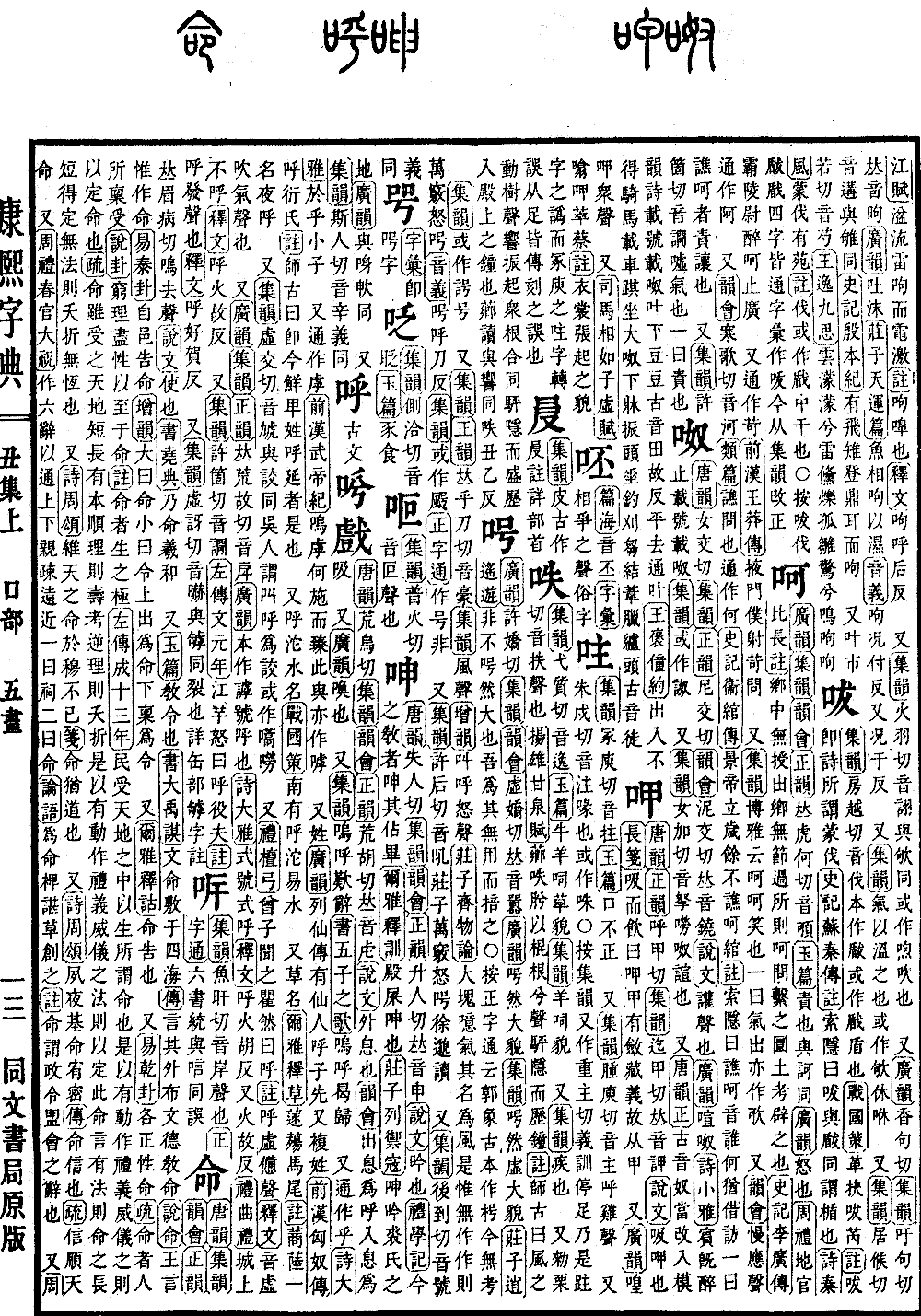
Chou Collection, Upper Volume
Radical: Mouth (kǒu)
Character: hū
Kangxi strokes: 8
Page 183, Entry 14
Ancient character for theater.
Tang Dynasty Rhymes (Tangyun): Pronounced hū.
Collected Rhymes (Jiyun), Rhyme Meetings (Yunhui), and Orthodox Rhymes (Zhengyun): Pronounced hū.
Explanation of Graphs (Shuowen): To exhale.
Rhyme Meetings (Yunhui): Exhaling air is called hū; inhaling air is called xī.
Also, from Broad Rhymes (Guangyun): To call out.
Also, from Collected Rhymes (Jiyun): Wu-hū, an exclamation.
Book of Documents (Shangshu), Song of the Five Sons: Alas, where shall we go?
Also commonly written as hū.
Book of Odes (Shijing), Greater Odes (Daya): Alas, young man.
Also commonly written as hū.
History of the Former Han (Qianhan), Annals of Emperor Wu: Alas, what should be done to reach this point?
Also written as hū.
Also a surname.
Broad Rhymes (Guangyun): Biographies of Immortals (Liexian Zhuan) mentions the immortal Hū Zixiān.
Also a double-surname.
History of the Former Han (Qianhan), Record of the Xiongnu: The Hūyǎn clan.
Commentary: Shigu states this is the modern surname Hūyán.
Also Hutuo, a river name.
Strategies of the Warring States (Zhanguoce): To the south are the Hutuo and Yi Rivers.
Also a plant name.
Erya, Explanation of Grasses: Zhúyàng is also known as mǎwěi.
Commentary: Shāng is also known as yèhū.
Also, from Collected Rhymes (Jiyun): Pronounced xiāo. Identical to the character xiào. People of the Wu region use xiào to mean to shout or call.
Also written as hāo-lāo.
Also, Book of Rites (Liji), Tan Gong: Zengzi heard this and, startled, said hū.
Commentary: Hū, a sound of weariness.
Explanation of Texts (Shiwen): Pronounced xū, the sound of exhaling air.
Also, from Broad Rhymes (Guangyun), Collected Rhymes (Jiyun), and Orthodox Rhymes (Zhengyun): Pronounced hù.
Broad Rhymes (Guangyun): Originally written as hū. To cry out.
Book of Odes (Shijing), Greater Odes (Daya): To call and to shout.
Explanation of Texts (Shiwen): Hū is pronounced hù.
Book of Rites (Liji), Qu Li: Do not shout on the city walls.
Explanation of Texts (Shiwen): Hū is pronounced hù.
Also, from Collected Rhymes (Jiyun): Pronounced hè.
Zuo Commentary (Zuozhuan), First Year of Duke Wen: Jiang Qian said angrily: Hū! You servant.
Commentary: Hū, an exclamation.
Explanation of Texts (Shiwen): Hū is pronounced hè.
Also, from Collected Rhymes (Jiyun): Pronounced xià. Identical to the character xià. To crack. Refer to the note on the character xià in the Pottery (fǒu) radical.
Textual verification: Erya, Explanation of Grasses, Zhúyàng is mǎwěi. Commentary: Shāng is also known as yèhū. The original text has been corrected to refer to the sub-commentary.