Chou Collection, Upper Volume
Radical: Mouth (kǒu)
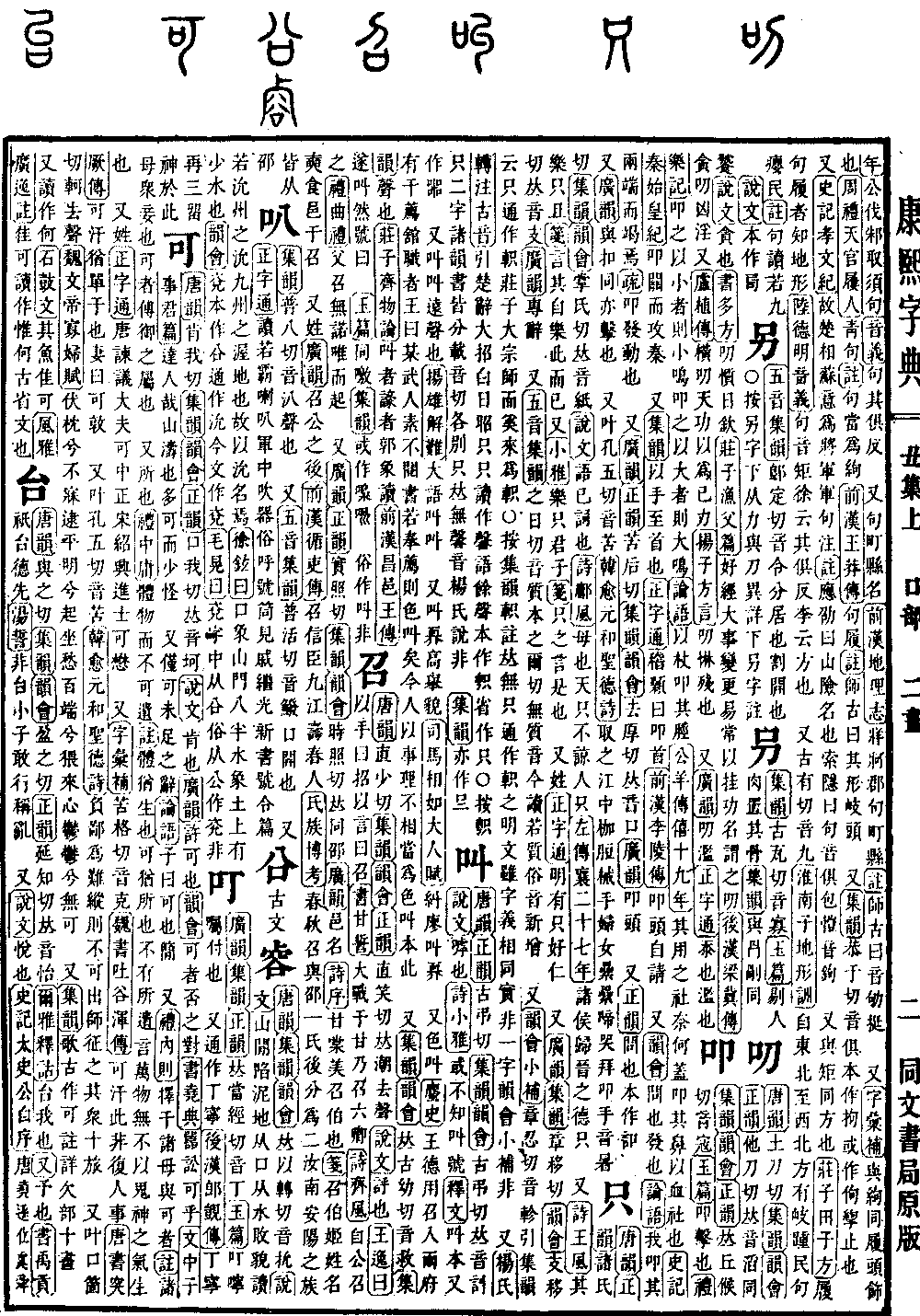
Only
Kangxi strokes: 5
Page 172, Entry 05
Pronounced zhi (rising tone).
Shuowen Jiezi (Explanation of Simple and Compound Characters): A grammatical particle indicating the end of a sentence.
Book of Odes (Shijing), Odes of Yong: My mother is Heaven, she does not understand me.
Zuo Tradition (Zuo Zhuan), Twenty-Seventh Year of Duke Xiang: The feudal lords returned to the virtue of Jin.
Also, Book of Odes (Shijing), Odes of Wang: Enjoy it only.
Commentary: It means that he only enjoys this.
Also, Book of Odes (Shijing), Minor Odes of Kingdom: Happy is the gentleman.
Commentary: The word zhi here means this.
Also a surname.
Zhengzitong (Comprehensive Dictionary of Characters): There was a person named Zhi Haoren during the Ming Dynasty.
Pronounced zhi.
Guangyun (Broad Rimes): Used in specialized phrasing.
Pronounced zhi.
Note: Originally pronounced zhi (entering tone), but the entering tone pronunciation is absent in early phonological sources. It is now read as zhi (entering tone), which is a common vulgar pronunciation added later.
Pronounced zhen.
Note: According to the Yunhui Xiaobu (Supplement to the Collection of Rimes), the author suggests that zhi can be used interchangeably with the character zhi. In the Zhuangzi, Great and Venerable Teacher, it is written as zhi. However, the commentary on zhi in the Jiyun (Collection of Rimes) does not explicitly state that zhi can be used as zhi. Although the meanings are similar, they are not the same character, so the Yunhui Xiaobu is incorrect.
According to Yang's Zhuanzhu Guyin (Transferred Annotation of Ancient Sounds), the text in the Chu Ci (Songs of Chu), Great Summoning, reads zhi. It suggests reading it as xing, serving as a terminal vocal particle. It was originally written as a complex form and simplified to zhi. Note: In various rime dictionaries, the two characters are recorded separately with distinct phonetic pronunciations. Zhi does not have the xing pronunciation; therefore, Yang's interpretation is incorrect.
Also written in a variant form.