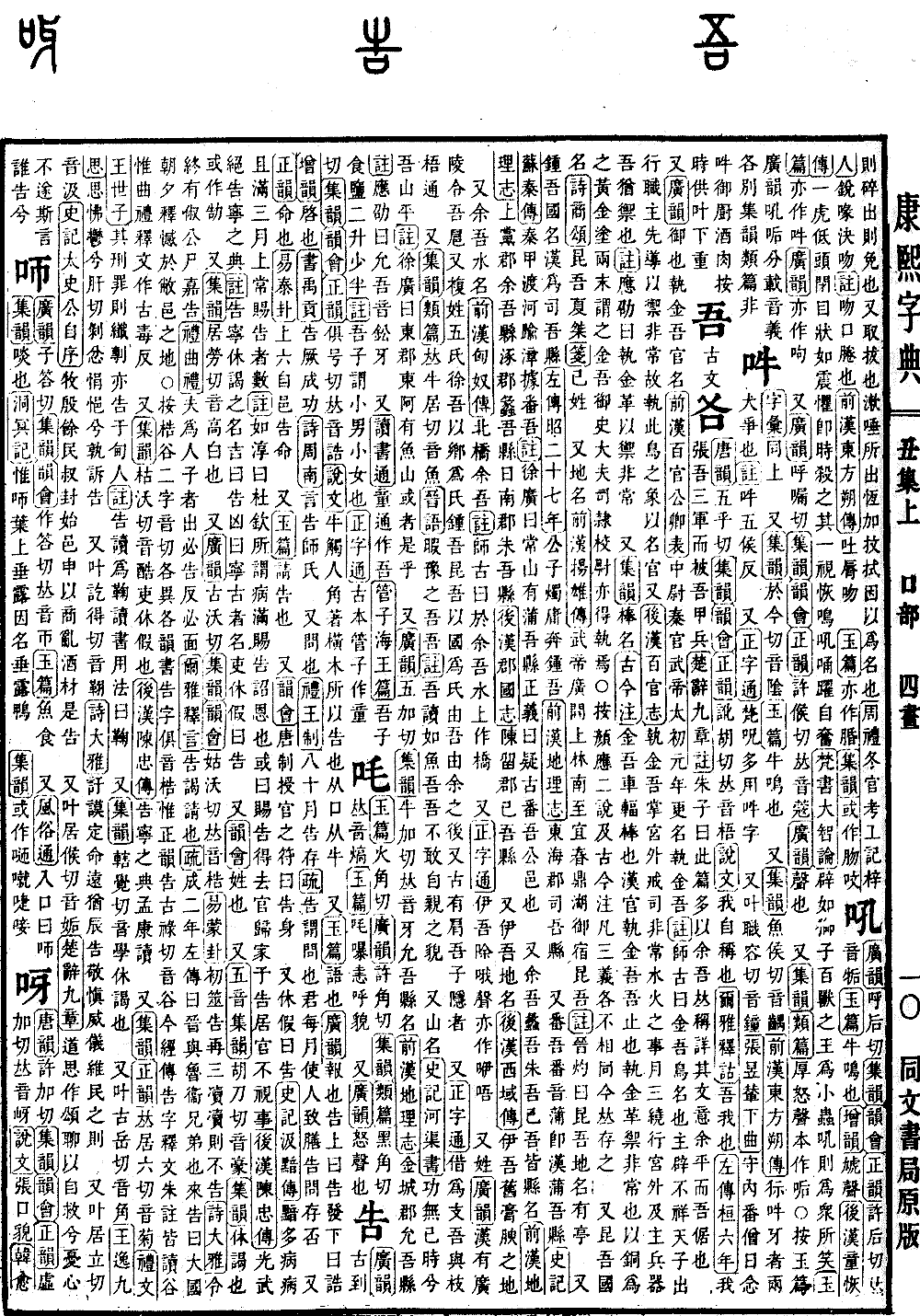
Chou Collection, Upper Volume
Radical: Mouth (kǒu)
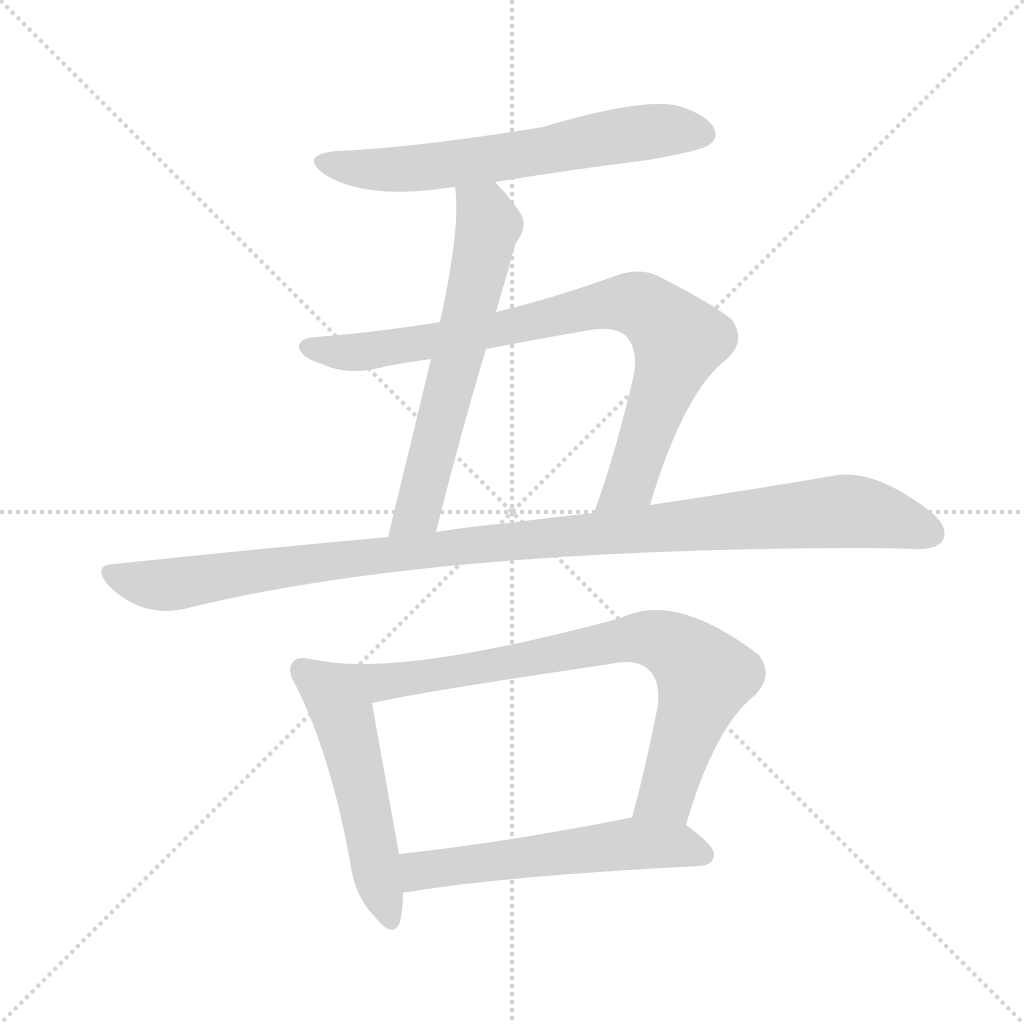
Wu
Kangxi stroke count: 7
Page 180, Entry 03
Ancient characters.
Pronounced wu (level tone).
Shuowen Jiezi (Dictionary of Explanations and Analyses of Characters): A pronoun for the self.
Erya (Approaching the Classics): Wu means I.
Zuo Zhuan (Chronicle of Zuo): I deploy my three armies and put on my armor and weapons.
Chu Ci (Verses of Chu), commentary on Nine Chapters (Jiuzhang): Zhu Xi said: This piece frequently uses the pronouns yu and wu; examining the meaning, yu is mild while wu is arrogant.
Also means to guard or resist. Zhi Jinwu is a title of an official.
Book of Han (Hanshu), Table of Officers and Ministers: The Commander (Zhongwei) was an official title in the Qin dynasty. In the first year of the Taichu era under Emperor Wu, it was renamed Zhi Jinwu.
Commentary: Yan Shigu stated: Jinwu is the name of a bird that prevents misfortune. When the Emperor traveled, this official was responsible for leading the procession to guard against emergencies; thus, the official bears the image of this bird as a name.
Book of the Later Han (Hou Hanshu), Treatise on Officials: The Zhi Jinwu was responsible for guarding against fires and emergencies outside the palace, patrolling the palace perimeter three times a month, and overseeing weaponry. Wu is synonymous with yu (to guard).
Commentary: Ying Shao stated: They hold weapons to guard against emergencies.
Also refers to a type of staff.
Gujin Zhu (Commentary on Old and New Matters): Jinwu is a type of staff used on wheel spokes. Han officials held the Jinwu. Wu means to stop; they held the weapon to guard against emergencies. It was made of copper, and the two ends were gilded with gold, hence the name Jinwu. The Censor-in-chief and the Colonel Director of Retainers were also permitted to carry it. The records of Yan Shigu, Ying Shao, and the Gujin Zhu provide three meanings, each distinct; they are all preserved here.
Kunwu is the name of a state.
Book of Odes (Shijing), Eulogies of Shang: Kunwu and the tyrant Jie of the Xia dynasty.
Commentary: A clan with the surname Si.
Also a place name.
Book of Han, Biography of Yang Xiong: Emperor Wu expanded the Shanglin Park, reaching south to Yichun and Dinghu, and the imperial lodge at Kunwu.
Commentary: Jin Zhuo stated: Kunwu is a place name, containing a courier station.
Zhongwu is the name of a state. During the Han dynasty, it became Siwu County.
Zuo Zhuan: Prince Zhuyong fled to Zhongwu.
Book of Han, Treatise on Geography: Siwu County in Donghai Commandery.
Fanwu (pronounced pu) is the same as the Han dynasty’s Puwu County.
Records of the Grand Historian (Shiji), Biography of Su Qin: Qin troops crossed the river, passed the Zhang, and occupied Fanwu.
Commentary: Xu Guang stated: There is a Puwu County in Changshan. The official commentary states: It is suspected that this was the public domain of ancient Fanwu.
Yuwu, Liwu, Zhuwu, and Yiwu are all names of counties.
Book of Han, Treatise on Geography: Yuwu County in Shangdang Commandery, Liwu County in Zhuo Commandery, Zhuwu County in Rinan Commandery.
Book of the Later Han, Treatise on Administrative Geography: Yiwu County in Liu Commandery.
Yiwu is a place name.
Book of the Later Han, Account of the Western Regions: Yiwu was formerly a land of fertile soil.
Yuwu is the name of a river.
Book of Han, Account of the Xiongnu: A bridge was built over the north end of the Yuwu River.
Commentary: Yan Shigu stated: A bridge was built over the Yuwu River.
Zhengzitong (Comprehensive Dictionary of Correct Characters): Yiwu, pronounced with the sound of "chu o," is also written as yiyou.
Also a surname.
Guangyun (Broad Rhymes): During the Han dynasty, there was an official named Wu Hu, the magistrate of Guangling.
Also compound surnames.
The Wu clan; Xuwu took the name of their district as a surname; Zhongwu and Kunwu took the name of their states as a surname; Youwu is a descendant of You Yu.
In ancient times, there was also a figure named Jian Wu, a hermit.
Zhengzitong: Borrowed for the term zhiwu (to prevaricate or deal with a situation). It is synonymous with zhiwu (using different characters).
Pronounced yu (level tone).
Jin Yu (Discourses of the States): The state of ease and leisure is wu-wu.
Commentary: Wu is read as yu. Wu-wu describes the appearance of not daring to approach oneself.
Name of a mountain.
Records of the Grand Historian, Treatise on the Irrigation of Rivers: The work has no end, and the Wu Mountain is flattened.
Commentary: Xu Guang stated: There is a Yu Mountain in Dong'e, Dong Commandery; perhaps this is it.
Pronounced ya (level tone).
Yunwu is the name of a county.
Book of Han, Treatise on Geography: Yunwu County in Jincheng Commandery.
Commentary: Ying Shao stated: Yunwu is pronounced as qian-ya.
Dushutong (Comprehensive Study of Books): Tong (child) is commonly written as wu.
Guanzi, Chapter on Sea and Salt: Wu-zi (little children) consume two sheng of salt, slightly less than half.
Commentary: Wu-zi refers to young boys and girls.
Zhengzitong: In ancient editions of Guanzi, it is written as tong.