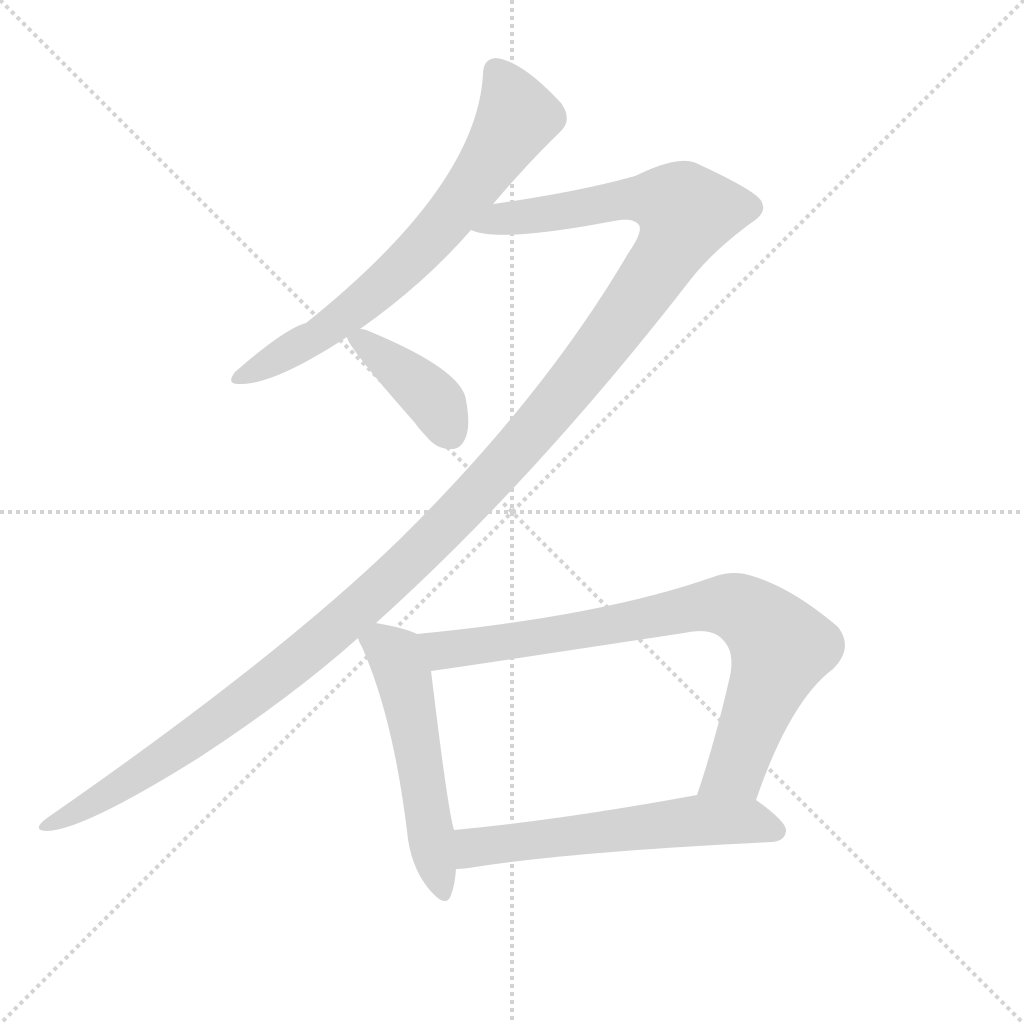
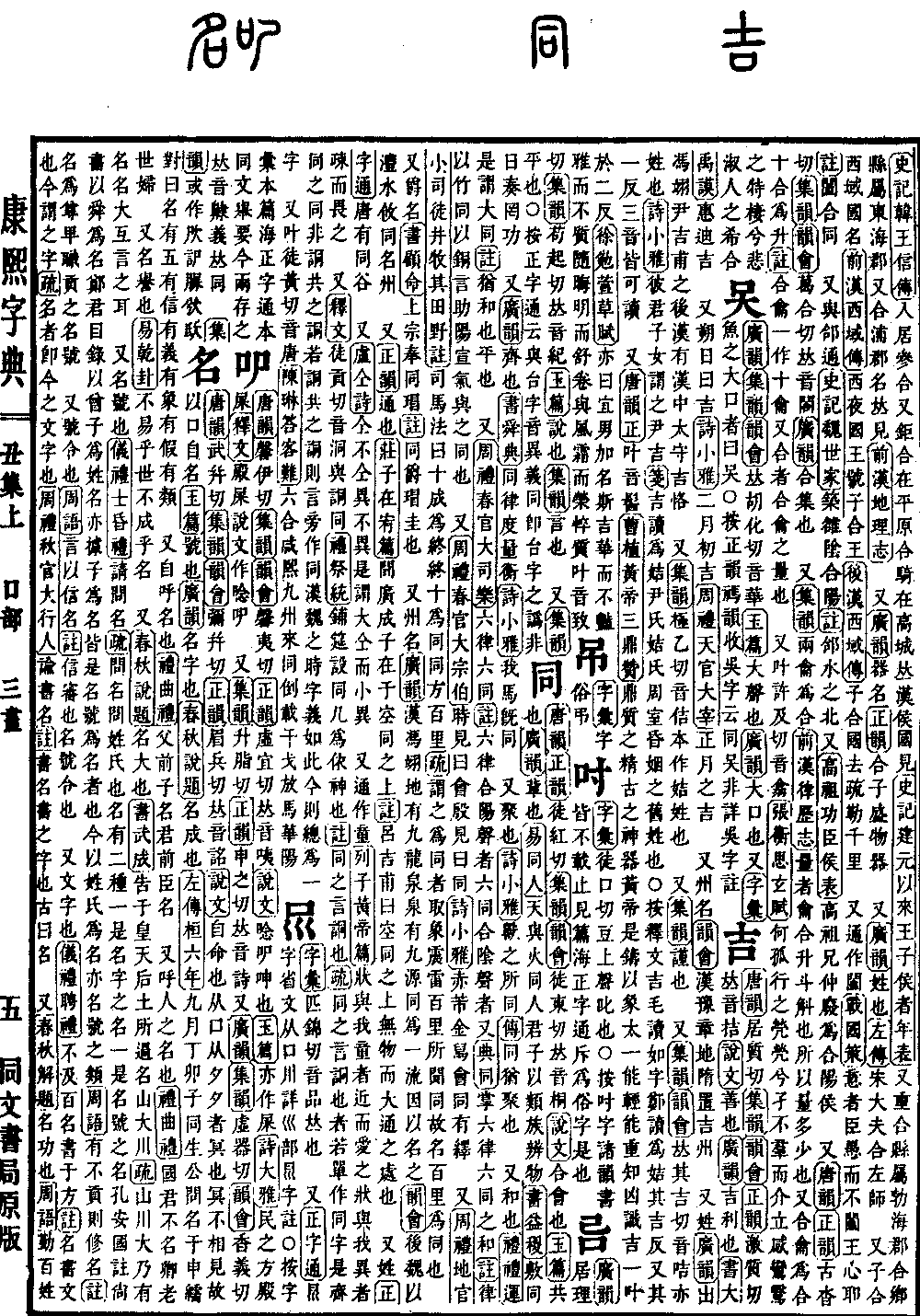
Chou Collection, Upper Volume
Radical: Mouth (kǒu)
Kangxi stroke count: 6
Page 175, Entry 09
Pronounced ming.
Explaining Characters (Shuowen): To name oneself. Derived from mouth and dusk. Dusk means darkness. In darkness, people cannot see each other, so they use their mouths to name themselves.
Jade Chapters (Yupian): A designation.
Broad Rhymes (Guangyun): A personal name.
Spring and Autumn, Explanatory Topics (Chunqiu Shuoti): Name means to complete.
Zuo Tradition (Zuo Zhuan), Sixth Year of Duke Huan: On the day of Dingmao in the ninth month, the son, Tong, was born. The Duke asked Shen Xu for a name. He replied: There are five kinds of names: based on belief, based on righteousness, based on appearance, based on borrowing, and based on similarity.
Also, to call one's own name.
Book of Rites (Liji), Songs of Propriety (Quli): In front of a father, a son uses his own name; in front of a ruler, a subject uses his own name.
Also, to call someone else's name.
Book of Rites (Liji), Songs of Propriety (Quli): A state ruler does not use the names of his high officials or elders.
Also, fame or reputation.
Book of Changes (Yijing), Qian Hexagram: Not changing for the world, not achieving fame.
Also, Spring and Autumn, Explanatory Topics (Chunqiu Shuoti): Name means great.
Book of Documents (Shujing), Martial Success (Wucheng): Reported to the Imperial Heaven and the Queen Earth, passing by famous mountains and great rivers.
Commentary (Shu): Mountains and rivers are great, hence they have names; fame and greatness are used interchangeably.
Also, titles or appellations.
Ceremonial and Rituals (Yili), Marriage Rites (Shihunli): Request to ask for the name.
Commentary (Shu): Asking for the name is asking for the surname and clan. There are two types of names: personal names and titles. Kong Anguo's commentary on the Book of Documents uses Shun as a name. Zheng's catalog uses Zengzi as a surname and name, also relying on the son's name; these are all instances where a title serves as a name. Today, using a surname as a name also belongs to the category of titles.
Discourses of the States (Zhouyu): If there is a failure to offer tribute, then rectify the titles.
Commentary (Zhu): Titles refer to the official names of duties and tribute.
Also, orders or commands.
Discourses of the States (Zhouyu): Speech with which to make the orders credible.
Commentary (Zhu): Credibility means clarity. Name means orders.
Also, writing or characters.
Ceremonial and Rituals (Yili), Pinyi Rites (Pinli): If there are fewer than one hundred characters, write them on a wooden tablet.
Commentary (Zhu): Writing names means characters; today they are called words (zi).
Commentary (Shu): Names are what we now call characters.
Rites of Zhou (Zhouli), Office of Autumn, Great Envoy: Explain the written names.
Commentary (Zhu): Written names are the characters of the writing; in ancient times they were called names.
Also, Spring and Autumn, Interpretations (Chunqiu Jieti): Name means merit.
Discourses of the States (Zhouyu): Exerting the hundred clans to serve as one's own merit.
Commentary (Zhu): Means merit.
Also, Explaining Names (Shiming): Name means to brighten, to clarify facts so they are distinct.
Also, Er Ya, Explaining Teachings (Shixun): Above the eyes is the name (brow).
Commentary (Zhu): Between the eyebrows and eyes.
Explaining Characters (Shuowen) cites the Book of Odes (Shijing), Qi Odes: Ah, the beautiful one.
Also, a surname.
Broad Rhymes (Guangyun): Descendants of the Chu official Peng Ming in the Zuo Tradition. Tang dynasty author Peng Ming wrote ten volumes on the administrative techniques of dukes and marquises.
Also, interchangeable with the word for command or destiny (ming).
Records of the Grand Historian (Shiji), Treatise on the Celestial Offices: Exempt from the seven destinies.
Commentary (Zhu): The Mian star has seven names.
Also, Biography of Zhang Er: To flee from one's destiny and roam outside the yellow region.
Commentary (Zhu): To discard one's name and escape the register.
Also, Rhyme Collection (Jiyun): Pronounced ming. Same as the word for inscription (ming). To record. See details in the Metal Radical, inscription entry.
Also, Rhyme Collection (Jiyun): Pronounced ming (falling tone). Same as the word for naming (zhuan). To designate various objects. See details in the Speech Radical, naming entry.
Also, rhyming with mian.
Daoist Canon Songs (Daozang Ge): Rising from the joyous meeting, gold writing the eastern flower name. Virtuous peace is the restraint of the secret place, expecting each other at the Yangluo River.
Also, rhyming with mo, pronounced mang.
Han Yu, Elegy for the Prince of Cao: Son and father changed their fiefs, the three kings guarded their names. Enduring for a hundred generations, thus there is the Accomplished King.
Also, rhyming with bi, pronounced bian.
Zhang Hua, Eulogy for Bao Yuantai: The fierce father, middle minister, was clearly famous in a marvelous age. Towering gentleman, born with brilliance.