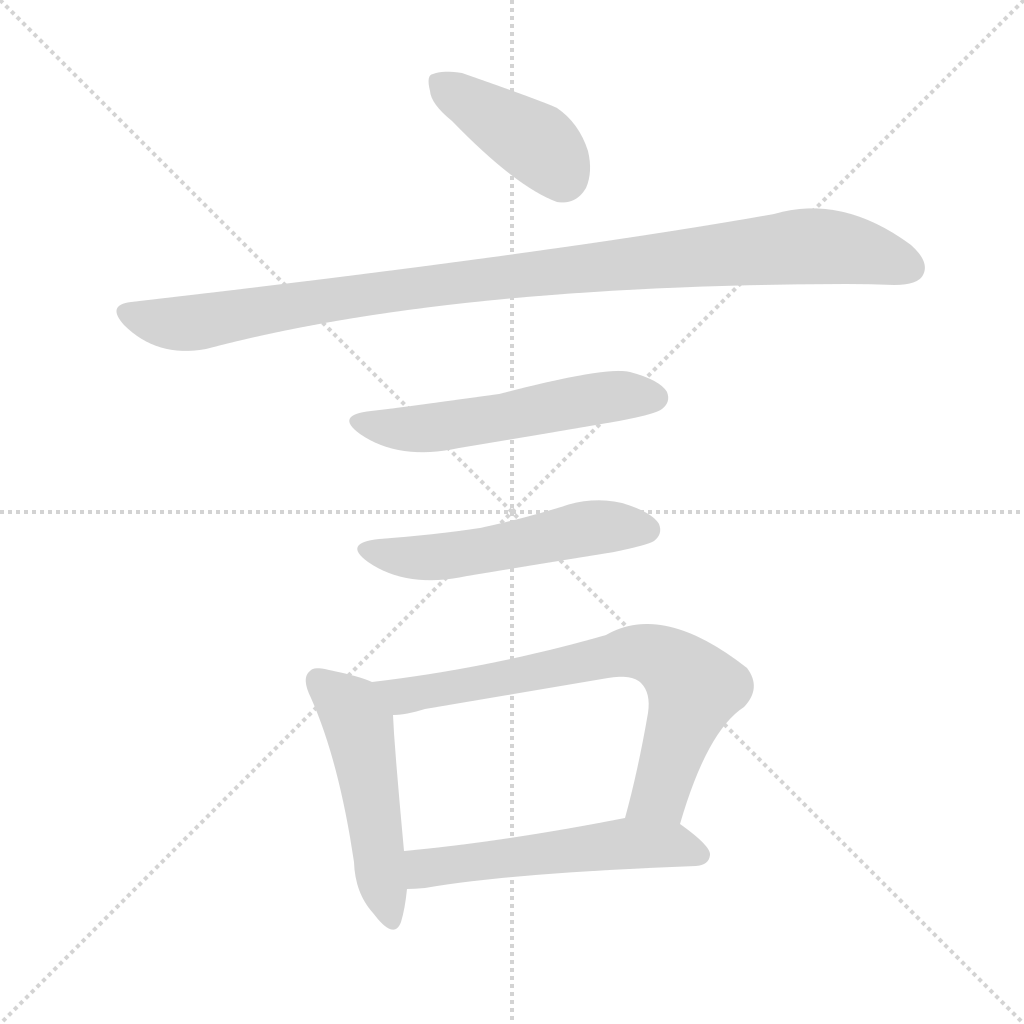
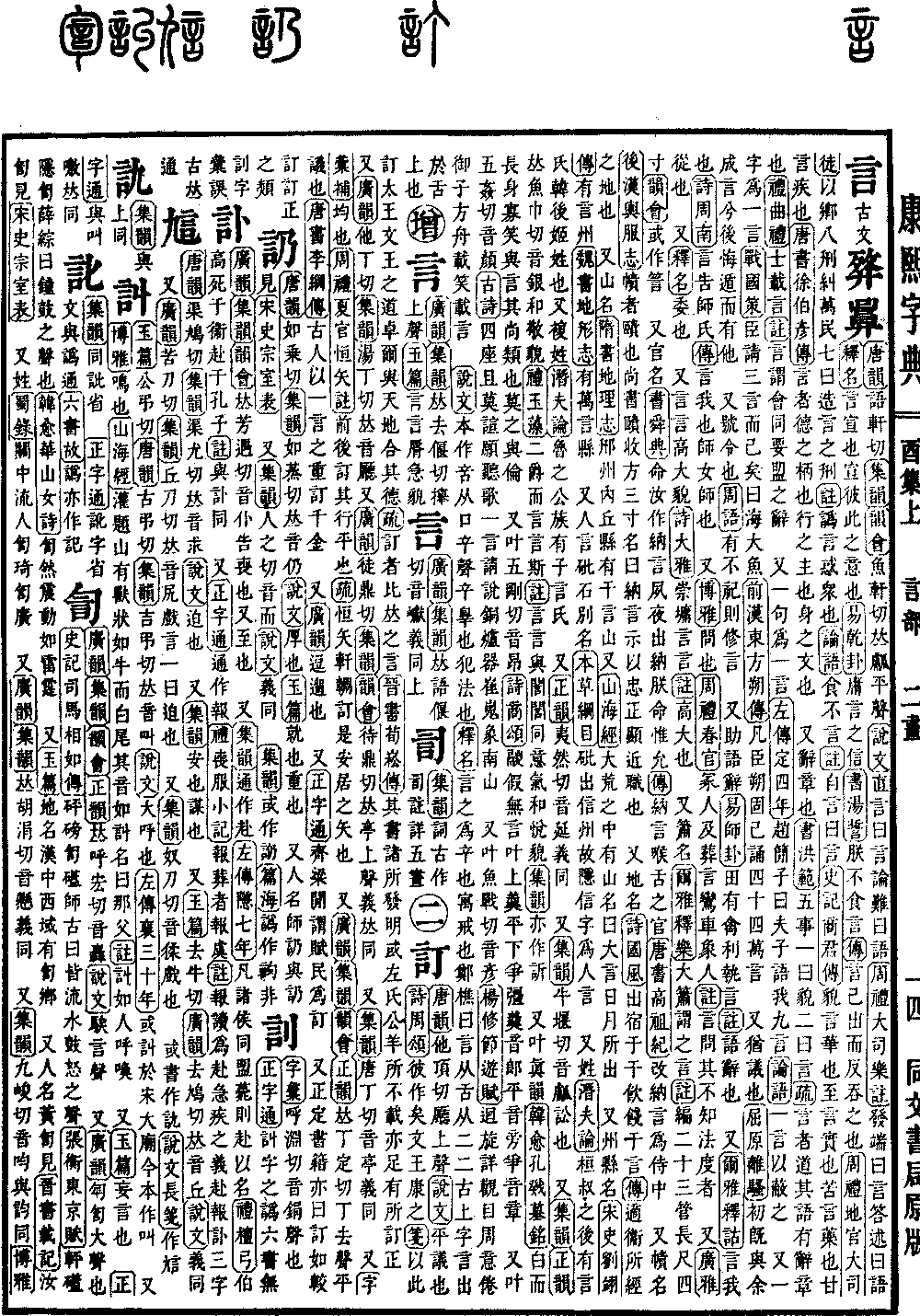
You Collection, Upper Volume. Radical: Speech (yán); Kangxi stroke count: 7; Page 1146, Entry 01.
Ancient text. Pronounced yán.
According to the Tang Rhyme (Tangyun), pronounced yǔ, and in the Collection of Rhymes (Jiyun) and Rhyme Compendium (Yunhui), pronounced yú. Flat tone.
According to the Explaining Graphs and Analyzing Characters (Shuowen): Expressing one's thoughts directly is called yan; debating and questioning is called yu.
According to the Commentary on the Rites of Zhou (Zhouli), Great Master of Music (Dasiyue): Initiating a topic is called yan; answering and narrating is called yu.
According to the Explaining Names (Shiming): Yan means to proclaim or communicate. It means to communicate mutual intentions.
According to the Classic of Changes (Yi), Qian Hexagram: Daily speech must be trustworthy.
According to the Book of Documents (Shujing), Oath of Tang (Tangshi): I will not violate my word.
Commentary: This means words once spoken that are retracted and swallowed back.
According to the Rites of Zhou (Zhouli), Earth Official, Great Minister of Justice (Dasitu): Using the eight statutes of the village to inspect the people, the seventh is to punish those who create rumors.
Note: Refers to using false speech to deceive the masses.
According to the Analects of Confucius (Lunyu): One does not speak while sleeping.
Note: Speaking on one's own initiative is called yan.
According to the Records of the Grand Historian (Shiji), Biography of Shang Yang (Shangjun Zhuan): Superficial words are flashy, deep and relevant words are substantial, discordant words are medicine for ailments, and sweet talk is a harmful disease.
According to the Old Book of Tang (Tangshu), Biography of Xu Boyan: Speech is the key to virtue, the guide for conduct, and the refinement of oneself.
Also refers to literary composition.
According to the Book of Documents (Shujing), Great Plan (Hongfan): The five governmental affairs; the first is demeanor, the second is speech.
Commentary: Yan refers to speech that possesses literary refinement and composition.
According to the Book of Rites (Liji), Conventional Rituals (Quli): The literati record the words of covenants and oaths.
Note: Yan refers to the literary composition of covenants made when feudal lords meet.
Also, one sentence is called one yan.
According to the Zuo Commentary (Zuozhuan), Fourth Year of Duke Ding: Zhao Zi said: That gentleman told me nine sentences.
According to the Analects of Confucius (Lunyu): Summarize it in one sentence.
Also, one character is called one yan.
According to the Strategies of the Warring States (Zhanguoce): Please allow me to say only three characters, which is "the sea has big fish."
According to the History of the Former Han (Qianhan), Biography of Dongfang Shuo: In total, I, Dongfang Shuo, have already read 440,000 characters.
Also serves as the equivalent of "yi," referring to an agreement.
According to the Qu Yuan, Encountering Sorrow (Lisao): Originally we had already agreed, but later you retracted and fled, having other plans.
Also refers to commands.
According to the Discourses of Zhou (Zhouyu): If there are those who do not perform sacrifices, the command is reiterated.
Also used as a modal particle.
According to the Classic of Changes (Yi), Shi Hexagram: Hunting yields a catch, beneficial to carry out (this order).
Note: It is a modal particle.
Also, according to the Erya, Explaining Standard Interpretations (Shigu): Yan refers to "me."
According to the Book of Odes (Shijing), Zhou Nan: I tell the female teacher.
Commentary: Yan means me. The teacher refers to the female teacher.
Also, according to the Boya: It means "to ask."
According to the Rites of Zhou (Zhouli), Spring Official: The duty of the Tomb Custodian: at the time of burial, inquire about the luan carriages and the elephant-men (to see if they conform to ritual).
Note: Yan is to inquire about those that do not conform to legal standards.
Also, according to the Guangya: It means "to follow."
Also, according to the Explaining Names (Shiming): It means "to entrust."
Also "yan yan," refers to a lofty appearance.
According to the Book of Odes (Shijing), Great Odes (Daya): The high city walls are very magnificent.
Note: A lofty appearance.
Also, it is a name for a type of flute.
According to the Erya, Explaining Music (Shilue): A large flute is called yan.
Note: It is composed of twenty-three bamboo pipes, one foot four inches long.
Yunhui: Or written as (variant form).
Also, a type of official title.
According to the Book of Documents (Shujing), Canon of Shun (Shundian): I appoint you as Nayan (Director of Speech), to transmit my commands morning and evening; you must be impartial.
Commentary: Nayan is the official position responsible for communication.
According to the Old Book of Tang (Tangshu), Chronicle of Emperor Gaozu: The official title of Nayan was changed to Shizhong.
Also, a name for a type of headpiece.
According to the History of the Later Han (Houhan), Records of Carriages and Clothing: A ze is a zhe. The zheshou worn by the Shangshu (Minister) is three inches square, called Nayan, symbolizing loyalty and integrity, showing it is an intimate official position.
Also, a place name.
According to the Book of Odes (Shijing), Guo Feng: Traveling and lodging in the land of Gan, drinking and parting in the land of Yan.
Commentary: A place passed through on the way to the State of Wei.
Also, a name for a mountain.
According to the Book of Sui (Suishu), Treatise on Geography: In Xingzhou, Neiqiu County, there is Mount Qianyan.
Also, according to the Classic of Mountains and Seas (Shanhaijing): In the Great Wilderness, there is a mountain called Mount Dayan, where the sun and moon rise.
Also, the name of a prefecture and county.
According to the History of the Song (Songshi), Biography of Liu Yi: There is Yan Prefecture.
According to the Book of Wei (Weishu), Treatise on Geography: There is Wanyan County.
Also "renyan" (human speech), another name for arsenic.
According to the Compendium of Materia Medica (Bencao Gangmu): Arsenic is produced in Xinzhou, so the character "xin" is split to implicitly call it "renyan."
Also, a surname.
According to the Qianfu Lun (Discourses of a Recluse): The descendants of Huan Shu have the Yan surname, descendants of the State of Han, of the Ji clan.
Also, a compound surname.
According to the Qianfu Lun (Discourses of a Recluse): The public clan of the State of Lu has the Ziyan surname.
Also, according to the Correct Rhymes (Zhengyun), pronounced yí, with the same sound as "yán." The meaning is the same.
Also, according to the Jiyun, pronounced niú, referring to litigation.
Also, according to the Jiyun and Correct Rhymes (Zhengyun), pronounced yín, meaning a gentle and respectful appearance.
According to the Book of Rites (Liji), Jade Pattern (Yuzao): After drinking the second cup of wine, one appears gentle and pleasant.
Note: "Yan yan" is the same as "yin yin," meaning a calm, peaceful, and pleasant appearance.
Jiyun: Also written as (variant form).
Also, rhyming with the zhen category.
According to the Han Yu, Inscription on the Tomb of Kong Huan: His skin was fair, his body tall, he rarely laughed or talked; ah, his demeanor, no one can compare to him.
Also, rhyming with the wugang category, sound ang.
According to the Book of Odes (Shijing), Eulogies of Shang (Shangsong): The crowd prays silently. It rhymes with the "geng" (pronounced lang) in the previous line and "zheng" (pronounced zhang) in the following line. "Ping" is pronounced pang.
Also, rhyming with the wujian category, sound yan.
According to the Ancient Poems: Everyone in the hall, please refrain from noise for a moment, I hope you will listen to me sing one yan. Please let me speak of this bronze incense burner; it stands tall like a mountain.
Also, rhyming with the yuzhan category, sound yan.
According to the Yang Xiu, Rhapsody on Leisurely Travels (Jieyou Fu): Back and forth I observe carefully, my eyes have seen everything, my heart is weary. I pilot a small boat, talking and laughing.
Shuowen: The original character was written as (variant). From "mouth" and "yen" as the phonetic component. "Yen" means "guilt," referring to breaking the law.
Explaining Names (Shiming): Yan means "xin," implying an admonition. Zheng Qiao said: The character yan is composed of "tongue" and "yen." "Yen" is the ancient character for "up," indicating that speech originates from the tongue.
Textual research: In the Analects of Confucius (Lunyu), "Eat without speaking." It has been carefully corrected according to the original text to "Sleep without speaking."
In the Rites of Zhou (Zhouli), Spring Official, Note: "Yan asks about those who do not know the law." It has been carefully corrected according to the original text "do not know" to "do not conform to."