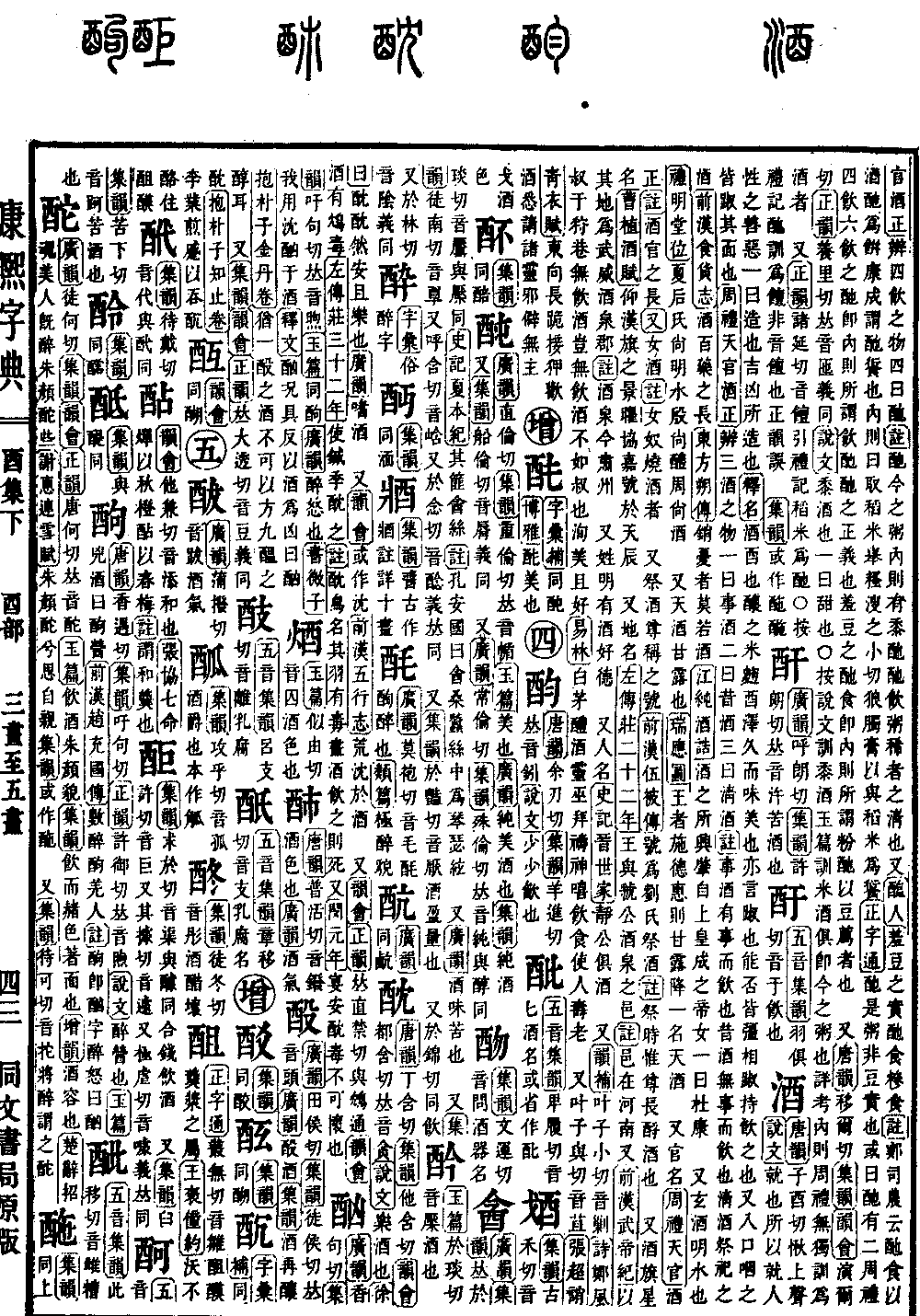
You Collection, Lower Volume
Radical: Wine (yǒu)
Kangxi Strokes: 10
Page 1281, Entry 03
Tang Rhymes (Tangyun): Pronounced jiu (rising tone), with a tone identical to the rising tone of the character qiao.
Explanation of Graphs and Analysis of Characters (Shuowen Jiezi): Interpreted as jiù, meaning that which is used to bring to completion the good and evil in human nature. Another interpretation is zào, referring to things brought about by auspicious or ominous events.
Explication of Names (Shiming): Wine, jiu, represents the meaning of the [the hour of] you; it is brewed using rice and yeast, and when fermented during the period of you (referring to a long duration), its flavor becomes mellow. It can also be said to be cù (constrained and uneasy), referring to how, whether one is able to drink or not, one is coerced into consuming it. Furthermore, because once wine enters the mouth and is swallowed, the face shows a constrained expression.
Book of Rites of Zhou (Zhouli), Section: Heavenly Officials, Subsection: Wine Administrator: Distinguishes between three types of wine: the first is shìjiǔ (service wine), the second is xījiǔ (aged wine), and the third is qīngjiǔ (clear wine).
Note: Shìjiǔ is wine consumed during specific occasions. Xījiǔ is wine consumed when there are no specific occasions. Qīngjiǔ is wine used for sacrificial rituals.
History of the Former Han (Qian Hanshu), Treatise on Food and Money: Wine is the chief of all medicines.
Biography of Dongfang Shuo: There is nothing better than wine for eliminating sorrow.
Jiang Chun, Wine Proclamation (Jiugao): The origin of wine began with the emperors of ancient times; it was brewed by the daughter of the Heavenly Emperor (another source says Du Kang).
Also, wine is clear water.
Book of Rites (Liji), Section: Hall of Distinction (Mingtangwei): The Xia Dynasty revered clear water, the Yin and Shang Dynasties revered sweet wine (lǐjiǔ), and the Zhou Dynasty revered wine.
Also, heavenly wine is sweet dew.
Illustrations of Auspicious Omens (Ruiyingtu): When a ruler implements virtuous governance and grants favors, sweet dew descends; sweet dew is also known as heavenly wine.
Also, an official title.
Book of Rites of Zhou (Zhouli), Section: Heavenly Officials: Establishes the Wine Administrator.
Note: This is the chief of the wine officials.
Also: Establishes the Female Wine Servant.
Note: Refers to female servants who are knowledgeable in brewing wine.
Also: Jìjiǔ (libationer) is an honorific title.
History of the Former Han (Qian Hanshu), Biography of Wu Bei: Called the Libationer of the Liu clan.
Note: During sacrifices, only the most senior person may pour wine as a libation.
Also: Wine Flag (jiǔqí) is the name of a constellation.
Cao Zhi, Rhapsody on Wine (Jiufu): Looking up at the brilliance of the Wine Flag star in the Milky Way, its fine reputation matches the stars of heaven.
Also, a place name.
Zuo Tradition (Zuozhuan), Year 22 of Duke Zhuang: The Son of Heaven of Zhou granted the Duke of Guo the territory of Wine Spring (Jiuquan) as a fief.
Note: The fief was in Henan.
Also, History of the Former Han (Qian Hanshu), Annals of Emperor Wu: Established Wuwei Commandery and Jiuquan Commandery in that region.
Note: Jiuquan is the modern-day Suzhou.
Also, a surname. In the Ming Dynasty, there was a person named Jiu Haode.
Also, a personal name.
Records of the Grand Historian (Shiji), Annals of Jin: Duke Jing of Jin was named Juju.
Also, Rhyme Supplement (Yunbu): In rhyming context, pronounced jiao (falling tone), similar in sound to jiǎo.
Book of Odes (Shijing), Odes of Zheng: Uncle went hunting, there was no one in the lane drinking wine. Is it truly that there is no one drinking wine? It is just not as good as Uncle (who drinks); he is truly handsome and excellent.
Forest of Changes (Yilin): Sweet wine filtered through white cogon grass, a miraculous shaman kneels and prays. The spirits joyfully consume the offerings, granting one longevity without aging.
Also, in rhyming context, pronounced ju (level tone), similar in sound to jū.
Zhang Chao, Satire on the Green-Clad Servant (Qiaojingyi Fu): Kneeling long toward the east, drawing near to joyfully drink fine wine. Inviting all the various spirits, (rebuking) perverse behavior for having no firm principles.
Critical Examination: Book of Rites of Zhou (Zhouli), Section: Heavenly Officials, Subsection: Wine Administrator: Female Wine Servant. Note: Female servants who burn wine. Respectfully note: in the original text, "burn wine" has been changed to "knowledgeable of wine."