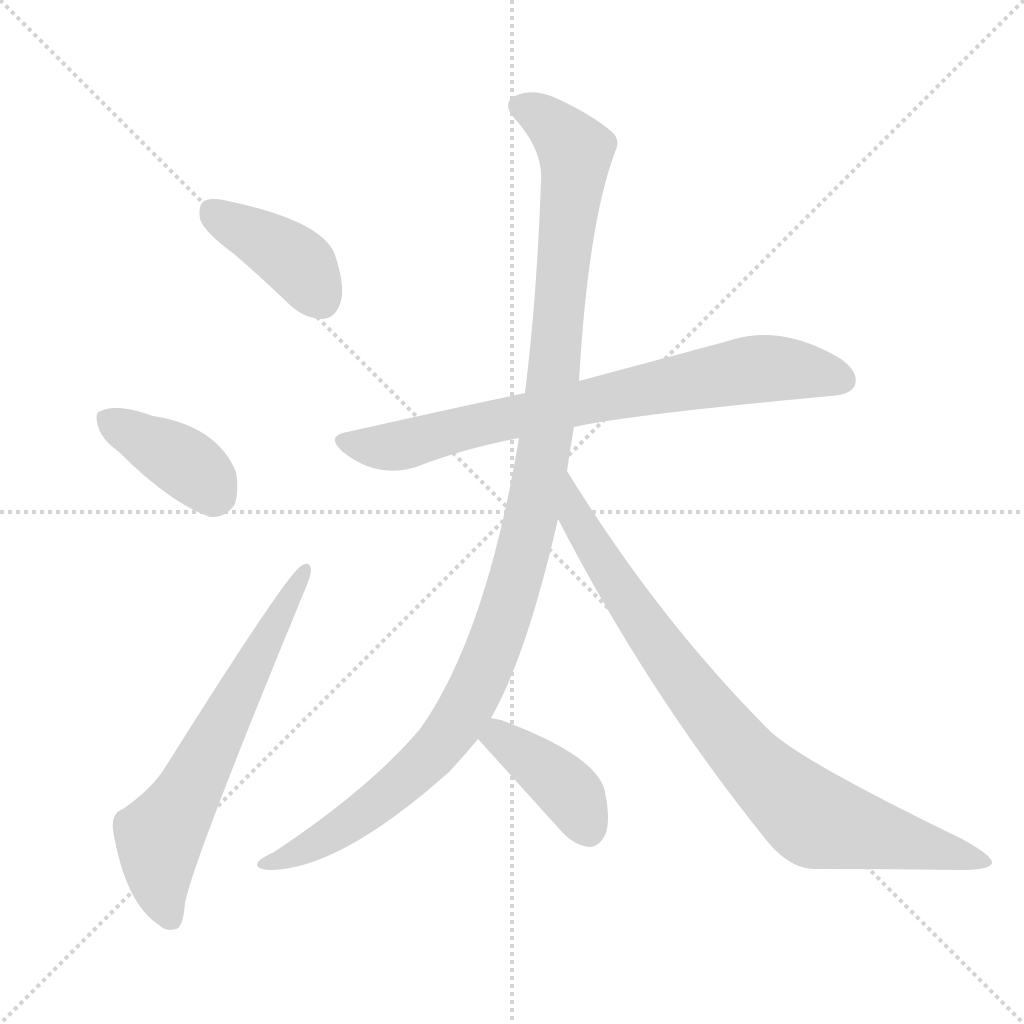
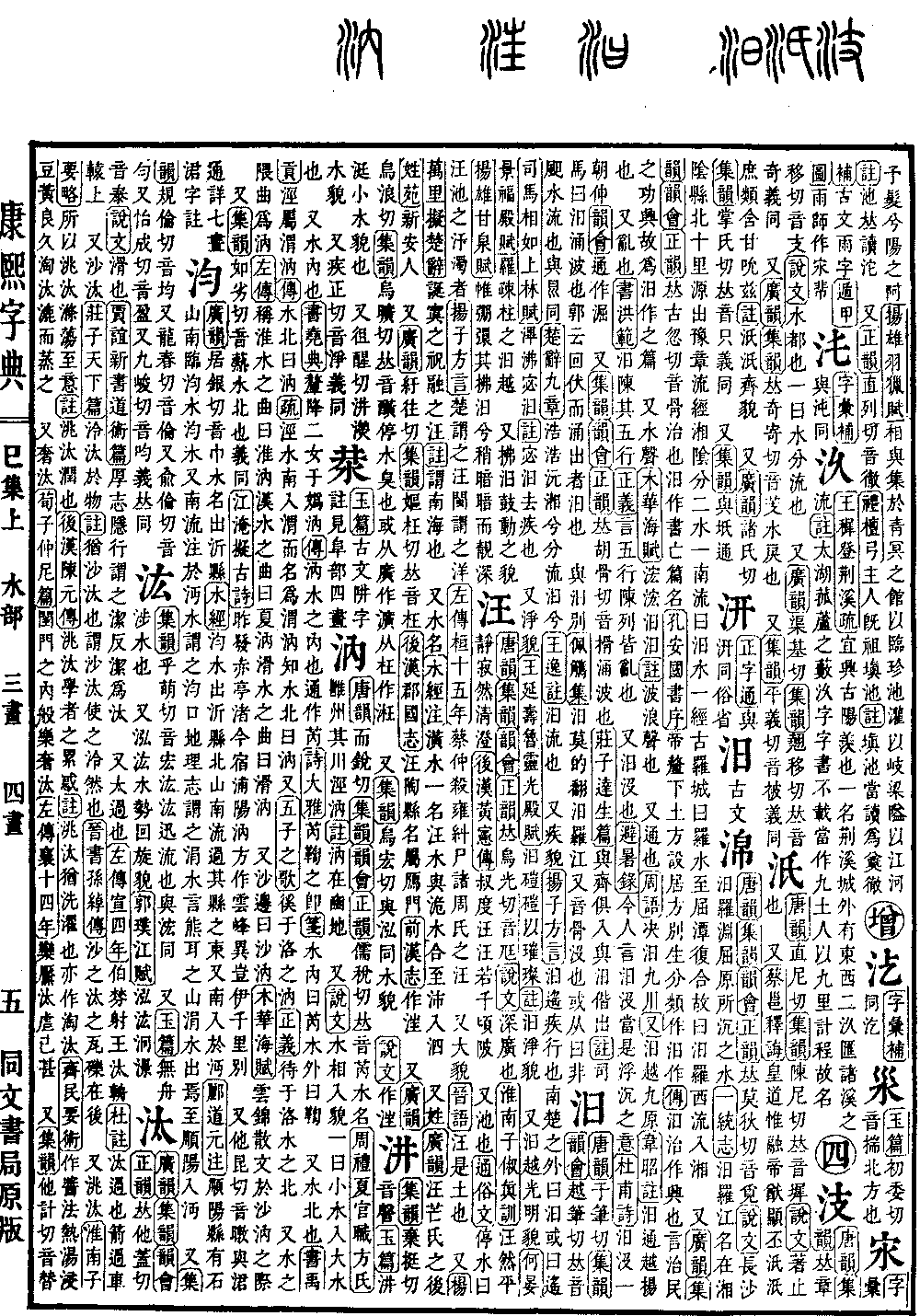
Si Collection, Upper Volume
Radical: Water (shuǐ)
Tai
Kangxi brush strokes: 8
Page 607, Entry 18
Broad Rhymes (Guangyun), Collected Rhymes (Jiyun), Rhymes Compilation (Yunhui), Correct Rhymes (Zhengyun): Pronounced tai (falling tone).
According to the Explaining Graphs and Analyzing Characters (Shuowen), it means smooth or slippery.
Jia Yi, New Book (Xinshu), Daoist Arts Chapter: To have a deep will and hidden conduct is called purity; the opposite of purity is excess.
It also means excessive.
Zuo Commentary (Zuozhuan), Fourth Year of Duke Xuan: Bo Fen shot at the King, the arrow passing over the carriage pole.
Du Commentary: Tai means to pass over. The arrow passed over the carriage pole.
Also means to sift or filter.
Zhuangzi, All Under Heaven Chapter: Ling tai in regard to things.
Commentary: It means the same as sifting or filtering, indicating a filtering process that renders things pure.
Book of Jin (Jinshu), Biography of Sun Chuo: Sifting it and filtering it, the rubble remains behind.
Also means to wash or cleanse (taotai).
Huainanzi, Summary of Essentials (Yaolue): Used to wash, cleanse, and scour the utmost intentions.
Commentary: Taotai means to moisten.
Book of the Later Han (Houhanshu), Biography of Chen Yuan: Taotai, the confusion of students.
Commentary: Taotai is the same as washing. It is also written as the variant form (taotai).
Essential Techniques for the Peasantry (Qimin Yaoshu): Method for making sauce: soak the yellow beans in hot water, after a long time wash and sift them, then drain and steam them.
Also means extravagant or indulgent.
Xunzi, Confucius Chapter: Within the private chambers, indulgence in pleasure and extravagance.
Zuo Commentary (Zuozhuan), Fourteenth Year of Duke Xiang: Luan Yan was too indulgent and tyrannical.
According to Collected Rhymes (Jiyun): Pronounced ti (falling tone). Refers to water waves.
Also pronounced da (falling tone). Refers to washing rice. Equivalent to the form (dai).
According to Correct Rhymes (Zhengyun): Pronounced ta (entering tone). Also means smooth or slippery.
Su Shi, Song of the Rice-Seedling Horse: Using my two feet as four hooves, rising and leaping, smooth and slippery like wild ducks.