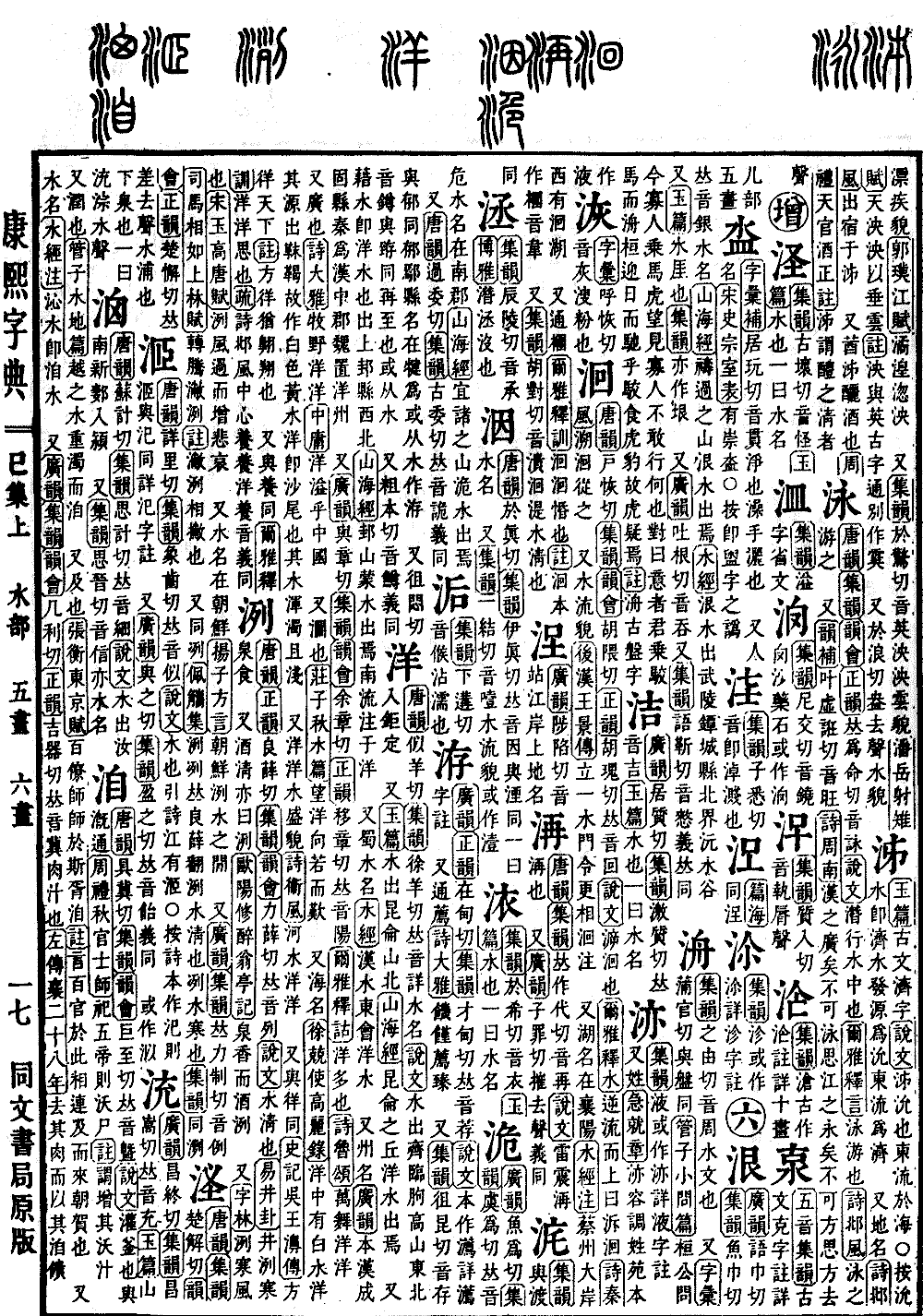
Si Collection, Upper Volume
Radical: Water (shuǐ)
Kangxi Strokes: 10
Page 619, Entry 34
Tang Dynasty Rhyme Dictionary (Tangyun) states: pronounced ji (falling tone).
Collected Rhymes (Jiyun) and Rhyme Compendium (Yunhui) state: pronounced ji (falling tone); the pronunciation is identical to the character ji.
Explaining Characters and Phrases (Shuowen Jiezi) defines it as pouring water into a pot or cauldron, equivalent to the character gai (to irrigate).
Rites of Zhou (Zhouli), Autumn Official, Master of Officials: It is recorded that during the sacrifice to the Five Emperors, one must pour water to wash the hands of the ceremonial representative and the king, and add water to the cauldron.
Note: The meaning is to add liquid for watering.
It also denotes to moisten or enrich.
Guanzi, Water and Earth Chapter: It is said that the water in the Yue region is turbid yet moistening.
It also carries the meaning of to reach or to arrive at.
Zhang Heng, Eastern Capital Rhapsody (Dongjing Fu): It is written that the various officials were solemn and orderly, connecting and arriving here.
Note: This means that the various officials were linked together and came to pay their respects.
It further refers to the name of a river.
Commentary on the Water Classic (Shuijing Zhu): It is recorded that the Qin River is the same as the Ji River.
Guangyun, Jiyun, and Yunhui state: pronounced jili; Zheng Rhyme (Zhengyun) states: pronounced jiqi; the pronunciation is identical to ji (falling tone). It refers to meat broth.
Zuo Tradition (Zuo Zhuan), 28th Year of Duke Xiang: It is recorded that the meat was removed, and only the broth was sent as a gift.
Collection of Distinctions (Peixi Ji) records it written in a variant form, and it is written as a common form in others.
Textual Research:
Rites of Zhou (Zhouli), Autumn Official, Master of Officials: It is recorded that during the sacrifice to the Five Emperors, one must pour water to wash the hands of the ceremonial representative.
Note: The meaning is to add liquid for watering.
Note carefully: Because the original text contains the phrase and to the king, wash hands, and pour water into the cauldron, it is stated that this means to add liquid for watering. This is precisely the explanation for the character ji. We have carefully added the six characters for and to the king, wash hands, and pour water into the cauldron.