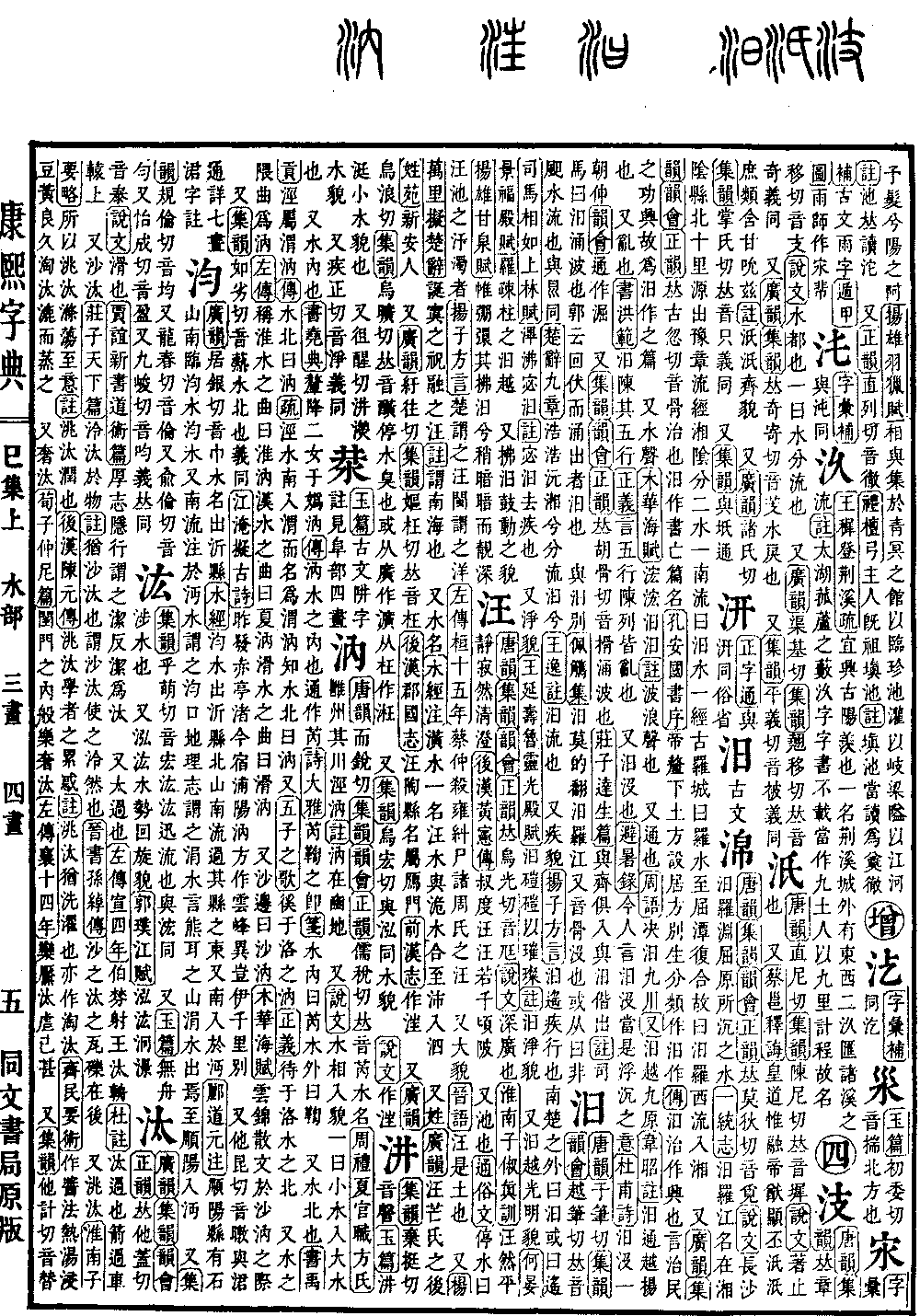
Si Collection, Upper Volume
Radical: Water (shuǐ)
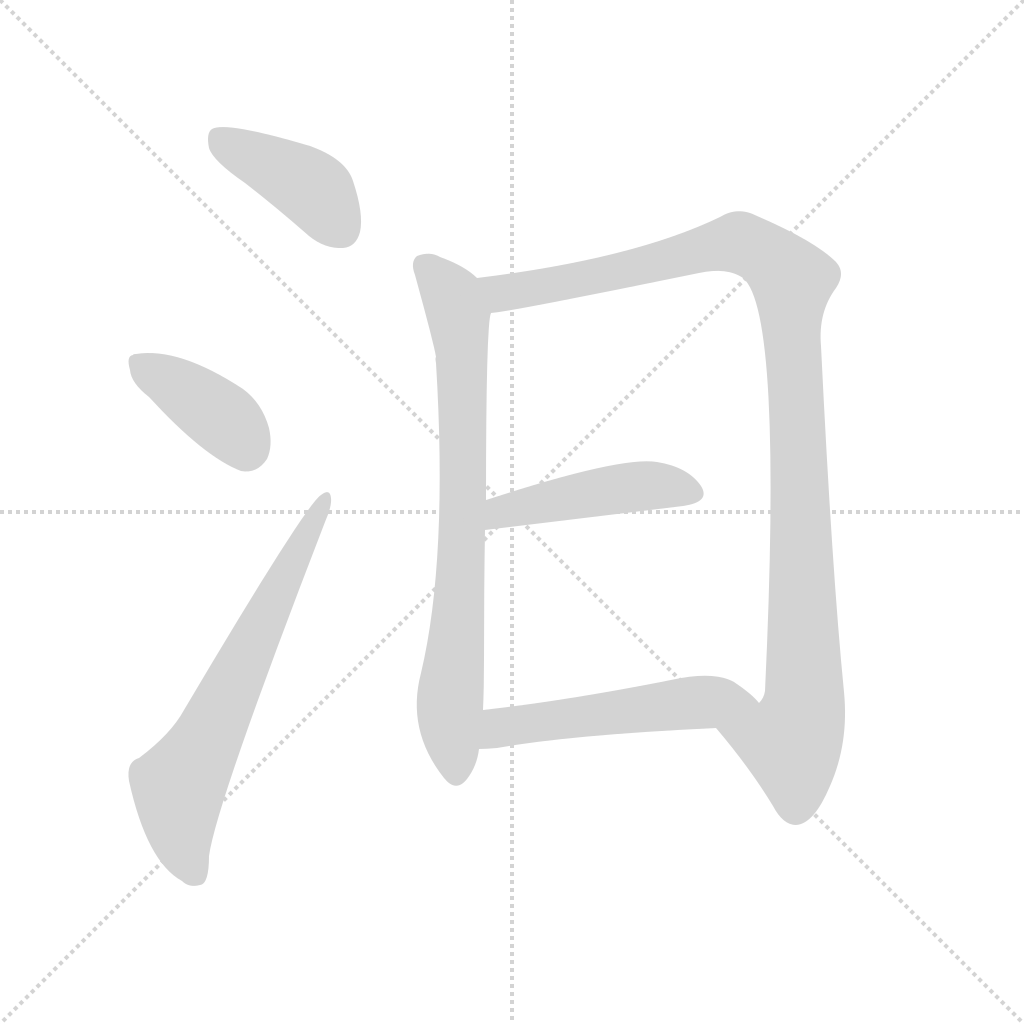
汨
Kangxi strokes: 8
Page 607, Entry 09
Ancient form: 淿
Tang Rhymes (Tangyun), Collected Rhymes (Jiyun), Rhyme Compendium (Yunhui), Correct Rhymes (Zhengyun): Pronounced mi (falling tone).
Shuowen Jiezi: The Miluo Abyss in Changsha, the water where Qu Yuan drowned himself.
Comprehensive Geography of the Empire (Yitongzhi): Miluo is the name of a river located ten li north of Xiangyin County. Its source originates in Yuzhang; it flows through Xiangyin and divides into two waters. One flows south and is called the Mi River; one passes the ancient Luo City and is called the Luo River. They join again at Qu Pool, hence the name Miluo. It flows west into the Xiang River.
Also: Guangyun, Collected Rhymes (Jiyun), Rhyme Compendium (Yunhui), Correct Rhymes (Zhengyun): Pronounced gu (entering tone).
To govern. Mi Zuo is the name of a lost chapter of the Book of Documents (Shangshu).
Kong Anguo's Preface to the Book of Documents (Shu Xu): The Emperor governed the land below, established dwelling places, separated living things into categories, and wrote the Mi Zuo.
Commentary: Mi means to govern. Zuo means to flourish. It refers to the merit of governing the people flourishing, hence it is the title of the chapter Mi Zuo.
Also: The sound of water.
Mu Hua, Sea Rhapsody (Hai Fu): Surging and rushing.
Commentary: The sound of waves.
Also: To clear or channel through.
Discourses of Zhou (Zhouyu): Channeled and opened the nine rivers.
Also: Opened and crossed the nine plains.
Wei Zhao's Commentary: Mi means to open; Yue means to spread.
Also: To be in disorder.
Book of Documents (Shangshu), Great Plan (Hongfan): The five elements were in disorder.
Commentary: It means the arrangement of the five elements was all in chaos.
Also: To be submerged.
Record of Avoiding Summer Heat (Bishu Lu): When people today say to be submerged, it should mean to float and sink.
Du Fu's Poetry: Submerged for a lifetime, one morning to be extended.
Rhyme Compendium (Yunhui): Often written in the variant form gu.
Also: Collected Rhymes (Jiyun), Rhyme Compendium (Yunhui), Correct Rhymes (Zhengyun): Pronounced hu (entering tone).
Surging waves.
Zhuangzi, Chapter on the Mastery of Life (Dasheng Pian): Enter together with the surge, exit together with the surge.
Commentary: Sima says: Mi refers to surging waves. Guo says: That which swirls and surges out is called Mi. It is distinct from the character gu.
Peixi Ji: Mi, pronounced with the phonetic of the character meaning target. Refers to the Miluo River. Also pronounced gu, meaning to submerge. Sometimes written with the character ri, which is incorrect.