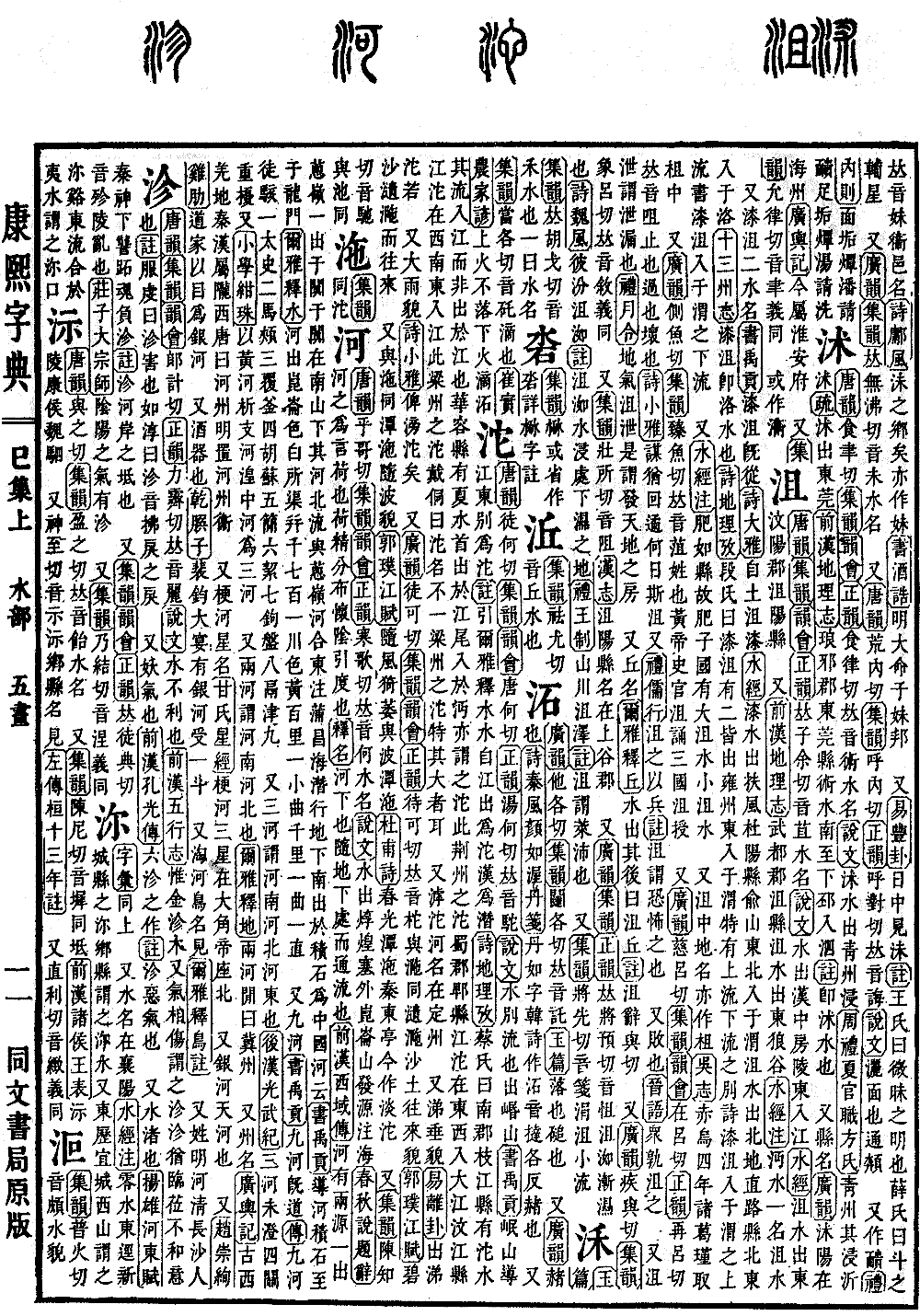
Si Collection, Upper Volume
Radical: Water (shuǐ)
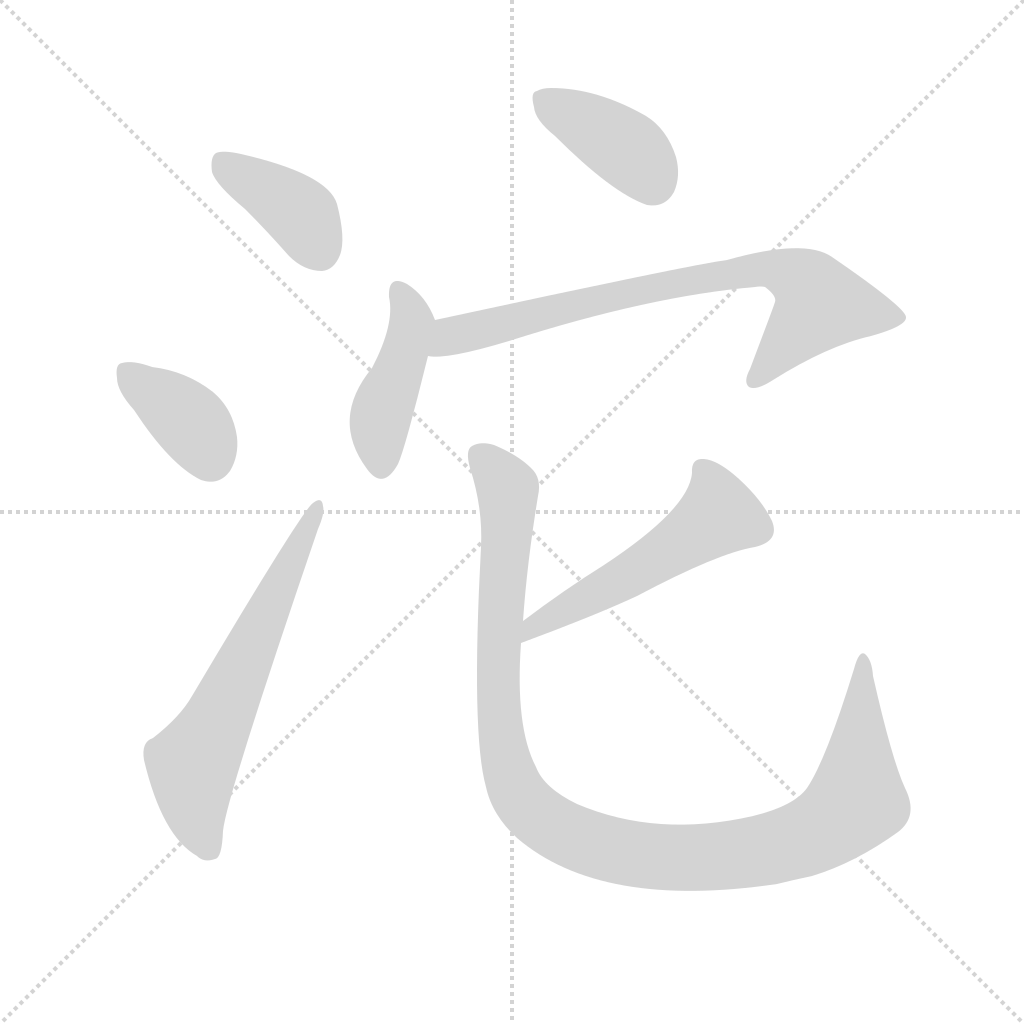
沱
Kangxi strokes: 9
Page 613, Entry 07
Pronounced tuo.
According to the Explaining Graphs and Analyzing Characters (Shuowen), it is a branch of the Yangtze River, originating in Mount Min. According to the Book of Documents (Shangshu), in the Tribute of Yu (Yugong) chapter, it states that Mount Min guides the river, and to the east, it separates to become the Tuo. The commentary cites the interpretation from the Progressive Dictionary (Erya), specifically the Explaining Water section, stating that when water flows out of the Yangtze River, it is called Tuo, and the Han River is called Qian.
According to the Geographical Examination of the Book of Odes (Shijing Dili Kao), Master Cai states that in Zhijiang County, Nanjun, there is the Tuo River, which flows into the Yangtze River but does not originate from it. In Huarong County, there is the Xia River, which originates from the Yangtze River and flows downstream into the Mi River; this is also called Tuo. This is the Tuo River of Jingzhou. The Jiangtuo in Pi County, Shujun, is to the east and flows west into the Yangtze River. The Jiangtuo in Wenjiang County is to the southwest and flows east into the Yangtze River; this is the Tuo River of Liangzhou. Dai Tong states that there is more than one watercourse called Tuo, and the Tuo River of Liangzhou is merely the largest among them.
Also, the Hutuo is the name of a river located in Dingzhou. It also describes the appearance of tears falling. In the Book of Changes (Yijing), regarding the Li hexagram, it says, shedding tears like rain (tuo ruo). It also describes the appearance of heavy rain. In the Book of Odes (Shijing), in the Minor Odes (Xiaoya) section, it says, making it pour heavily (pangtuo).
Pronounced tuo. Same as the character (tuo). Regarding the term (wèituó), it describes the appearance of sand and soil flowing back and forth with the water. In the River Rhapsody (Jiangfu) by Guo Pu, it says, green sand flows back and forth (wèituó). It is also the same as the character (tuo). Regarding the term (tántuó), it describes the appearance of rising and falling with the waves. In the River Rhapsody (Jiangfu) by Guo Pu, it says, swaying with the wind, rising and falling with the waves (tántuó). In a poem by Du Fu, it mentions spring light rising and falling (tántuó) at the East Pavilion of Qin. It is now written as (dàntuó).
Pronounced chi. Same as the character for pool (chí).
Textual research: In the original text of the Explaining Graphs and Analyzing Characters (Shuowen), it says, a river separating and flowing. Based on the original text, the word water has been corrected to river.