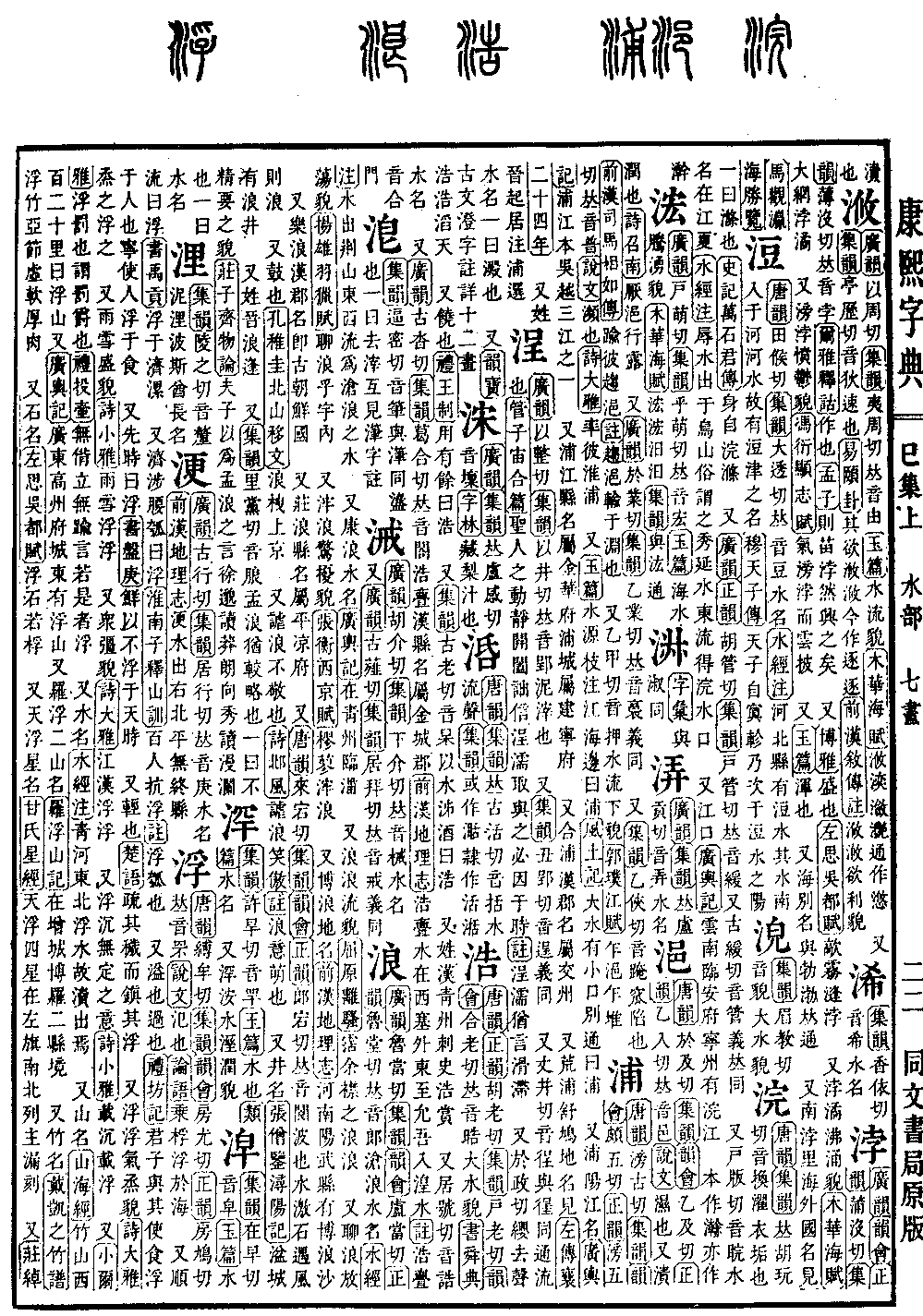
Si Collection, Upper Volume
Radical: Water (shuǐ)
Kangxi Strokes: 11
Page 624, Entry 23
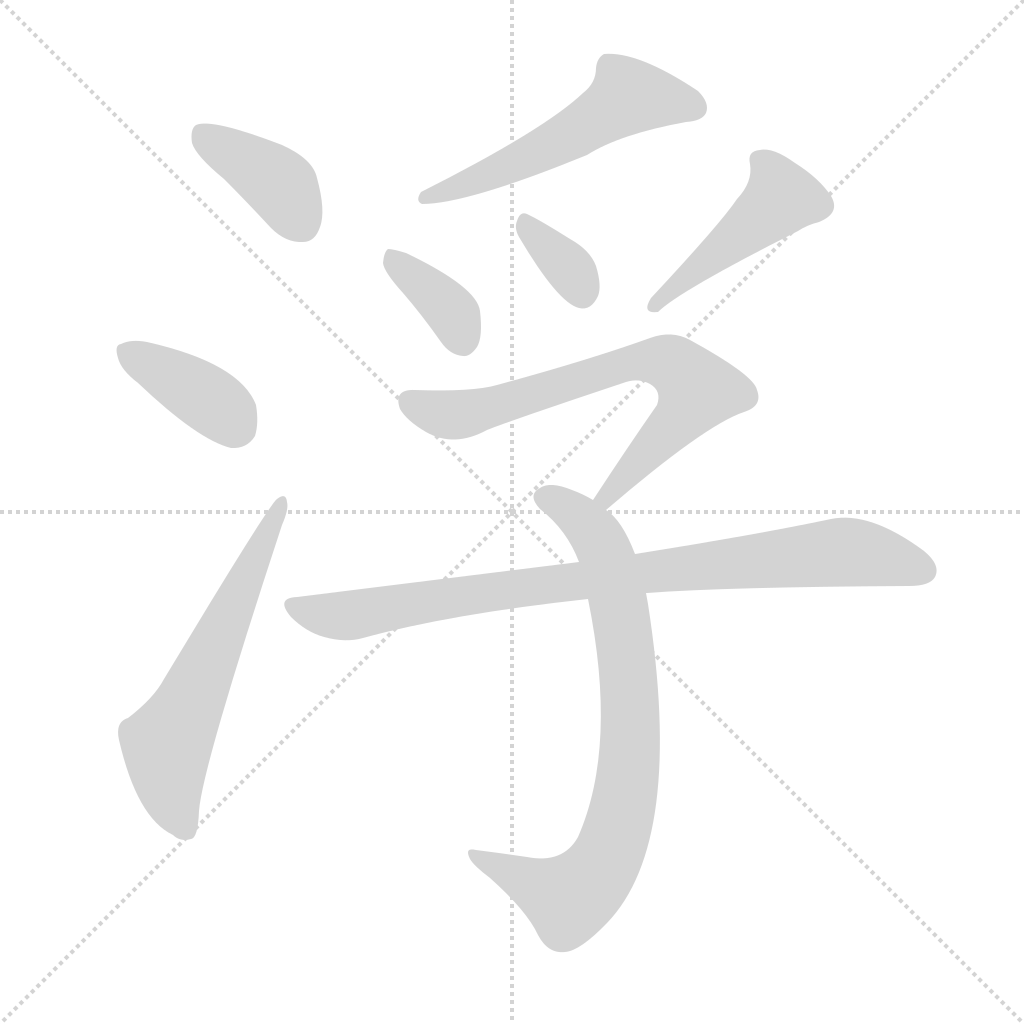
Pronounced fú.
Shuowen Jiezi (Explanation of Writing): To float.
Analects (Lunyu): Boarding a raft to float upon the sea.
Also, to go with the current is called fú.
Book of Documents (Shangshu), Tribute of Yu (Yugong): Floated upon the Ji and Luo rivers.
Also, crossing a river using a waist-gourd is called fú.
Huainanzi (Book of the Prince of Huainan), Explanation of Mountains (Shishan Xun): One hundred men carried the gourds. Note: Fú refers to a gourd.
Also, to overflow or to exceed.
Book of Rites (Liji), Record of Preventions (Fangji): A gentleman would rather let the people exceed their provisions than let the provisions exceed the people.
Also, to be premature.
Book of Documents (Shangshu), Announcement of Pan Geng: Few are those who do not exceed the appropriate time.
Also, light.
Guoyu (Discourses of the States), Discourses of Chu (Chuyu): Clear away the corruption and settle the levity.
Also, fú-fú, the appearance of vapor rising.
Book of Odes (Shijing), Greater Odes (Daya): Steaming and rising, the vapor swells.
Also, the appearance of heavy snowfall.
Book of Odes (Shijing), Lesser Odes (Xiaoya): The falling snow is thick and abundant.
Also, the appearance of a numerous and powerful force.
Book of Odes (Shijing), Greater Odes (Daya): The Yangtze and Han rivers are vast and powerful.
Also, fú-chén, a state of being unsettled.
Book of Odes (Shijing), Lesser Odes (Xiaoya): Sometimes sinking, sometimes floating.
Also, Xiao Erya (Small Dictionary of Elegant Words): Fú means to punish, referring to a penalty cup of wine.
Book of Rites (Liji), Record of Pitch-pot (Touhu): Do not stand with your back turned, do not speak out of turn; if one does this, they are penalized with a cup.
Also, a river name.
Commentary on the Classic of Waterways (Shuijing Zhu): To the northeast of the Qing River, the old channel of the Fú River emerges.
Also, a mountain name.
Classic of Mountains and Seas (Shanhaijing): One hundred and twenty miles west of Bamboo Mountain is Fú Mountain.
Also, Guang Yu Ji (Records of the Vast World): To the east of the city of Gaozhou Prefecture in Guangdong, there is Fú Mountain.
Also, Luofú, the name of two mountains.
Records of Mount Luofu (Luofushan Ji): Located on the borders of Zengcheng and Boluo counties.
Also, a bamboo name.
Dai Kaizhi’s Bamboo Manual (Zhupu): Fú bamboo has short joints and is hollow, soft, and thick-fleshed.
Also, a stone name.
Zuo Si, Rhapsody on the Capital of Wu (Wudu Fu): The floating stone is like a raft.
Also, Tianfú, a star name.
Gan’s Classic of Stars (Gan Shi Xingjing): Tianfú consists of four stars, arranged north and south of the Left Flag; it governs the water clock.
Also, Zhuang Chuo’s Chicken Rib Fragments (Jilei Bian): Halfway along a fishing rod, a reed stem is tied; this is called a fú-zi (float).
Also, Zhen Quan’s Pulse Classic (Maijing): Fú represents wind and emptiness.
Also, Pronounced fú. To drift.
Also, Pronounced féi (variant reading).
Chu Ci (Songs of Chu), Far-off Journey (Yuanyou): Pointing to the Flame God, I race directly forward; I shall travel toward the southern limits. Gazing at the wilderness beyond the world, vast and indistinct, I wander, shadowless, and drift by myself.
Textual Correction: Book of Odes (Shijing), Greater Odes (Daya): The original text says "zheng zhi fu zhi." According to the original book, it has been corrected to "zheng zhi fu fu."