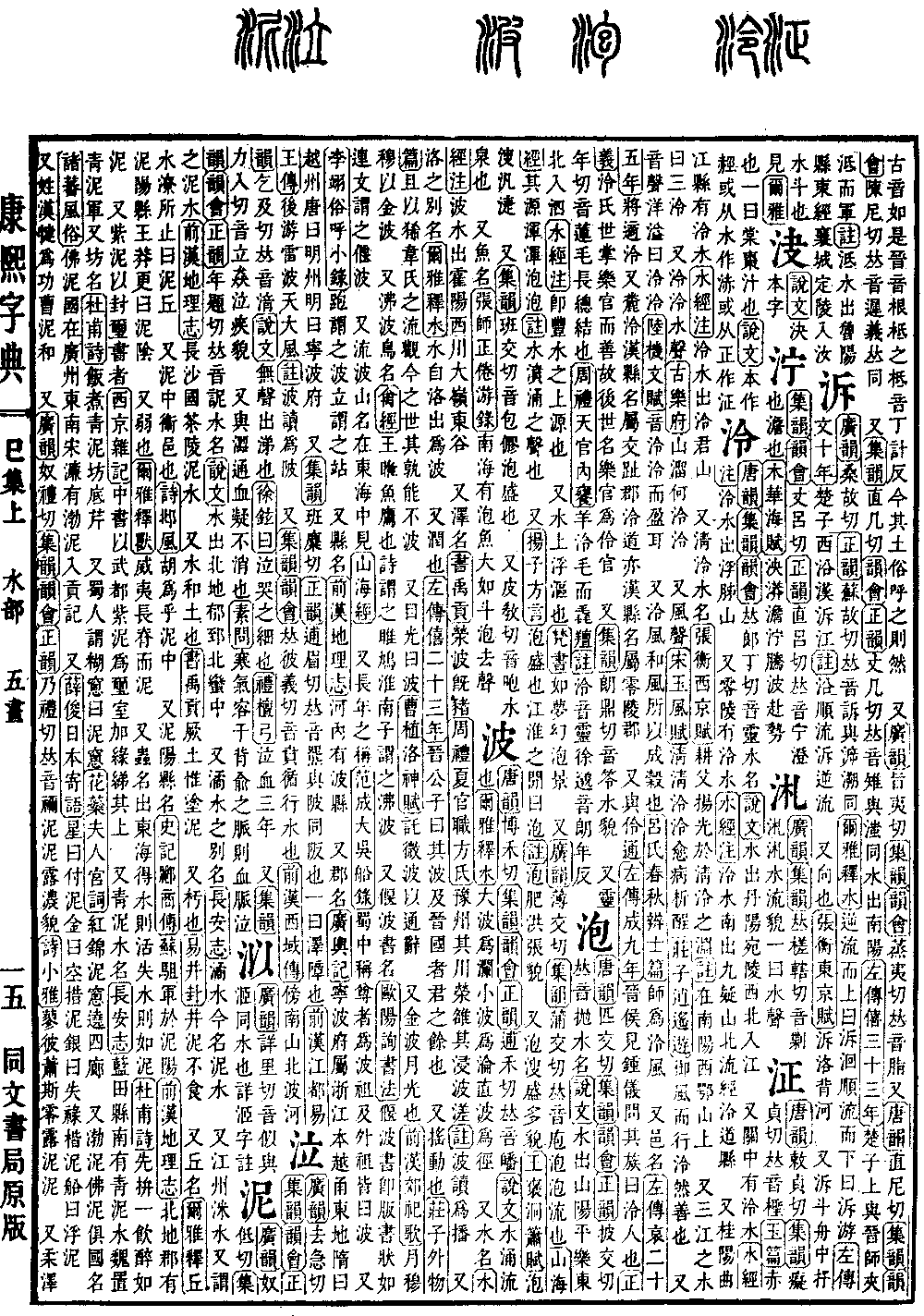
Si Collection, Upper Volume
Radical: Water (shuǐ)
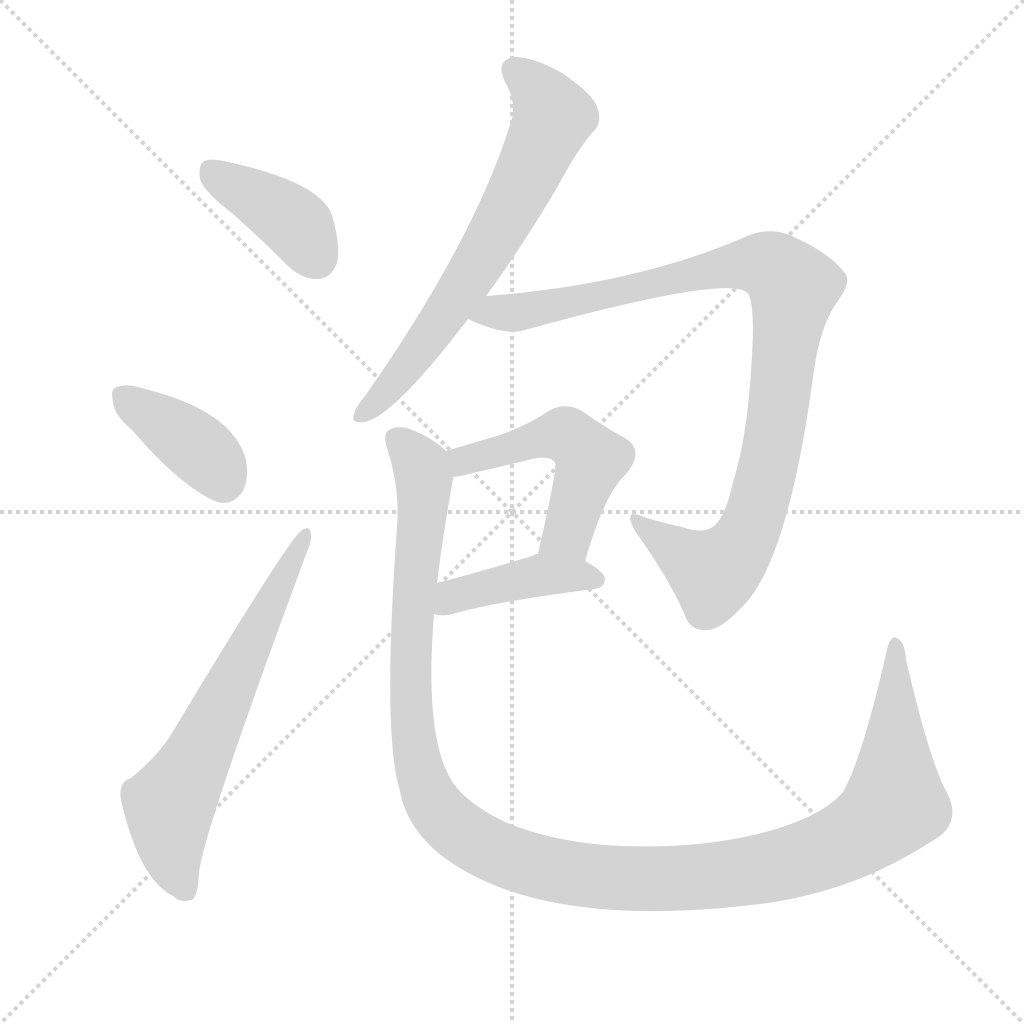
Entry: Pao
Kangxi Strokes: 9
Page 617, Entry 07
Pronounced pao. A river name. According to the Shuowen Jiezi (Dictionary of Explanations of Characters), the water originates in Shanyang Pingle and flows northeast into the Si River. According to the Commentary on the Classic of Waterways (Shuijing Zhu), it is the upper source of the Feng River. It also refers to the floating bubbles on water. According to the Buddhist scriptures, it is like a dream, an illusion, a bubble, or a shadow.
Also pronounced pao. Pao pao refers to the flowing of water. According to the Classic of Mountains and Seas (Shanhai Jing), its source is voluminous and flowing. The commentary states this describes the sound of water gushing forth.
Also, according to the Dialect (Fangyan) by Yang Xiong, pao means flourishing. Between the Yangtze and Huai rivers, it is called pao. The commentary states that pao fei describes something vast and expansive. It also refers to pao sou, which describes a state of being abundant and numerous. In the Rhapsody on the Panpipes (Dongxiao Fu) by Wang Bao, it appears as pao sou fan.
Also pronounced bao. Pao means flourishing.
Also pronounced pao. Refers to a water spring.
Also refers to a type of fish. According to the Weary Traveler’s Record (Juanyou Lu) by Zhang Shizheng, the South Sea contains the bubble fish, which is as large as a peck. Pao is in the departing tone.