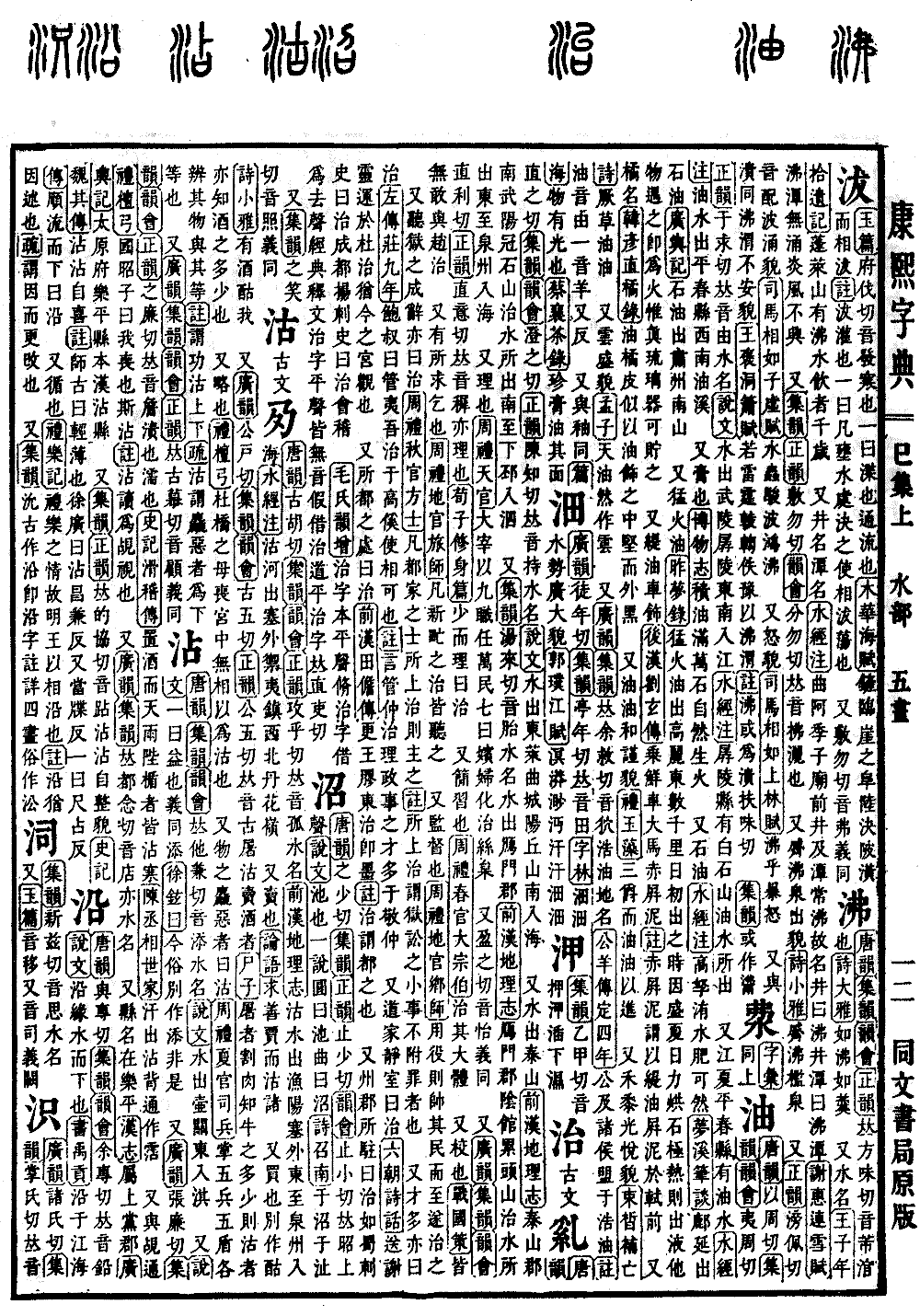
Si Collection, Upper Volume
Radical: Water (shuǐ)
Kangxi Strokes: 9
Page 614, Entry 04
Pronounced you.
Pronounced you.
Pronounced you.
The reading is the same as you. It refers to the name of a river. The Explaining Graphs and Analysis of Characters (Shuowen Jiezi) records: The You River originates in Chanling County, Wuling Commandery, and flows southeast into the Yangtze River. The Commentary on the Classic of Waterways (Shuijing Zhu) records: There is White Stone Mountain in Chanling County, which is the source of the You River. Additionally, Pingchun County in Jiangxia Commandery also has a You River. The Commentary on the Classic of Waterways (Shuijing Zhu) records: The You River originates at You Creek, southwest of Pingchun County.
It also refers to oil or grease. The Records of Investigations of Things (Bowuzhi) records: If ten thousand dan of grease are gathered together, they will spontaneously ignite.
It also refers to petroleum. The Commentary on the Classic of Waterways (Shuijing Zhu) records: The Wei River in Gaonu has grease on its surface that can be ignited. The Brush Talks from Dream Brook (Mengxi Bitan) records: The Fuyan region produces petroleum. The Records of the Vast World (Guangyuji) records: Petroleum is produced in the southern mountains of Suzhou.
It also refers to fierce-fire oil. The Records of Yesterday’s Dreams (Zuomenglu) records: Fierce-fire oil is produced several thousand li east of Goryeo. When the sun first rises, the heat of the summer sun causes the stones to become extremely hot and seep out a liquid; if anything else touches it, it will ignite. Only genuine glass vessels can contain it.
It also refers to ti-oil, a decorative element on a carriage. The Book of the Later Han (Hou Hanshu), Biography of Liu, records: Riding in carriages with bright decorations and tall horses, with red mud-screens in front of the carriage bar. The commentary states: The red mud-screen refers to a mud-screen in front of the carriage bar coated with ti-oil.
It also refers to a type of orange. The Record of Oranges (Julu) by Han Yanzhi records: The oil orange has a skin that looks as if it has been coated in oil, with firm flesh and a dark-colored peel.
It also refers to you-you, describing a gentle and respectful demeanor. The Book of Rites (Liji) records: After drinking three cups of wine, one retires in a gentle and respectful manner.
It also describes the glossy and pleasing appearance of grain. The Supplementary Poems (Buwangshi) by Shu Xi records: The grass there is glossy and luxuriant.
It also describes the density of clouds. The Book of Mencius (Mengzi) records: The sky is filled with dense clouds rising up.
Pronounced you (falling tone).
Haoyou is the name of a place. The Commentary of Gongyang (Gongyang Zhuan) on the fourth year of Duke Ding records: Duke Ding and the feudal lords held an alliance at Haoyou. The commentary states: The sound of you is like you; another pronunciation is yang-you.
Also written as a variant form of glaze (you). The Collection of Characters (Pianhai) refers to the glossy surface of an object. The Record of Tea (Chalu) by Cai Xiang records: The surface of precious tea paste is glossy and bright.
Verification: In the Book of Rites (Liji), the text reads: After three cups of wine, they proceed in a gentle and respectful manner. We have noted that the original text has been corrected from proceed to retire.