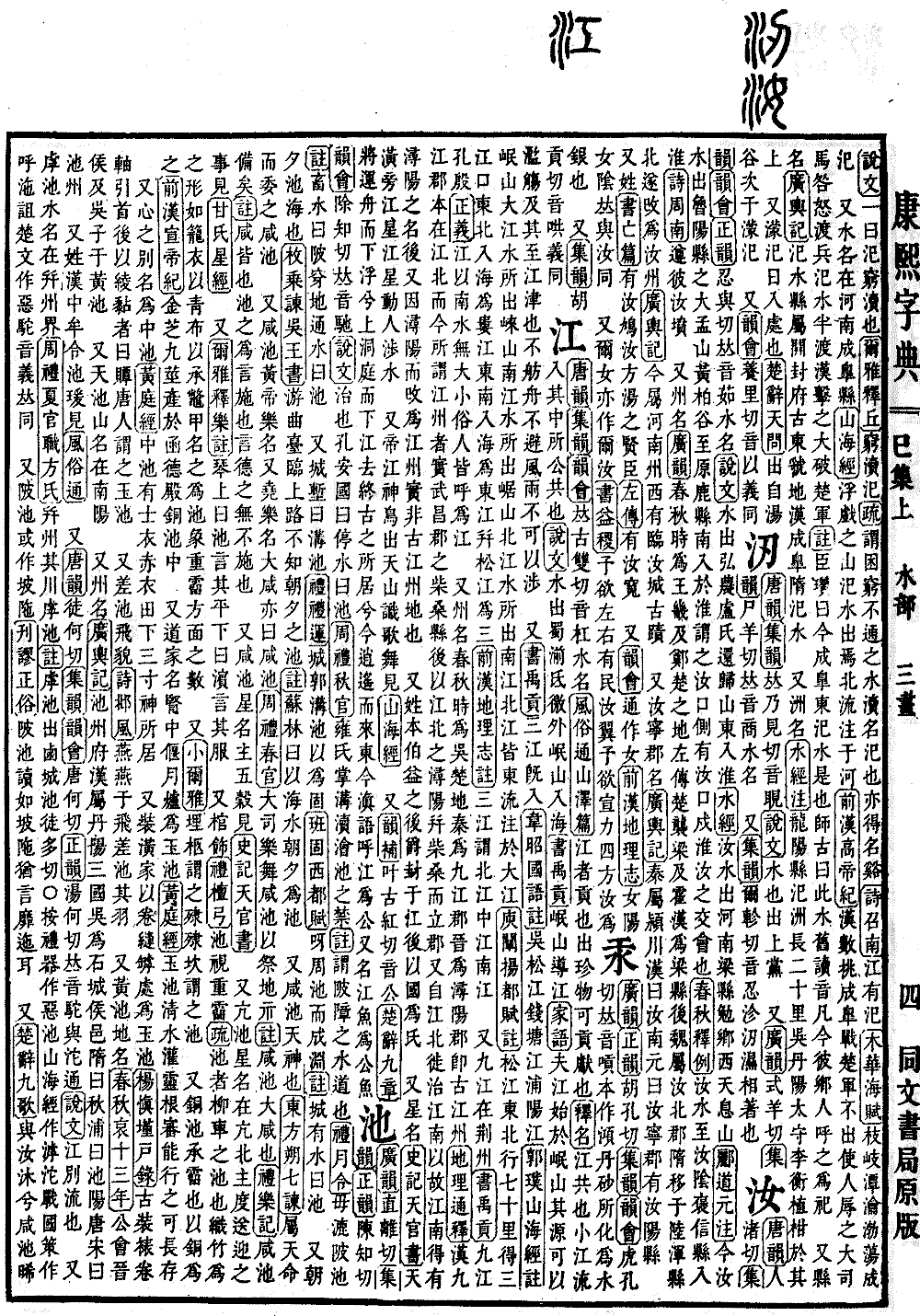
Si Collection, Upper Volume
Radical: Water (shuǐ)
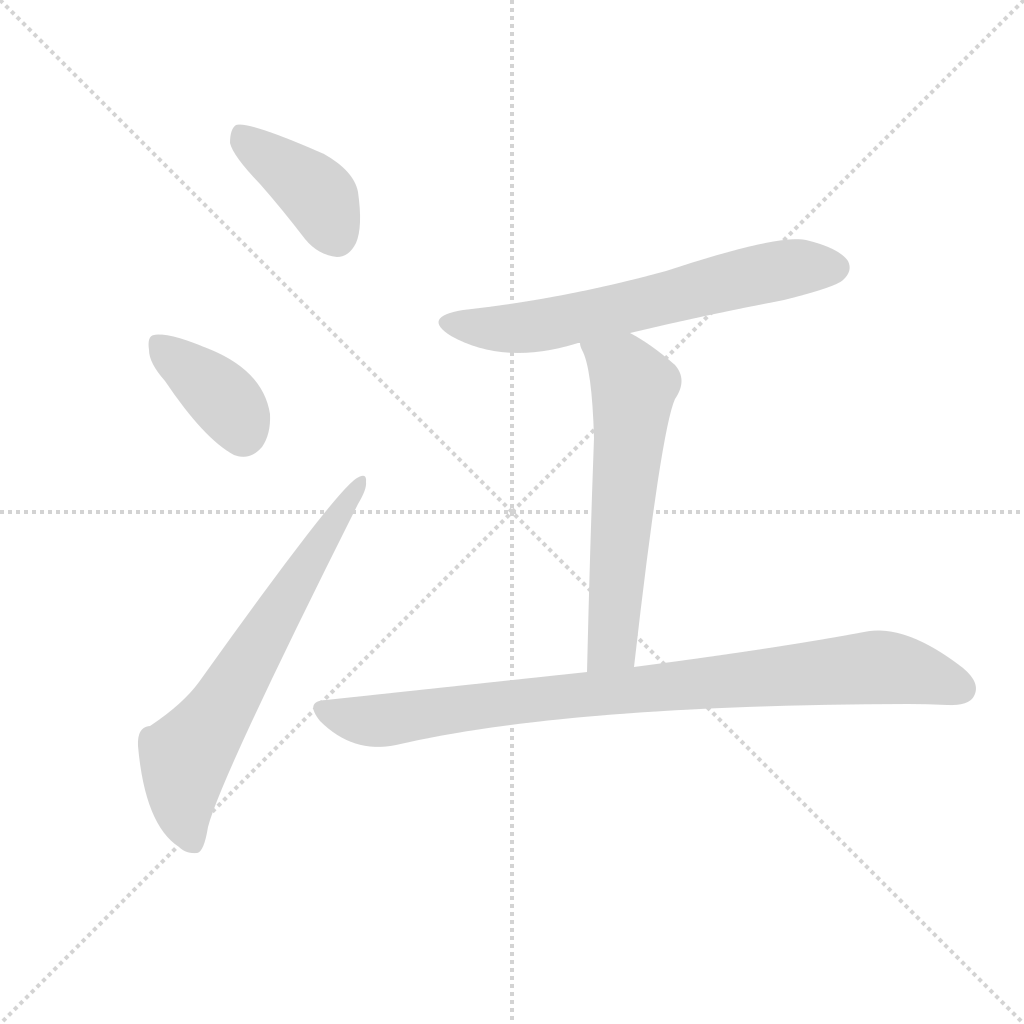
江
Kangxi strokes: 7
Page 606, Entry 04
Pronounced gāng. The name of a river.
General Customs (Fengsu Tong), Section on Mountains and Marshes: The term Jiang signifies tribute. It produces precious items that can be presented as tribute.
Explanation of Names (Shiming): Jiang means common. Small rivers flow into it, making it something shared by all.
Analytical Dictionary of Characters (Shuowen Jiezi): The Jiang River originates from the Min Mountains, outside the border of the Jian ethnic group in the Shu region, and flows into the sea.
Classic of History (Shangshu), Tribute of Yu (Yu Gong): The Min Mountains guide the Yangtze River.
School Sayings of Confucius (Kongzi Jiayu): The Yangtze River originates in the Min Mountains; at its source, the flow is so small that it can only float a wine cup. By the time it reaches Jiangjin, it cannot be crossed without a boat, and one cannot evade wind and rain.
Also, Classic of History (Shangshu), Tribute of Yu (Yu Gong): The three rivers have flowed into the sea.
Wei Zhao’s Commentary on Discourses of the States (Guoyu): The three rivers refer to the Wusong River, the Qiantang River, and the Puyang River.
Guo Pu’s Commentary on Classic of Mountains and Seas (Shanhaijing): The Min Mountains are the source of the Great River (Yangtze). The Lai Mountains are the source of the South River. The Ju Mountains are the source of the North River. Both the South and North rivers flow eastward into the Great River.
Yu Chan’s Commentary on Rhapsody on the Capital of Yang (Yangdu Fu): The Song River flows northeast for seventy li to reach the Three Rivers Estuary; the branch flowing northeast into the sea is the Lou River, and the branch flowing southeast into the sea is the East River, which, combined with the Song River, constitutes the three rivers.
Commentary on the Geography Treatise in the History of the Former Han (Qianhan Shu): The three rivers refer to the North, Middle, and South rivers.
Also, the Nine Rivers (Jiujiang) are located in the Jing Province region.
Classic of History (Shangshu), Tribute of Yu (Yu Gong): The Nine Rivers are numerous and their waters are vast.
Correct Meaning of the Classic of History (Shangshu Zhengyi): South of the Yangtze River, all bodies of water, regardless of size, are commonly referred to as Jiang by the people.
Also, a province name. During the Spring and Autumn period, it belonged to the territories of the Wu and Chu states; during the Qin dynasty, it was the Jiujiang Commandery; during the Jin dynasty, it was the Xunyang Commandery, which was the ancient Jiang Province.
General Explanations of Geography (Dili Tongshi): The Jiujiang Commandery of the Han dynasty was originally located north of the Yangtze River, but the place currently known as Jiang Province is actually Chaisang County of Wuchang Commandery. Later, Xunyang and Chaisang, located north of the Yangtze, were merged to establish a commandery, and the administrative seat was moved from north of the river to south of the river; thus, the name Xunyang came to be used south of the river. Later, it was renamed Jiang Province because of Xunyang, though it is not actually the territory of the ancient Jiang Province.
Also, a surname. Descendants of Boyi who were enfeoffed in the Jiang region, later taking the name of the fief as their surname.
Also, a star name. Records of the Grand Historian (Shiji), Treatise on the Celestial Offices: Beside the Tianhuang star is the Jiang star. When the Jiang star oscillates, it portends that someone will cross a river.
There is also the Dijiang, a divine bird. It originates from the Heaven Mountains and understands singing and dancing. Found in the Classic of Mountains and Seas (Shanhaijing).
Also, as a phonetic supplement, pronounced gōng.
Songs of Chu (Chu Ci), Nine Chapters (Jiuzhang): I shall steer the boat and drift downstream, with Dongting above and the Yangtze below. Leaving the home where my ancestors have lived for generations, I now drift toward the East.
In contemporary Yunnan dialect, the Jiang is called gong. Fish found in the Jiang are also called gong fish.