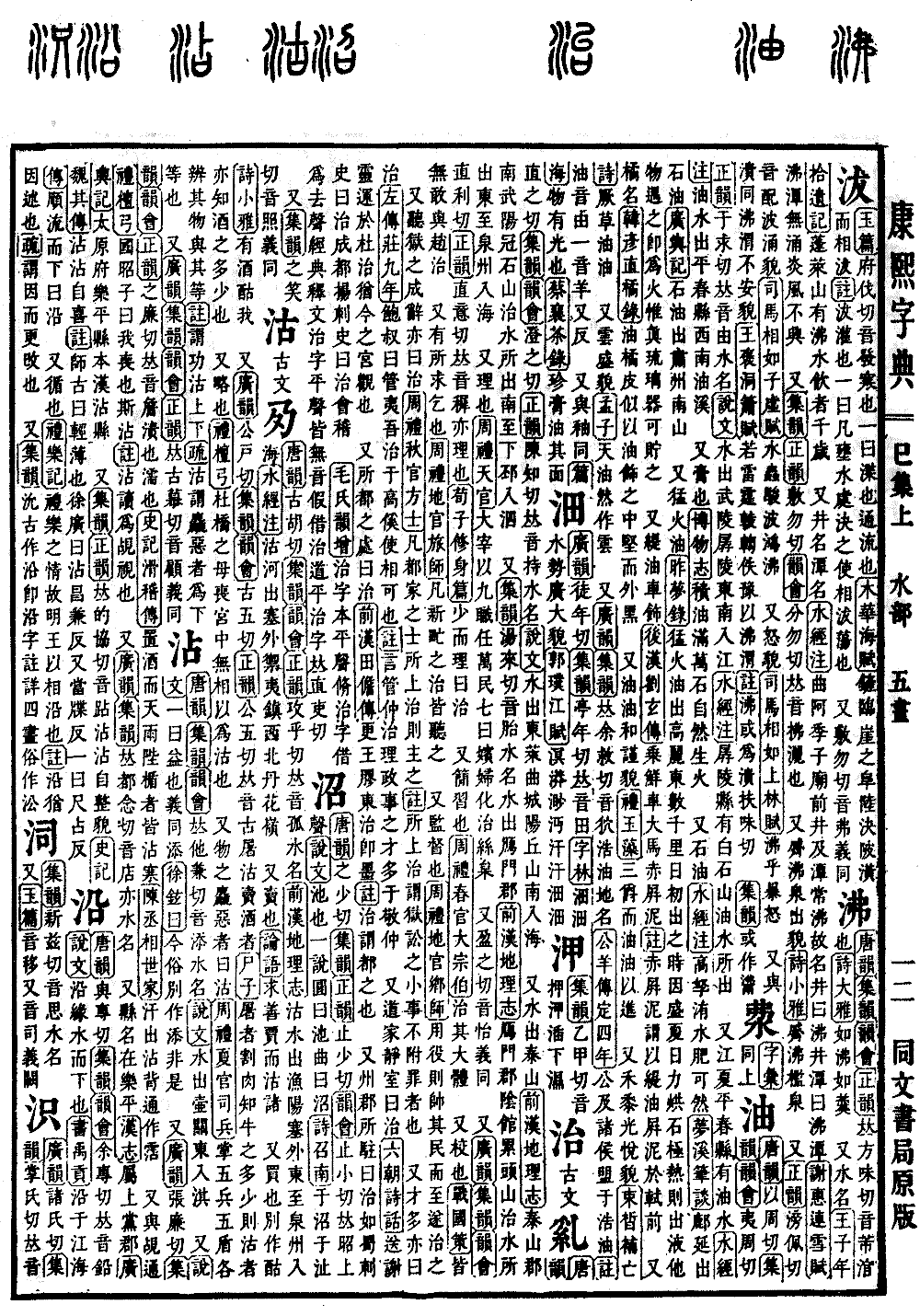
Si Collection, Upper Volume
Radical: Water (shuǐ)
Page 614, Entry 12
Pronounced tian. It is the name of a river. According to the Explaining Graphs and Analyzing Characters (Shuowen Jiezi), this river originates in Huguan and flows east into the Qi River. Another interpretation in the same text defines it as meaning to increase, with the same meaning as the character for add. Xu Xuan notes that people have now created a separate character for add, which is incorrect.
Pronounced zhan. It means to dampen or moisten. In the Records of the Grand Historian (Shiji), Biography of the Jesters, it mentions the setting of a banquet when it began to rain, leaving the guards by the stairs cold and wet. In the Biography of Chancellor Chen, it describes sweat soaking through one's back; this meaning is also equivalent to the variant character zhan.
It is also interchangeable with the character chan. In the Book of Rites (Liji), record of Tan Gong, Guo Zhaoxi states: When I performed funeral rites, I personally observed the proceedings. Here, the character is pronounced and used like chan, meaning to observe.
Pronounced dian. It is also the name of a river. It is also the name of a county located in the Leping region. The Book of Han (Hanshu), Treatise on Geography, records it as belonging to Shangdang Commandery. The Records of Universal Geography (Guangyu Ji) records that Leping County in Taiyuan Prefecture was originally Zhan County during the Han Dynasty.
Pronounced die. The reduplicated form zhanzhan describes the appearance of someone feeling self-satisfied or pleased with themselves. In the Records of the Grand Historian (Shiji), Biography of Marquis Weiqi and Marquis Wu'an, it is used in the phrase self-satisfied (zhanzhan zixi). The commentator Shigu notes that it means frivolous and lacking in gravity. Xu Guang states that the character has a pronunciation of changjian, another of dangdie, and a third interpretation of chizhan.