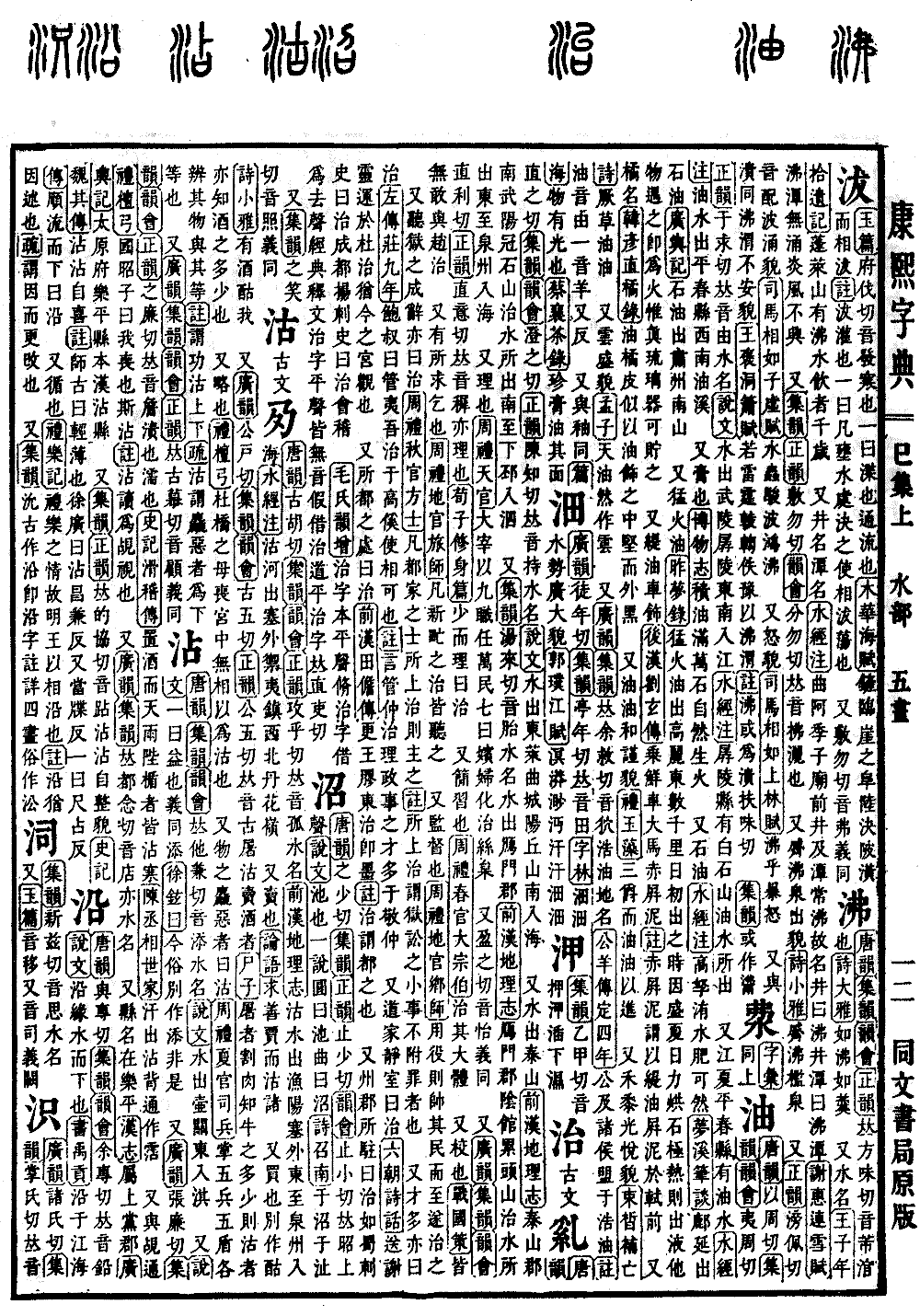
Si Collection, Upper Volume
Radical: Water (shuǐ)
Kangxi Strokes: 9
Page 614, Entry 07
Ancient form: 乿
Pronounced chi (level tone)
The name of a river. According to the Explanation of Characters (Shuowen), the river rises in Mount Yangqiu, Qucheng, Donglai, and flows south into the sea. Another river by the same name rises in Mount Tai. According to the History of the Former Han (Qianhan shu), Geography Treatise, the Zhi River rises in Mount Guanshi in Nanwuyang, Tai Mountain, and flows south to Xiapi, where it enters the Si River.
Also pronounced tai (level tone). The name of a river. The river rises in Yanmen Commandery. According to the History of the Former Han (Qianhan shu), Geography Treatise, the Zhi River rises in Mount Leitou, Yinguan, Yanmen Commandery, and flows east to Quanzhou, where it enters the sea.
Also means to manage or regulate. In the Rites of Zhou (Zhouli), Heaven Offices, the Grand Coordinator utilizes the nine official duties to appoint the myriad people; the seventh is to supervise women in the processing of silk and hemp.
Also pronounced yi (level tone). The meaning is the same.
Pronounced zhi (falling tone). Also means to manage or regulate. In the Xunzi, Cultivating the Self Chapter, it is written: when young and regulated, it is called zhi.
Also means to practice or study. In the Rites of Zhou (Zhouli), Spring Offices, Grand Minister of Rites: to practice the grand rites.
Also means to verify or scrutinize. In the Strategies of the Warring States (Zhanguo Ce): none dared to verify with Zhao.
Also means to request or petition. In the Rites of Zhou (Zhouli), Earth Offices, Travel Officer: for all new arrivals, listen to their petitions.
Also means to supervise. In the Rites of Zhou (Zhouli), Earth Offices, Rural Officer: when utilizing corvée labor, lead the people and supervise them.
Also refers to the final verdict of a legal case. In the Rites of Zhou (Zhouli), Autumn Offices, Square Officer: for all matters submitted to the capital and family officials, govern them. The commentary states that the matters submitted refer to minor lawsuits and disputes that do not involve criminal punishment.
Also refers to someone of great talent. In the Zuo Tradition (Zuozhuan), Duke Zhuang, Year 9, Bao Shu says: Guan Yiwu is better at managing affairs than Gao Xi, and can serve as prime minister. The commentary explains that Guan Zhong possessed more talent for managing political affairs than Jing Zhong.
Also refers to the quiet chambers of Daoists. In the Poetry Talk of the Six Dynasties (Liuchao Shihua): seeing off Xie Lingyun at the Du chamber, similar to the temples and monasteries of today.
Also refers to a place where one resides as a capital. In the History of the Former Han (Qianhan shu), Biography of Tian Dan: made king of Jiaodong, with the capital at Jimo. The commentary states that capital here means the place of residence.
Also refers to the administrative seat where a prefecture or commandery official is stationed, such as the Governor of Shu residing in Chengdu, or the Governor of Yang residing in Kuaiji.
According to the Mao Family Rhyme Additions (Mao Shi Yun Zeng), the character zhi was originally in the level tone; it was borrowed in the falling tone for the sense of repairing or regulating. In the Classical Text Explanations (Jingdian Shiwen), the character is never given a level tone pronunciation; for the sense of managing the Way or peaceful governance, it is pronounced zhi (falling tone).
Textual correction: In the Rites of Zhou (Zhouli), Spring Offices, Grand Minister of Rites, the original text says to practice the grand rites (da li), not the grand body (da ti).