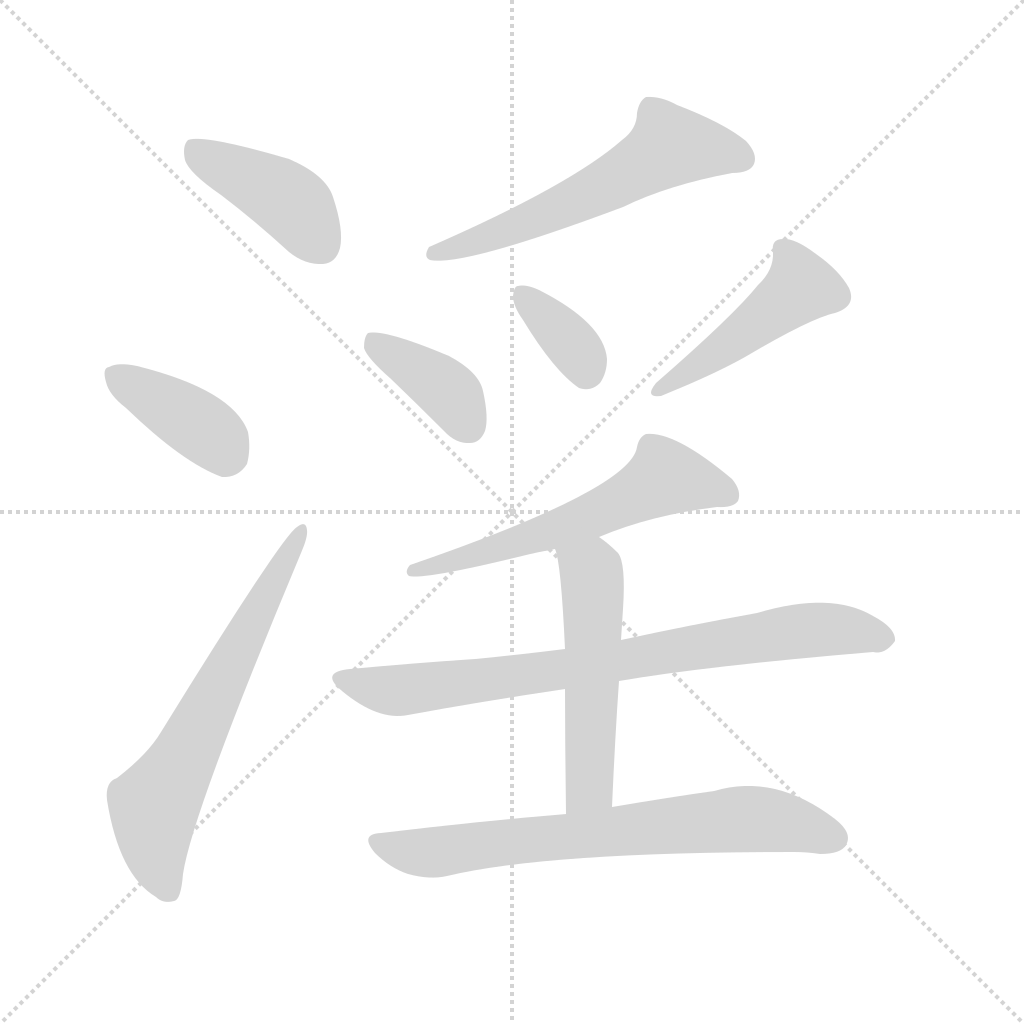
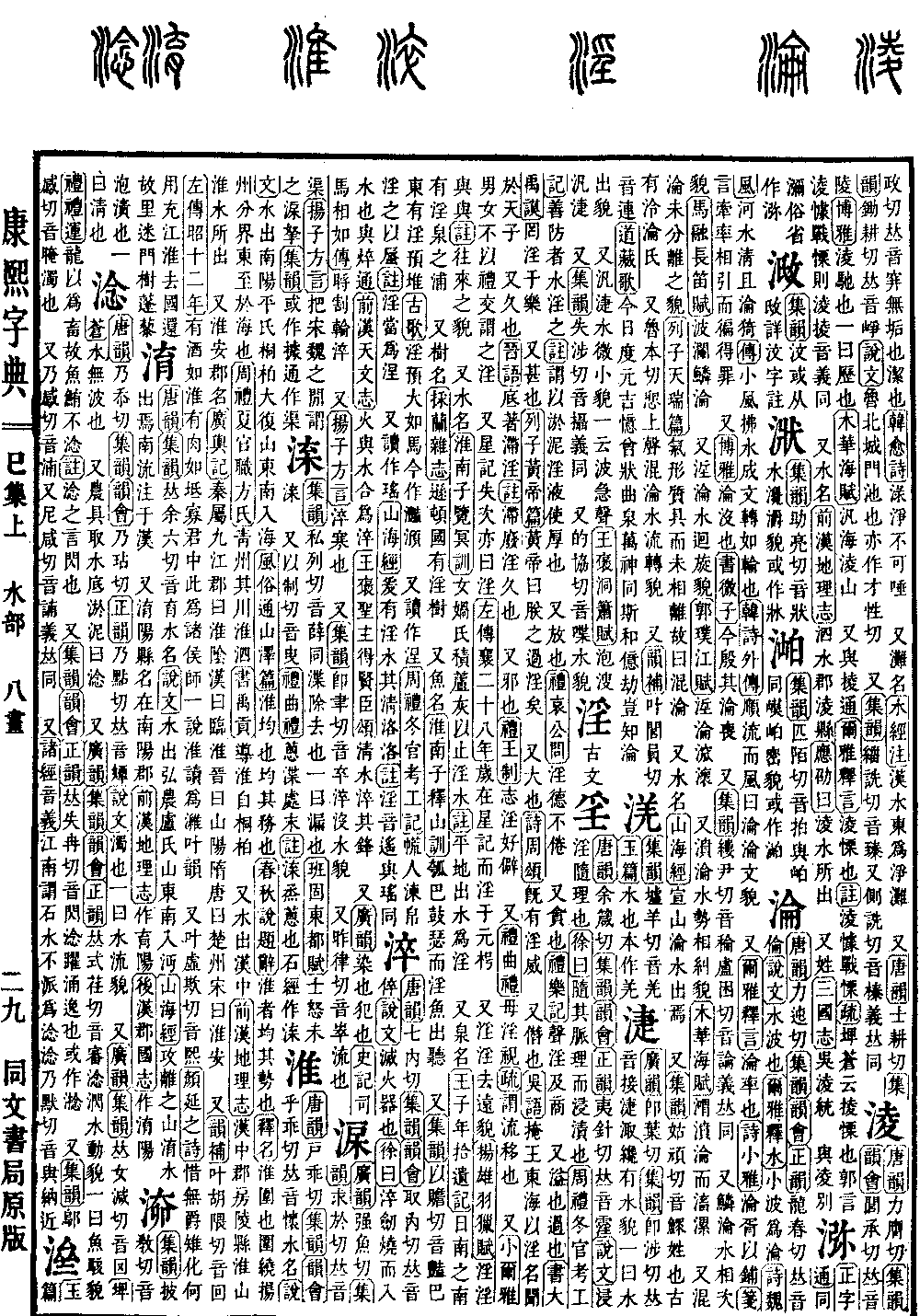
Si Collection, Upper Volume
Radical: Water (shuǐ)
Yin; Kangxi strokes: 12; Page 631, Entry 09
Ancient form. Pronounced yin.
Shuowen Jiezi (Explaining Single-component Characters and Analyzing Compound Characters): To soak or immerse, following the natural grain or principle.
Xu Kai says: To soak and permeate according to the veins or structure of an object.
Book of Rites (Zhouli), Winter Officers, Record of Trades: Those who are good at building dikes use water to soak them.
Commentary: This refers to using silt-laden liquid to soak the dikes, making them thicker.
Also: To release or be unrestrained.
Book of Rites (Liji), Questions of Duke Ai: Unrestrained in virtue and never weary.
Also: To be greedy or gluttonous.
Book of Rites (Liji), Record of Music: When music is excessive and reaches the Shang note.
Also: To overflow or exceed limits.
Book of Documents (Shangshu), Counsels of the Great Yu: Do not be excessive in musical enjoyment.
Also: Extreme or severe.
Liezi, Yellow Emperor Chapter: The Yellow Emperor said: My errors have been extreme.
Also: Great.
Book of Odes (Shijing), Odes of Zhou: Already possessing great majesty.
Also: To usurp or overstep.
Discourses of the States (Guoyu), Narratives of Wu: Seizing the eastern seas of the King, and gaining a reputation for usurpation before the Son of Heaven.
Also: To be long-lasting or protracted.
Discourses of the States (Guoyu), Narratives of Jin: The foundations are obstructed and the stagnation is long-lasting.
Commentary: Stagnation is a state of abandonment and long-standing delay.
Also: Wicked or depraved.
Book of Rites (Liji), Royal Regulations: With intentions that are wicked and preferences that are perverse.
Also: Book of Rites (Liji), Qu Li: Do not look with an unfocused or wandering gaze.
Sub-commentary: This refers to eyes that drift or wander.
Also: Xiao Erya: When men and women interact without observing the proper rituals, this is called lewdness or illicit relations.
Also: When the planet Jupiter loses its expected position, this is also called yin.
Zuo Tradition (Zuozhuan), 28th Year of Duke Xiang: The year was in the Xingji constellation, and it moved into the Yuanxiao constellation.
Also: Yin-yin, the appearance of going far away.
Yang Xiong, Rhapsody on Feather Hunting: Moving far off and leisurely.
Commentary: The appearance of coming and going.
Also: Name of a water source.
Huainanzi, Surveying the Obscure: Nuwa gathered reed ashes to stem the overflowing waters.
Commentary: Water emerging on flat ground is called yin.
Also: Name of a spring.
Wang Zinian, Records of Occurrences (Shiyiji): South of Rinan, there is the bay of the Yin Spring.
Also: Name of a tree.
Cailan Zazhi: The country of Xundun has the Yin tree.
Also: Name of a fish.
Huainanzi, Explaining Mountains: When Hubu played the zither, the Yin fish emerged to listen.
Also: Pronounced yan. In Badong, there is the Yanyu Mound.
Ancient Song: The Yanyu is as large as a horse. Nowadays written as Yanyu.
Also: Pronounced nie.
Book of Rites (Zhouli), Winter Officers, Record of Trades: The dyer treats the silk, soaking it with clam ash.
Commentary: Yin should be read as nie.
Also: Pronounced yao.
Classic of Mountains and Seas (Shanhaijing): There is the Yin River, its waters clear and flowing.
Commentary: Yin is pronounced yao, the same as yao (jade-like).