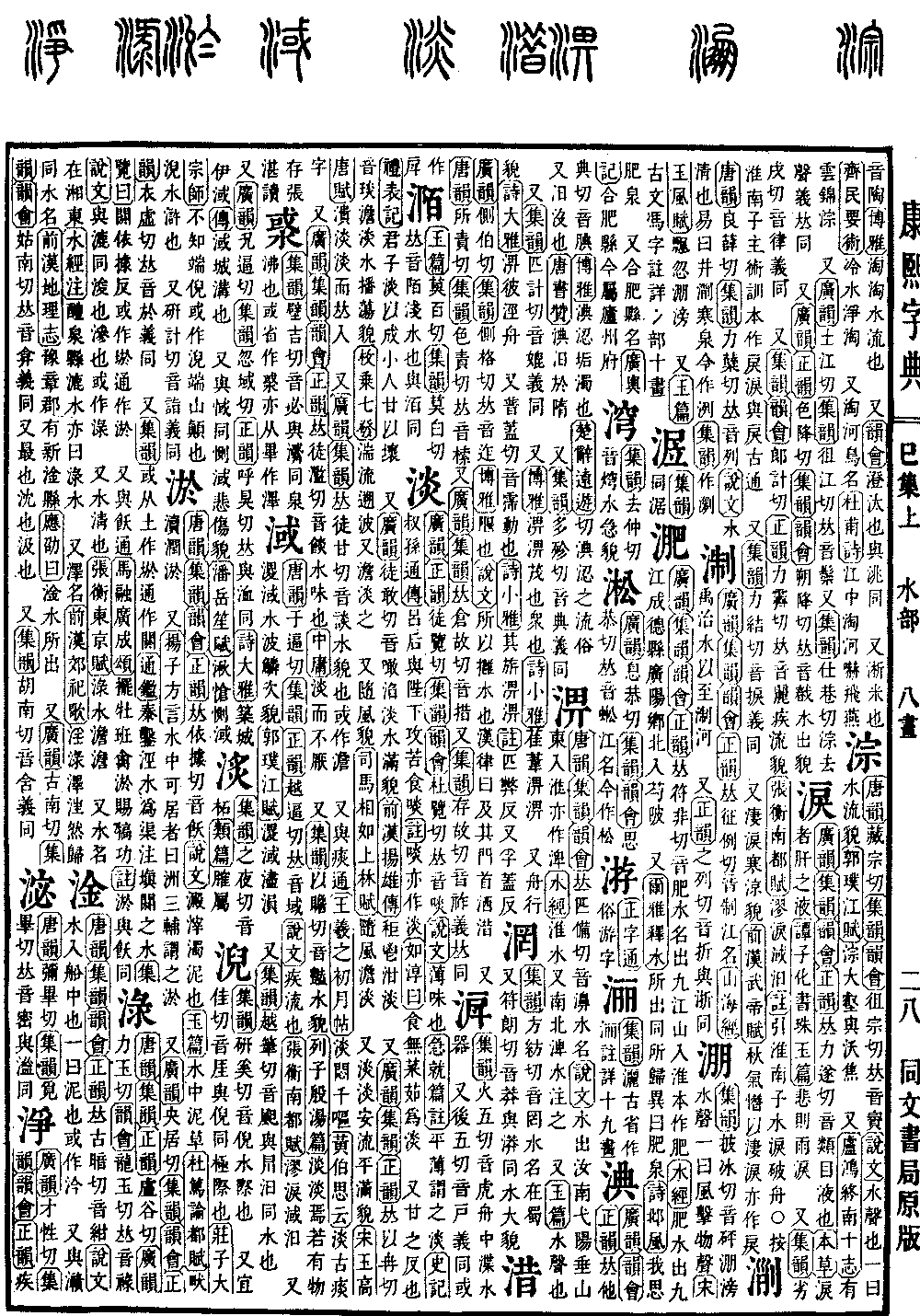
Si Collection, Upper Volume
Radical: Water (shuǐ)
Kangxi Strokes: 12
Page 630, Entry 18
Pronounced dan.
According to the Shuo Wen Jie Zi (Explaining Graphs and Analyzing Characters), it refers to a flavor that is not rich.
According to the commentary on the Emergency Primer (Jijiu Pian), a flavor that is plain and thin is called dan.
In the Records of the Grand Historian (Shiji), Biography of Shusun Tong, it is written that Empress Lu and the Emperor suffered hardships and ate simple food. The commentary notes that it is also written as dan.
Ru Chun states that eating food without vegetables is called dan. It also refers to a flavor that is the opposite of sweet.
In the Book of Rites (Liji), Record of Expressions of Feelings, it is stated that a gentleman achieves success through being simple and detached, while a small man is ruined by indulgence in sweetness.
Pronounced dan.
Describes the appearance of water that is full.
In the Book of Han (Hanshu), Biography of Yang Xiong, it mentions the fragrance of black millet wine.
Pronounced yan.
Describes the appearance of water waves shaking and undulating.
In the Seven Stimuli (Qi Fa) by Mei Sheng, it describes rushing water flowing against the waves and undulating gently.
Also refers to swaying with the wind.
In the Rhapsody on the Shanglin Park (Shanglin Fu) by Sima Xiangru, it describes the movement following the wind.
Also, refers to the appearance of water flowing steadily and overflowing.
In the Gaotang Rhapsody (Gaotang Fu) by Song Yu, it describes water waves breaking apart and flowing in a calm, steady manner.
Pronounced tan.
Describes the appearance of water. Sometimes written as a variant form (dàn).
Also interchangeable with the character for phlegm (tán).
In the First Month Letter (Chuyue Tie) by Wang Xizhi, it mentions a feeling of fullness and nausea. Huang Bosi notes that in this context, the character is the ancient form for phlegm.
Pronounced dan.
The flavor of water.
In the Doctrine of the Mean (Zhongyong), it describes a state of being simple and peaceful without causing weariness.
Pronounced yan.
Describes the appearance of water.
In the Liezi, Tang Questioning Chapter (Tangwen Pian), it describes a quiet and indistinct state as if something exists. Zhang Zhan follows this reading.
Textual research: In the Liezi, Yin Tang Chapter has been corrected to Tang Questioning Chapter according to the original text.