Si Collection, Upper Volume
Radical: Water (shuǐ)
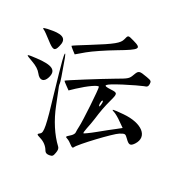
Yun; Kangxi strokes: 8
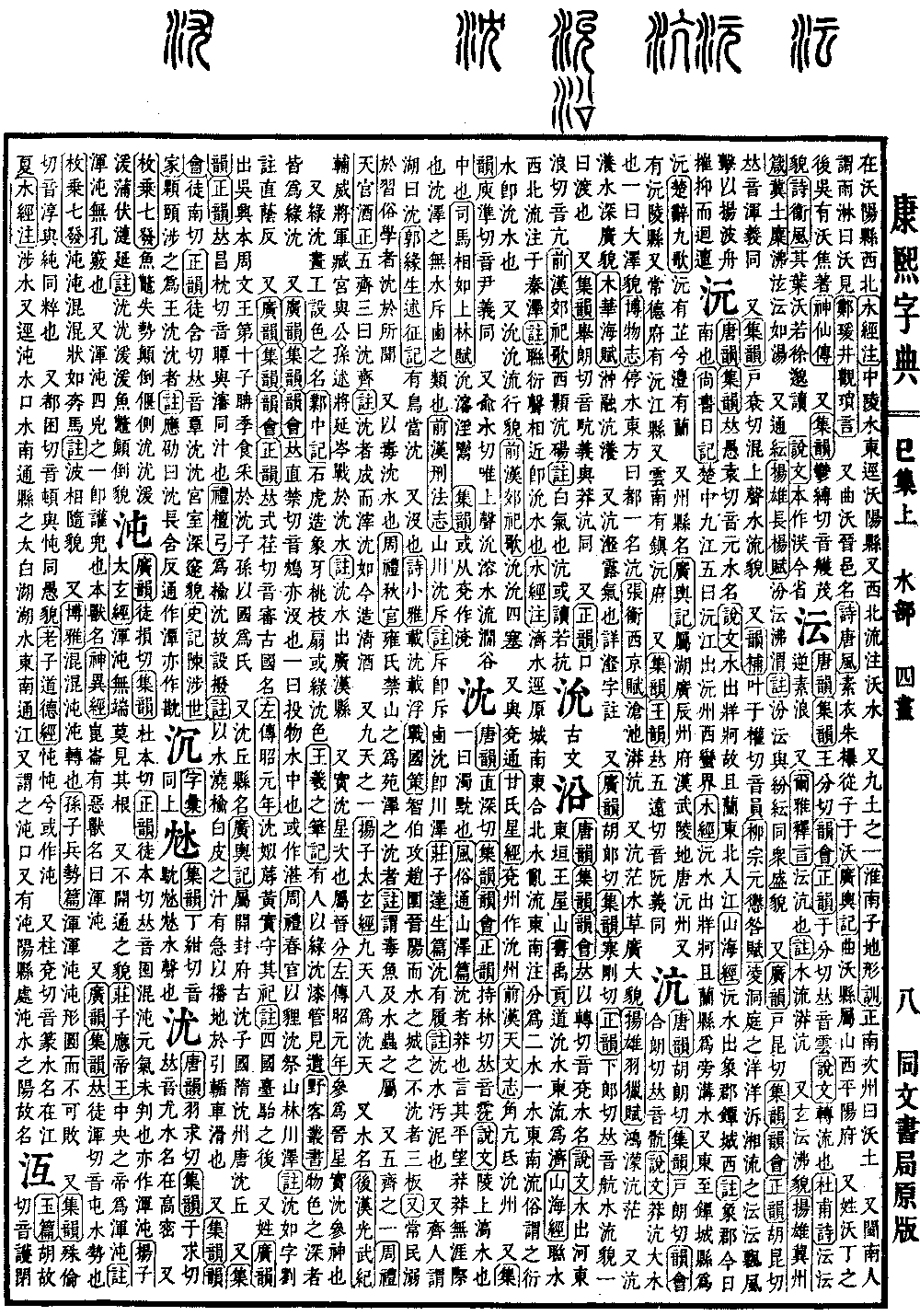
Page 610, Entry 01
According to Tang Rhymes (Tangyun) and Collection of Rhymes (Jiyun), it is pronounced yun. According to Dictionary of Rhymes (Yunhui) and Correct Rhymes (Zhengyun), it is pronounced yun. According to Explaining Graphs and Analyzing Characters (Shuowen), it means water flowing and turning. In a poem by Du Fu, it says, Flowing and swirling against the white waves. Also, according to Progress to Refinement (Erya), Shiyan chapter, it means vast. The commentary notes that it describes the appearance of water flowing in a vast and expansive manner. Also, it describes the appearance of boiling. In the Admonition for Jizhou by Yang Xiong, it is written that the land of Jizhou is bubbling and swirling like boiling soup. It is also used interchangeably with the character meaning abundant and chaotic. In the Changyang Rhapsody by Yang Xiong, it mentions boiling and swirling. The commentary notes that this is the same as abundant and chaotic, describing a large crowd or profusion. Also, according to Broad Rhymes (Guangyun), it is pronounced hun. According to Collection of Rhymes (Jiyun), Dictionary of Rhymes (Yunhui), and Correct Rhymes (Zhengyun), it is pronounced hun. The meaning is the same. Also, according to Collection of Rhymes (Jiyun), it is pronounced hun (rising tone), meaning the appearance of flowing water. Also, according to Supplement to Rhymes (Yunbu), it is rhymed with the sound yuan. In the Poem on Repenting Faults by Liu Zongyuan, it says, Traversing the vastness of Dongting Lake, moving against the swirling currents of the Xiang River. The strong winds strike to raise waves; the boat is shattered and suppressed, turning back and forth.
Verification: In the Poem on Repenting Faults by Liu Zongyuan, the text is given as moving against the swirling currents. Following the original text, the character has been corrected from the variant to moving against.