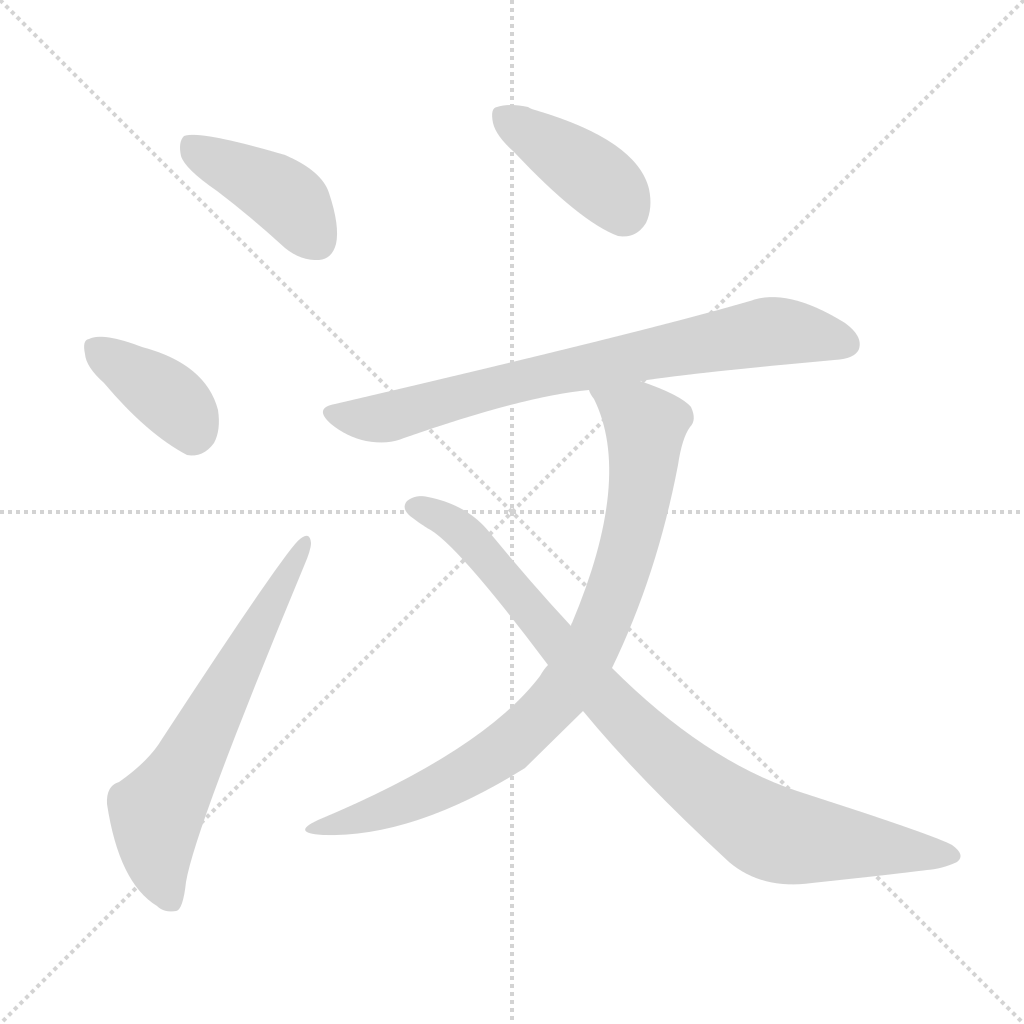
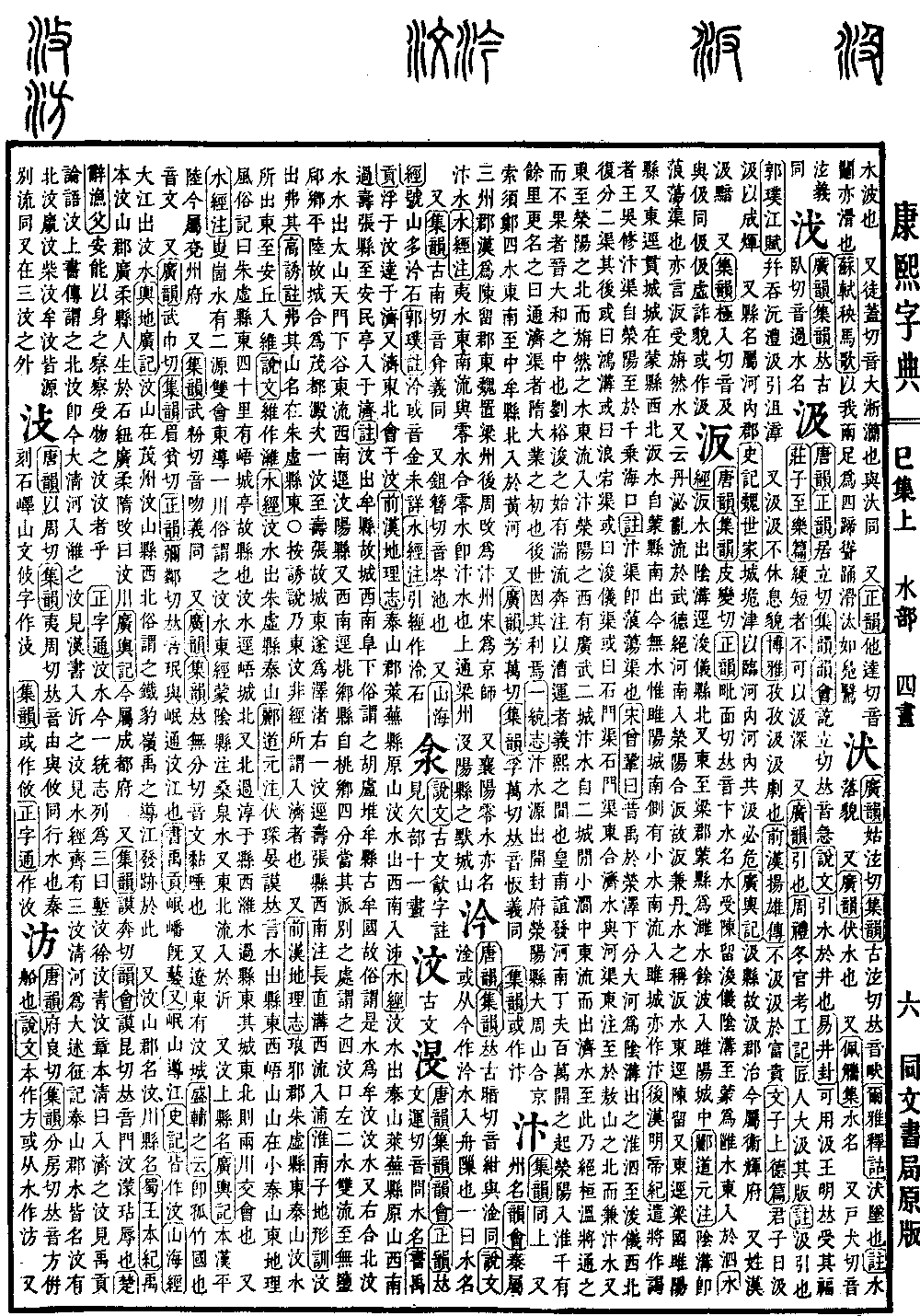
Si Collection, Upper Volume. Radical: Water (shuǐ). Wen. Kangxi Dictionary stroke count: 8. Page 608, Entry 08.
Ancient writing form is written as a variant (min).
Tang Rhymes (Tangyun), Collection of Rhymes (Jiyun), Rhyme Compendium (Yunhui), and Correct Rhymes (Zhengyun) record its pronunciation as wen (falling tone), sounding the same as the character for question (wen). It is the name of a river.
Classic of History (Shujing), Tribute of Yu (Yugong) records: Floating upon the Wen River, one arrives at the Ji River. It is also recorded that the Ji River flows northeast to converge with the Wen River.
History of the Former Han Dynasty (Qian Hanshu), Treatise on Geography records: The Yuan Mountain in Laiwu County, Taishan Commandery, is the source of the Wen River, which flows southwest into the Ji River.
Commentary on the Water Classic (Shuijing) records: The Wen River originates at the foot of Yuan Mountain in Laiwu County, Taishan, flows southwest past Shouzhang County, and enters the Ji River at Anmin Pavilion.
Note explains: The Wen River originates beneath a mound southwest of the old city of Mou County; colloquially it is called Hulu Mound. Mou County was the ancient state of Mou, so the common people refer to this water as the Mou Wen. The Wen River also merges on the right with the North Wen River. The North Wen River originates in the valley beneath Tianmen on Mount Tai, flows east, then flows southwest passing Wenyang County, and further southwest through Taoxiang County, where it divides into four branches; the place of bifurcation is called the Four Wen Mouth. Two branches on the left flow together southward to the old city of Pinglu in the area of Wuyan and Qu, where they merge to become the Maodu Marsh. Another branch of the Wen flows east of the old city of Shouzhang, forming a marshy lake. A right branch of the Wen flows southwest of Shouzhang County, enters the Changzhi Ditch, and flows west into the Ji River.
Huainanzi, Training in Topography (Dixun) records: The Wen River originates at Fuqi Mountain.
Gao You commentary explains: Fuqi is a mountain name located east of Zhuxu County. Note: What Gao You speaks of is the East Wen, not the Wen River mentioned in the classics that flows into the Ji River.
Also, History of the Former Han Dynasty (Qian Hanshu), Treatise on Geography records: East Mount Tai in Zhuxu County, Langya Commandery, is the source of the Wen River, which flows east to Anqiu County and enters the Wei River.
Analytical Dictionary of Characters (Shuowen Jiezi): The character for Wei is written as a variant (wei).
Commentary on the Water Classic (Shuijing) records: The Wen River originates at Mount Tai in Zhuxu County.
Li Daoyuan commentary cites the words of Fu Chen and Yan Mo: The Wen River originates at Wu Mountain, located east and west of Zhuxu County; Wu Mountain is east of Little Mount Tai. Geography and Customs Records (Dili Fengsu Ji) says: Forty li east of Zhuxu County is Wu City, which is the old county seat. The Wen River flows north of Wu City and flows north past the west of Chunyu County. The Wei River flows east of Chunyu County, and the northeast of that city is where the two rivers meet.
Also, Commentary on the Water Classic (Shuijing Zhu) records: The Gao River has two sources, which converge and flow east to form a river, colloquially called the Wen River, flowing east past Mengyin County, entering the Sangquan River, and flowing northeast into the Yi River.
Also, Wenshang is a county name.
Gazetteer of the Ming Empire (Guangyu Ji) records: Wenshang County was originally Pinglu County of the Han Dynasty; it now belongs to Yanzhou Prefecture.
Also, Collection of Rhymes (Jiyun) records its pronunciation as wen (rising tone), sounding the same as the character for kiss (wen). The meaning is the same.
Also, Collection of Rhymes (Jiyun) and Guangyun record its pronunciation as wen (level tone), meaning thick or sticky saliva.
Also, there is a Wen City in Liaodong.
Sheng Fuzhi says: It is the Gūzhú State. Pronounced wen (level tone).
Also, Guangyun records its pronunciation as min (level tone), Jiyun records it as min (level tone), and Correct Rhymes (Zhengyun) records it as min (level tone), sounding the same as the character for min (min). It is interchangeable with min. It refers to the Wen River (that is, the Min River).
Classic of History (Shujing), Tribute of Yu (Yugong) records: The Min and Bo Mountains are already cultivable. It also records: The Min Mountain leads the Yangtze River.
Historical Records (Shiji) uses the character for Wen in place of Min.
Classic of Mountains and Seas (Shanhaijing) records: The Great River (Yangtze) originates at Wen Mountain.
Geography Record of the Earth (Yudi Guangji) records: Wen Mountain is northwest of Wenshan County in Mao Prefecture, colloquially known as Tiebao Ridge. Great Yu's dredging of the Yangtze River began here.
Also, Wen Mountain is a commandery name. Wenchuan is a county name.
Records of the King of Shu (Shuwang Benji) records: Great Yu was originally a native of Guangrou County, Wen Mountain Commandery, born at Shiniu. Guangrou County was renamed Wenchuan County during the Sui Dynasty.
Gazetteer of the Ming Empire (Guangyu Ji) records: It now belongs to Chengdu Prefecture.
Also, Collection of Rhymes (Jiyun) records its pronunciation as men (level tone), Rhyme Compendium (Yunhui) records it as men (level tone), sounding the same as the character for gate (men). The term wenmeng means to stain or insult.
Songs of the South (Chuci), The Fisherman (Yufu) records: How can one with a body so pure, accept the staining of worldly things?
Correcting the Vulgar (Zhengzitong) records: Regarding the Wen River, the General Gazetteer (Yitongzhi) now lists three, called the Jianwen, Xuwen, and Qingwen. Zhang Benqing states: The Wen River that flows into the Ji River is seen in the Tribute of Yu and the Analects (Lunyu). Wenshang, which the commentaries call the North Wen, is the same Wen River that now flows into the Wei River, seen in the History of the Former Han Dynasty (Qian Hanshu). The Wen River that flows into the Yi River is seen in the Water Classic (Shuijing). There are three Wen Rivers in the Qi region, of which the Qing River is the main one. The Narrative of the Expedition (Shuzhengji) records: Waters in Taishan Commandery are all called Wen River; there are the North Wen, Ying Wen, Chai Wen, and Mou Wen, all having different sources but flowing in the same direction, and these are in addition to the three previously mentioned Wen Rivers.
Verification:
Commentary on the Water Classic (Shuijing Zhu) records: The Wen River flows past the southwest of Shouzhang County, entering the Changzhi Ditch, and flows west into the Pu. I respectfully note that in the original text, "into the Pu" should be changed to "into the Ji."
Classic of Mountains and Seas (Shanhaijing) records: The Great River originates at the Wen River. I respectfully note that this sentence comes from the commentary on the Classic of Mountains and Seas (Shanhaijing). I have added the word "commentary" under the word "classic" and, according to the original text, changed "Wen River" to "Wen Mountain."