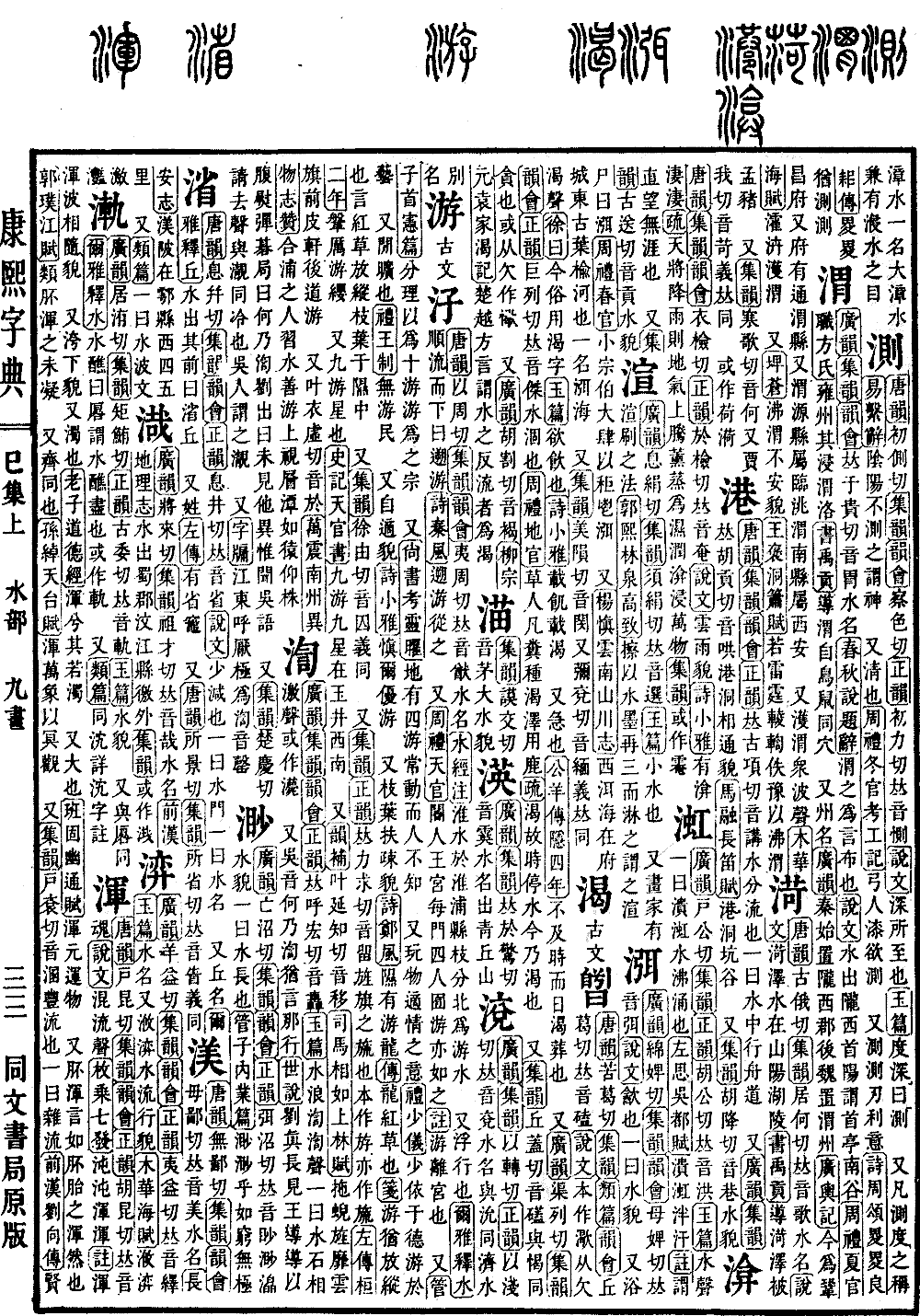
Si Collection, Upper Volume
Radical: Water (shuǐ)
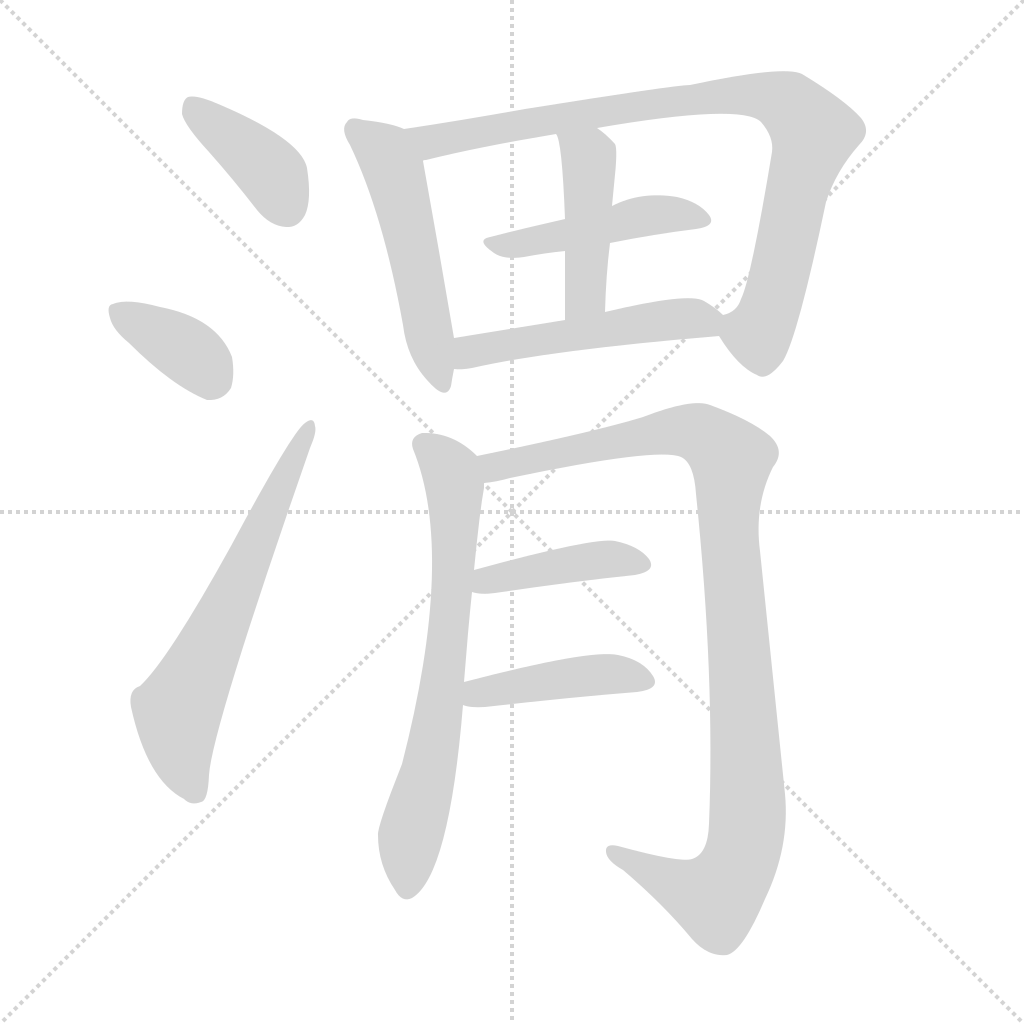
渭
Kangxi stroke count: 13
Page 635, Entry 02
Broad Rhymes (Guangyun), Collected Rhymes (Jiyun), and Collection of Rhymes (Yunhui) cite the pronunciation as wei (falling tone).
Name of a river.
Book of Spring and Autumn Annals (Chunqiu) Supplementary Explanations (Shuoti ci): The name Wei means distribution.
Etymology Dictionary (Shuowen): The Wei River originates in the valley south of Weishouting on Mount Shouyang in Longxi.
Rites of Zhou (Zhouli), Ministry of Summer, Bureau of Regional Governance: In the region of Yongzhou, the rivers include the Wei and the Luo.
Book of Documents (Shujing), Tribute of Yu (Yugong): Dredging the Wei River begins at Mount Niaoshutongxue.
Also the name of a prefecture.
Broad Rhymes (Guangyun): The Qin dynasty established Longxi Commandery; the Later Wei dynasty established Wei Prefecture.
Record of Universal Geography (Guangyu ji): It currently belongs to Gongchang Prefecture. There is also Tongwei County, Weiyuan County (belonging to Lintao Prefecture), and Weinan County (belonging to Xi'an Prefecture).
Also huowei, describing the sound of numerous waves.
Mu Hua, Rhapsody on the Sea (Hai fu): The water surges, producing a huowei sound.
Also, according to the Picang dictionary, feiwei describes an unsettled state.
Wang Bao, Rhapsody on the Bamboo Flute (Dongxiao fu): Like thunder rumbling, the sound is unrestrained and unsettled.
Textual research: Etymology Dictionary (Shuowen) states the water originates in the valley south of Weishouting, Mount Shouyang, Longxi. Following the original text, the character wei has been corrected to Wei.