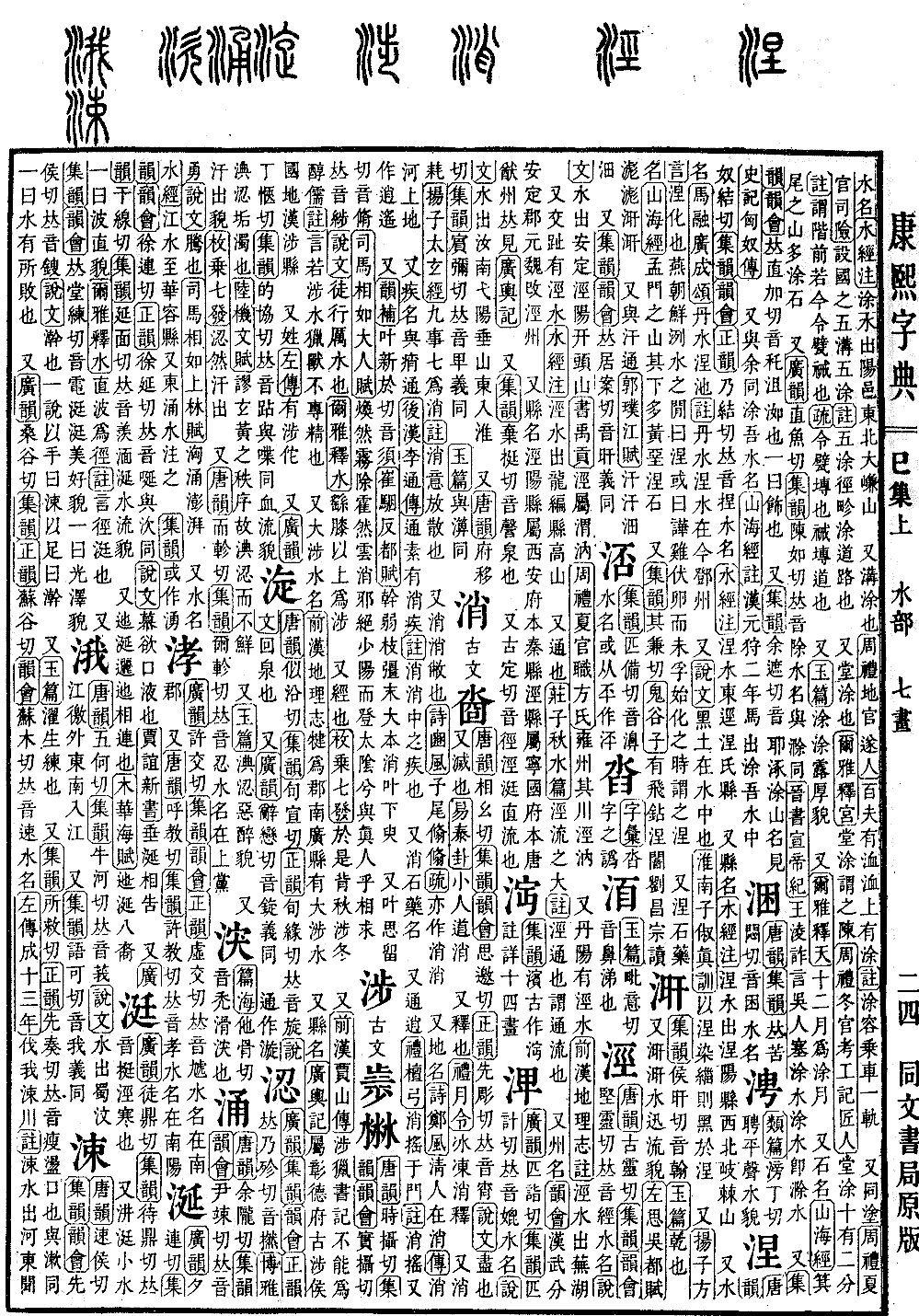
Si Collection, Upper Volume
Radical: Water (shuǐ)
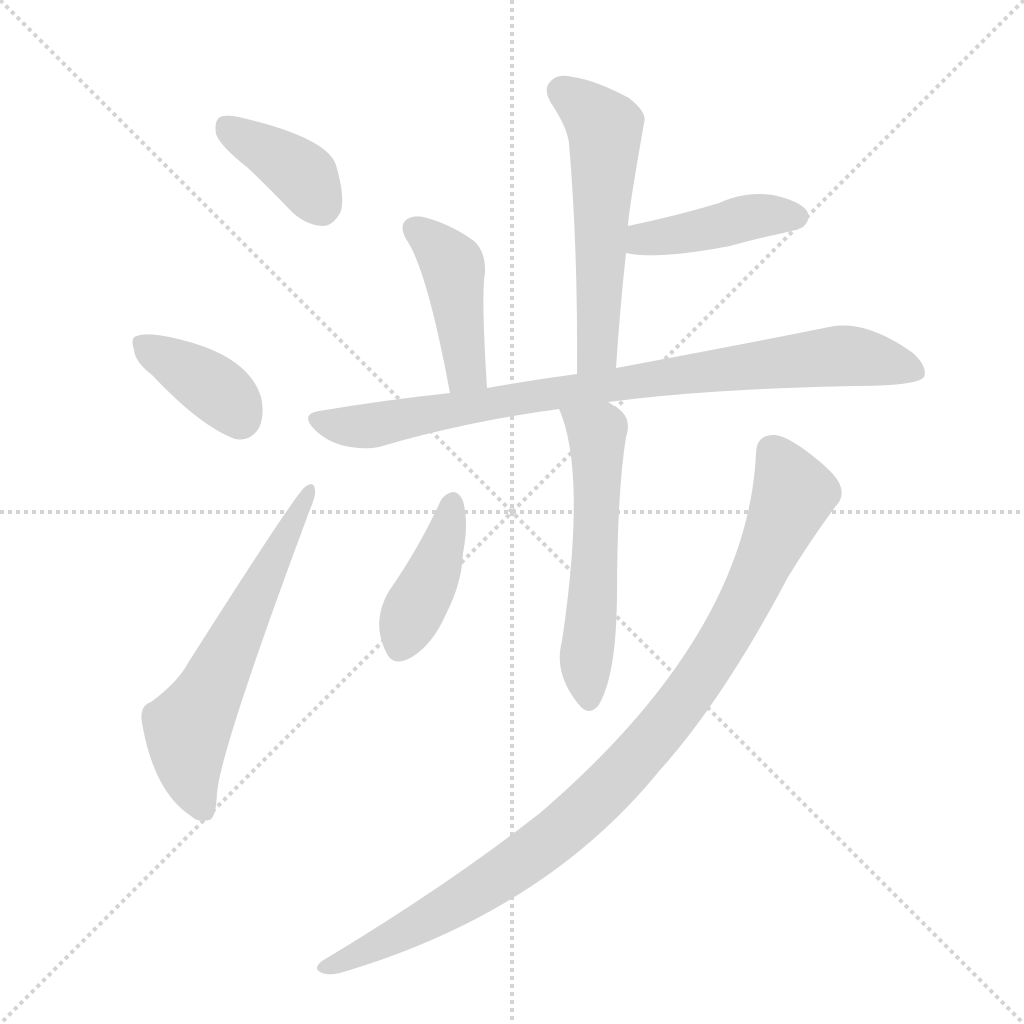
Entry: She
Kangxi stroke count: 11
Page 626, Entry 13
Ancient character. According to the Tang Rhyme (Tangyun), pronounced she. According to the Collected Rhymes (Jiyun) and the Rhyme Anthology (Yunhui), pronounced she. According to the Explaining Graphs (Shuowen), it means to cross a river on foot. According to the Literary Expositor (Erya), in the chapter on water, it states that water reaching above the knees is called she.
It also means to experience or undergo. According to Mei Cheng in Seven Stimuli (Qi Fa), it describes passing through from autumn into winter.
Also, according to the Biography of Jia Shan in the History of the Former Han (Qianhan Shu), it refers to browsing books widely without becoming a pure scholar. The commentary notes that it is like wading through water to hunt, lacking focus and depth.
Also, Great She, the name of a river. According to the Treatise on Geography in the History of the Former Han (Qianhan Shu), there is a Great She River in Nanguang County, Jianwei Commandery.
Also, a county name. According to the Record of World Geography (Guangyu Ji), it belongs to Zhangde Prefecture, the ancient territory of the State of She, and was She County during the Han Dynasty.
Also, a surname. According to the Zuo Commentary (Zuozhuan), there was She Tuo.
Also, according to the Broad Rhymes (Guangyun), pronounced die. According to the Collected Rhymes (Jiyun), pronounced die. It is the same as die, describing the appearance of blood flowing.