Si Collection, Upper Volume
Radical: Water (shuǐ)
Kangxi Strokes: 14
Page 634, Entry 10
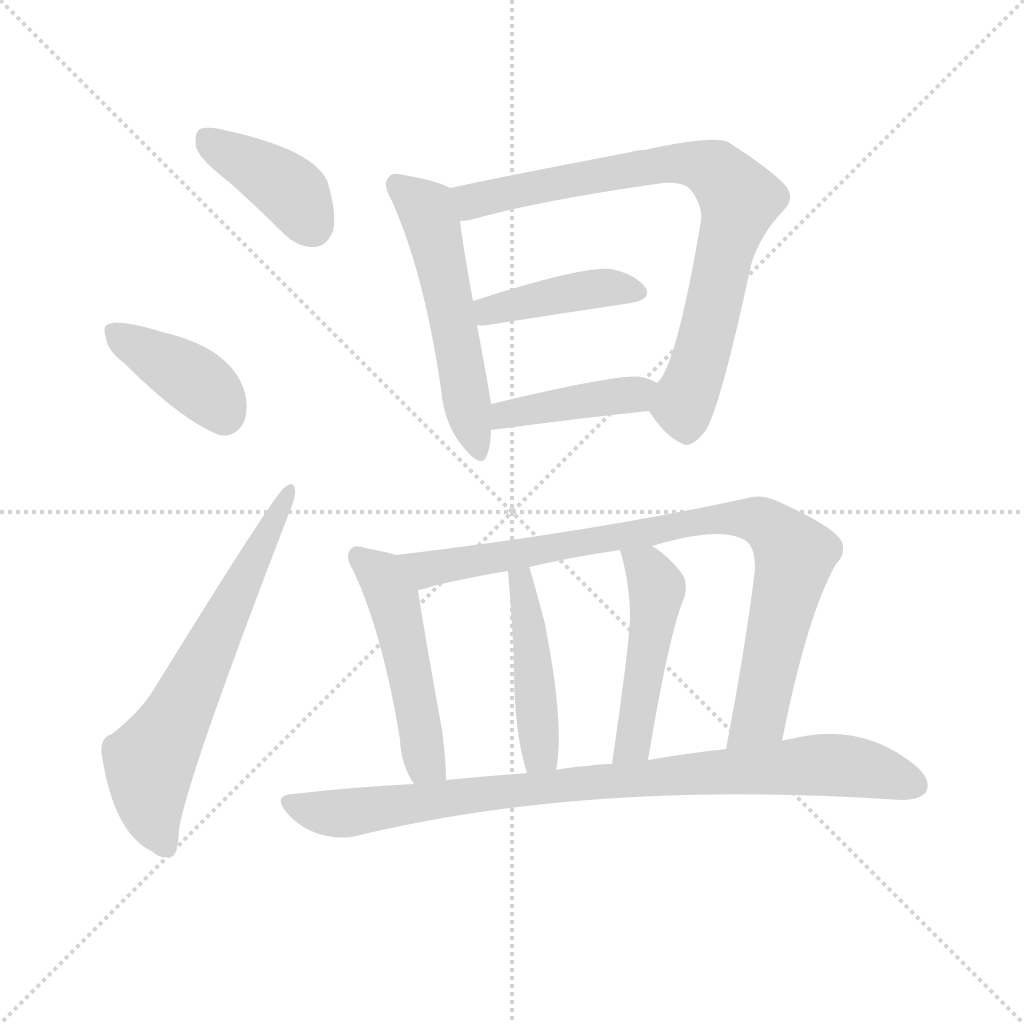
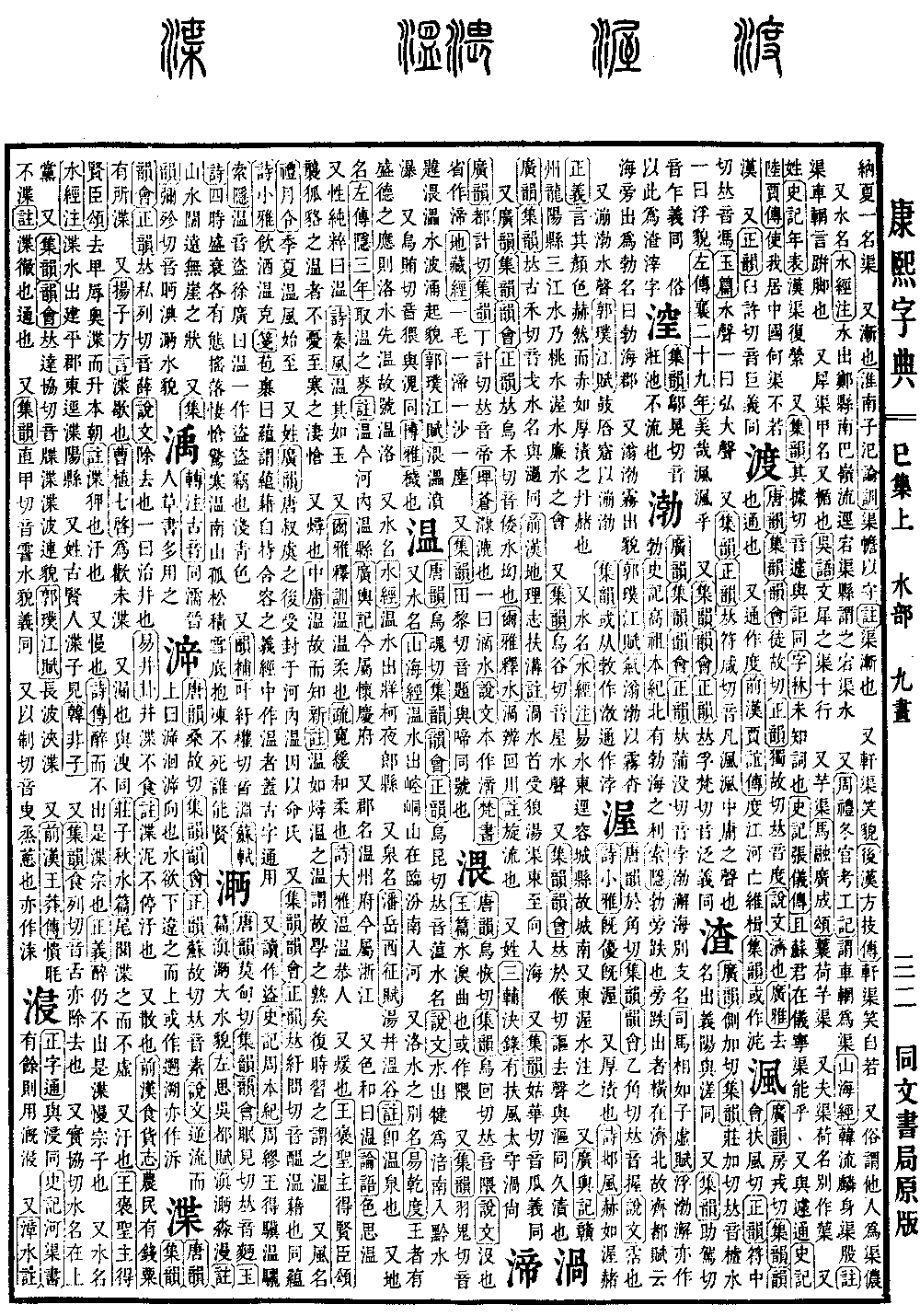
Pronounced wen. The name of a river. According to the Explaining and Analyzing Characters (Shuowen), it is a river that originates in the south of Fu in Jianwei and flows into the Qian River. Also, the name of a river. According to the Classic of Mountains and Seas (Shanhaijing), the Wen River originates in Kongtong Mountain and flows south of Linfen into the Yellow River. Also, an alternative name for the Luo River. According to the Book of Changes: Apocrypha of the Qian Hexagram (Yi: Qian Zaodu), when a king possesses great virtue as an omen, the Luo River first warms, hence it is called the Warm Luo. Also, the name of a river. According to the Commentary on the Water Classic (Shuijing), the Wen River originates in Yelang County, Zangke. Also, the name of a spring. According to Pan Yue’s Rhapsody on the Western Journey (Xizheng Fu), it refers to hot springs.
Also, a place name. According to the Zuo Commentary (Zuozhuan), it refers to the taking of wheat from Wen. The commentary notes that Wen is present-day Wen County in Henei. According to the Expanded Record of the World (Guangyu Ji), it is currently part of Huaiqing Prefecture. Also, a prefecture name. Wenzhou Prefecture, now part of Zhejiang.
Also, when colors are harmonious, it is called wen. According to the Analects (Lunyu), one's countenance should be warm. Also, when a nature is pure, it is called wen. According to the Book of Odes (Shijing), warm as jade.
Also, according to the Er’ya: Explanation of Teachings (Er’ya: Shixun), wenwen means gentle. The commentary notes it refers to being broad, relaxed, and harmonious. According to the Book of Odes (Shijing), warm and respectful men. Also, to be warm. According to Wang Bao’s Ode to the Sage Lord Finding Virtuous Ministers (Shengzhu De Xianchen Song), those clothed in the warmth of fox and raccoon fur do not worry about the bitter chill of extreme cold.
Also, to warm up or review. According to the Doctrine of the Mean (Zhongyong), to review the old and learn the new. The commentary notes that this use of wen is like warming something up, meaning that one’s previous learning is mastered and reviewed again from time to time.
Also, a type of wind. According to the Record of Rites (Liji), in the final month of summer, the warm winds begin to arrive. Also, a surname. According to the Extended Rhymes (Guangyun), descendants of Tang Shu Yu were enfeoffed at Wen in Henei and subsequently adopted it as their clan name.
Pronounced yun. To be contained or reserved. Same as the character meaning to store or contain. According to the Book of Odes (Shijing), drinking wine with self-restraint. The commentary explains that to wrap or contain is to be reserved and self-contained, meaning to harbor and accept. The use of wen in the classic is a case where the ancient character was used interchangeably.
Also pronounced dao. According to the Records of the Grand Historian (Shiji), King Mu of Zhou obtained a fast horse of a dark, murky color. The commentary notes that wen is pronounced dao; Xu Guang stated that one version of the text writes the character as the one meaning theft. It denotes a light blue-green color.
Also, according to the Supplement to the Rhymes (Yunbu), rhyming with yuan. According to a poem by Su Shi: The four seasons rise and fall, each with its own character; swaying and falling, cold and warmth startle the mind. The lone pine of the Southern Mountain sits beneath the snow; embracing the frost, it does not die; who else is so virtuous?
Textual Research: In the Book of Changes: Apocrypha of the Qian Hexagram (Yi: Qian Zaodu), it states that when a king possesses great virtue as an omen, the Luo River first warms, hence it is called the Warm Luo. We observe that the Taiping Imperial Encyclopedia cites this as the Qian Zaodu. We have now added the character for Zaodu accordingly.